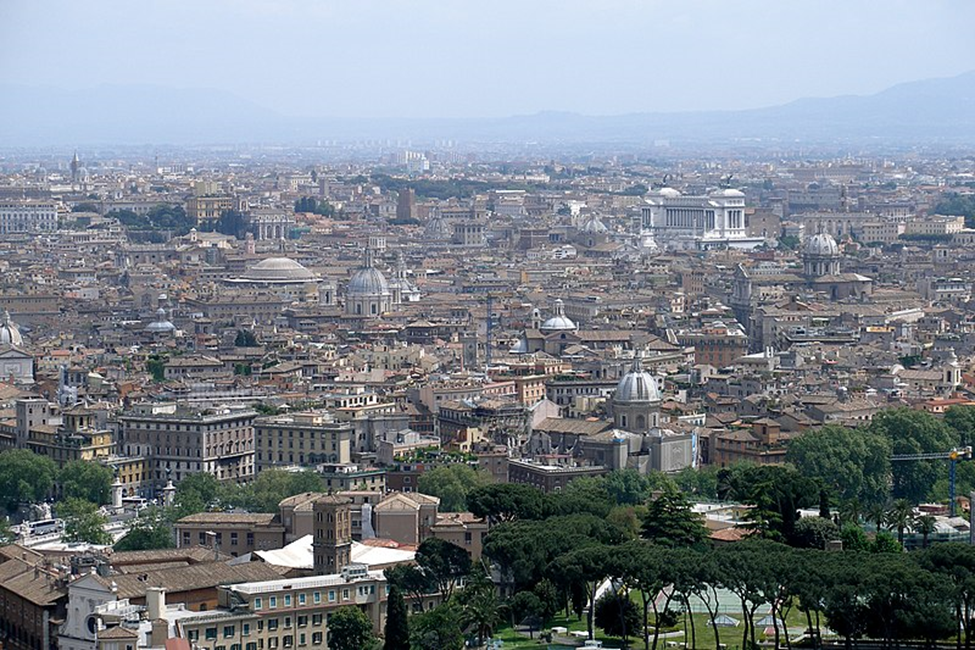
Introduction:
The City of Rome (“Urbs”) stands out as one of Europe’s greatest tourist destinations. Perhaps the world’s most fascinating place historically, religiously, and aesthetically, it annually attracts more than 9 million international visitors, and for good reason.
The allure of this Universal City of emperors and popes to which all roads lead results largely from the fact that Rome consists not simply of one city, but many, a metropolis whose roots stretch back continuously well over 2500 years. The Roman poet, Tibulus, was the first to aptly describe it in one of his Elegies as the ‘Eternal City’. Its secular and religious monuments, art, and architecture reflect the many different epochs of the turbulent history it frequently witnessed and over which it often presided. The tangible and ready accessibility to these timeless treasures continues to unite past, present, and future as powerfully as it touches and stirs the imaginations of its many visitors. Too many to mention are the epithets attached to this Eternal City: Rome, the City of …. you name it: churches, palaces, fountains, ancient roads, columns, statues, gates, courtyards, umbrella pines, ruins and monuments, madonellas, balconies, arches, cupulas and dome, shops and boutiques, obelisks, narrow and winding streets, outdoor markets, museums, belltowers, outdoor restaurants, ivy draped walls, bookstalls – all these rolled into one, magnificent, City-wide museum and work of art. The ancient historian, Livy, in the 1st century AD declared that ‘the gods themselves designed the City”: (‘fata interveniunt’, divinely willed), he said. And yet, despite the continuous changes the City has experienced over its long history, for its visitors it remains always the Eternal City. No city in the Westen world better expresses its political and ecclesiastical history and culture better than that of the Roman City, preserved as these are in centuries-old stone and fashioned by its rulers, secular and religious, to capture the imagination and loyalty of their subjects.
Rome Through The Ages was from 2005 to 2024 an interdisciplinary course taught at Holy Cross College. It explored and shared with students, aspects of Rome’s ancient, medieval and modern cultures: historic and aesthetic, secular and religious. Classroom instruction prepared students for a seven-day tour of the City’s most important sites, monuments, churches, shrines, and museums during their annual Spring vacation. It examined the history of Rome in its most important stages with emphasis especially on its artistic and architectural heritage. Students visited popular tourist places like the Roman Fora, Colosseum, Pantheon, St. Peter’s Basilica, the Trevi Fountain. Every itinerary, however, included, as much as possible, Rome’s sometimes overlooked treasures such as the medieval Tre Fontane Abbey and places holding heralded and unheralded works of Bramante, Raphael, Michelangelo, Caravaggio, Borromini, and Bernini. Places which to many seem mundane or insignificant truly are works of art in and of themselves: piazzas, fountains, courtyards, cloisters, devotional shrines. Dispersed throughout the City, they played a significant part of the daily itinerary.
This guide is intended for the Holy Cross College community, members of my own Congregation of Holy Cross, and friends who intend or, perhaps, hope to visit Rome, short or long term, and are desirous of a reasonably focused and informed on-line guide to the most important and interesting monuments and sites described in the introduction. The presentation of the guide is both descriptive, anecdotal, but most especially and intentionally, visual. Attached to every article are numerous photos appropriate to the specific content. Readers of the guide can benefit visually from the City’s many magnificent and memorable monuments either on site in Rome with the guide downloaded to their I-phones, or from chairs in the comfort of their own rooms with the text accessible via a link on the Holy Cross College website.
The guide offers a description of many, but not all, of the City’s historical places and its content focuses on sites visited by HCC students. The itineraries focused on specific geographical locations. By systematically saturating targeted parts of the City, students maximized the number of important places they encountered in daily excursions.
The 12 itineraries mostly explore areas in the central historical zone of the City. For the hale, hearty, energetic and curious, virtually all sites are accessible on foot. Those places located outside the City walls require other means of transportation, easily accessible by way of bus, underground Metro service, taxi or uber driver
Its table of contents lists each of the itineraries by general title indicating its locale and enumerates within each, sequentially numbered articles of specific, targeted sites. Many articles describe more than one site. Highlighted parts of the text indicate places of special interest to the reader. Underlined parts of the text alert the reader to objects accompanied by an image. The index lists alphabetically the specific sites and topics of the guide and provides the section number where information on these can be found. A search box and links in the guide itself will provide easy navigation to and around itineraries, sites, and individuals mentioned in the text.Future Congregational/student visitors to Rome, short term or longer, may find useful all, but more realistically, selective parts of the itineraries.
This guided tour of parts of the City represents an attempt for over twenty years to share with students some knowledge and experience of its history, art, architecture, culture and topography. It makes no claim to rise to the level of high scholarship but, rather, represents an effort to combine personal observation, interest, and insight together with information and anecdotes garnered from resources referenced in the list of recommended readings about the most important city in the cultural history of Western Civilization. If this project has succeeded in furthering the readers’ knowledge of the City, an appreciation of its impact on the long story of Western civilization, and a love of its inexhaustible and breath-taking treasures, then its purpose will have been well served.
I am grateful to the Holy Cross College administration, particularly Dr. Marco Clark and Provost Michael Griffin, for allowing me to host the manuscript on the College website. Thanks also to Mr. Douglas Blair, Director of IT at the College and Dr. Kyle Sherbert, Academic Director of the Computer Science department, who facilitated the actual construction of the website by supervising the work of students, Elias Ramirez, James Gammon and others who brought the work to completion.
Michael B. Sullivan csc
22 March 2024