
‘Tanto alto quanto se puote’ (go as high as you can) urges the motto on Pamphylj family coat of arms. No one in the family achieved as much as Giovanni Battista Pamphylj when he became Pope Innocent X in 1644. His family, descendants of Pope Alexander VI (Borgia), originated in Gubbio, but transferred to the City in the 15th century to pursue professional careers in the church where he and an uncle found great success. Innocent’s papacy (1644-1655), energetic and contentious, embroiled him in controversies with the Barberini’s in the City, Cardinal Mazarin in France, Jansenists in Holland and France, and Catholic ruling houses of Europe over the Treaty of Westphalia (1644) which he condemned. After his papal election he immediately went to work to expand the family enclave in Piazza Navona. Pope Innocent X constructed his 17th century family chapel, Sant’Agnese and the attached Palazzo, over the foundations of an earlier 12th century church. Under all of them lay the foundations of the brothel where St.Agnes died a martyr during Diocletian’s persecution of Christians in 304.

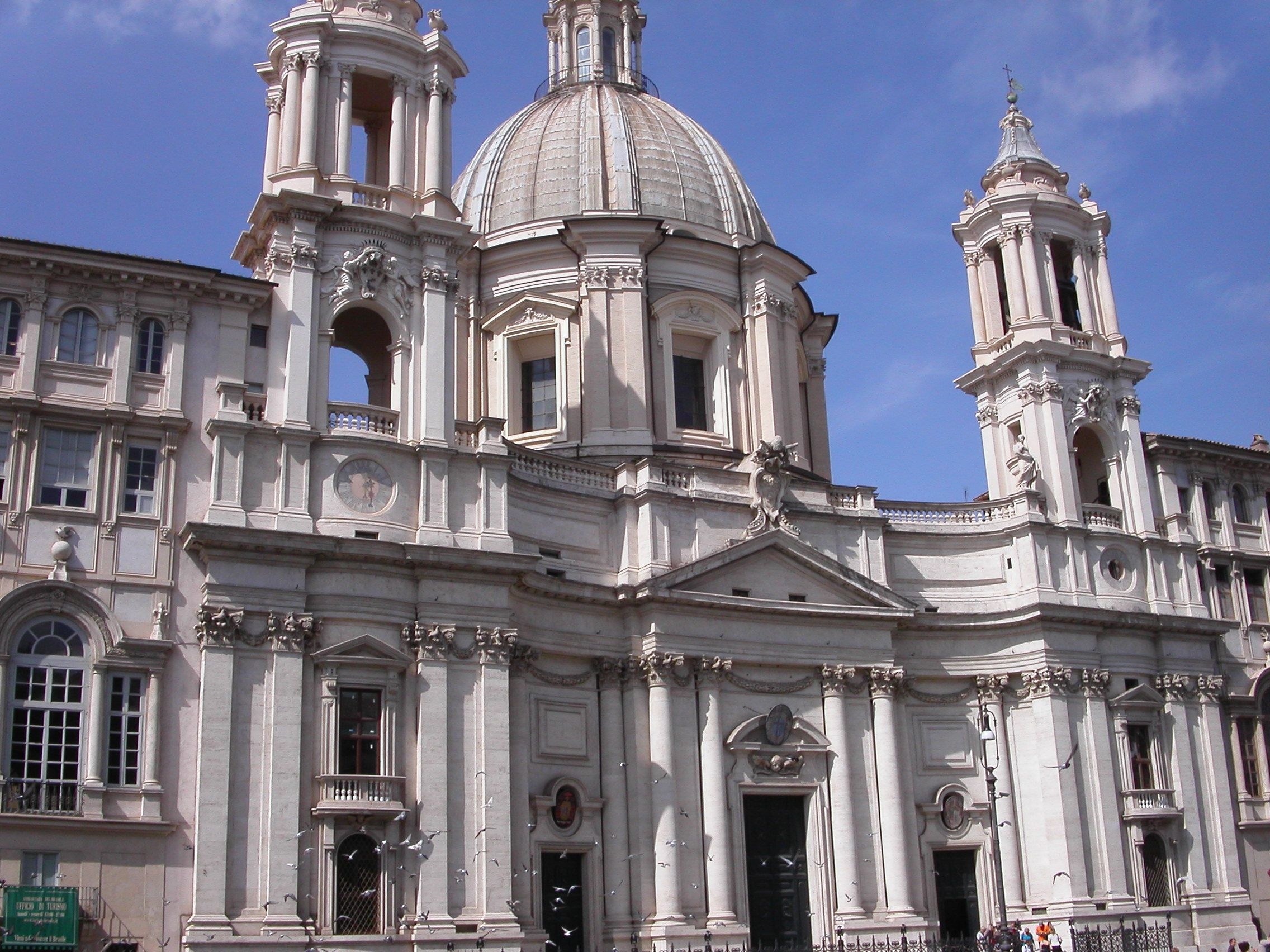
The architects Girolamo Rainaldi and his son Carlo designed this Greek-cross church. Their plan called for steps intruding into the piazza, a plan unacceptable to neighbors and to the pope who called on Francesco Borromini to provide an alternative strategy. In 1653 Borromini, the most innovative genius of his age, tore down the Rainaldi façade to provide greater visibility to the dome, created a concave shaped façade, and added two towers to create contrast and balance to the whole.

This technical innovation allowed for the placement of its curved steps to complement the new design of the facade.

More important, however, it resulted in the creation of one of the City’s most graceful facades, employing concave lines which undulate between the two elegant campaniles (bell towers), a marvelously integrated unit, at once stately, tasteful, elegant, and harmonious.

When Innocent X died in 1655, Borromini had almost completed the façade, except for its cornice. Although the pope’s nephew, Camilo Pamphylj, took charge of the church, he paid little interest in its completion. Disillusioned, Borromini abandoned the project, and Carlo Rainaldi took his place. Rainaldi modified elements of the Borromini scheme by adding another story to each of the two bell towers.

After Camillo Pamphylj’s death in 1666, his aunt, Donna Olimpia Maidalchini, assumed responsibility for the project. She, in turn, entrusted its completion to Gian Lorenzo Bernini.

He modified parts of the Borromini plan, especially in the space above the main entrance, with the addition of a pediment and attic.

The Greek cross plan of this complex, oval-shaped church involves the superimposition of an octagon upon a square.

A very high drum with windows on each side and a lantern designed by Carlo Rainaldi serves as the base of the impressive octagonal dome of the church.

The concave façade of the church, designed by Borromini, but executed by the Rainaldis, contains three separate design components: a wide center comprising the actual façade and, on each side of it, twin, 3-storied, bell towers (campanili).
The large central door bears the highly visible Pamphlj family dove found throughout the entire structure.

Two identical bell towers (campanili) on the sides of the facade include two clocks, originally showing separate times, ancient (days divided into two twelve-hour segments) and modern (northern Europe time/ tempo ultramontano). The back of the church, on Via dell’Anima, still reveals the front entrance and sealed off doors of the former medieval church over which the current structure now sits.

The domed nave itself has an octagonal form, two of whose arms are the chapels dedicated to St. Agnes and St. Sebastian, on the right and left respectively. Some parts of the walls are remnants of the ancient Stadium.

The dome dominates the interior space. Its design invites spectators to look up and see the heavens opening before their eyes. Frescoes around it depict the Apotheosis of St. Agnes and allegories of the four cardinal virtues paired with their respective religious counterparts: prudence and providence, justice and peace, fortitude and charity, and temperance and chastity.

Inner spaces abound with characteristic elaborate and ostentatious Baroque decorations especially visible in the magnificent bas relief sculptured altarpieces in its side chapels.

The four arms of the church contain doors above which sit cantoria, boxes for singers, decorated with angels, a feature very common in Baroque church architecture.

John the Baptist, the baptismal name of Pope Innocent X, is reflected in the high altar’s dedication to the Baptist. The altar and its 12th-century tabernacle rest against the far wall. The columns (verde antico) surrounding these originate from the ancient triumphal arch of the emperor Marcus Aurelius.

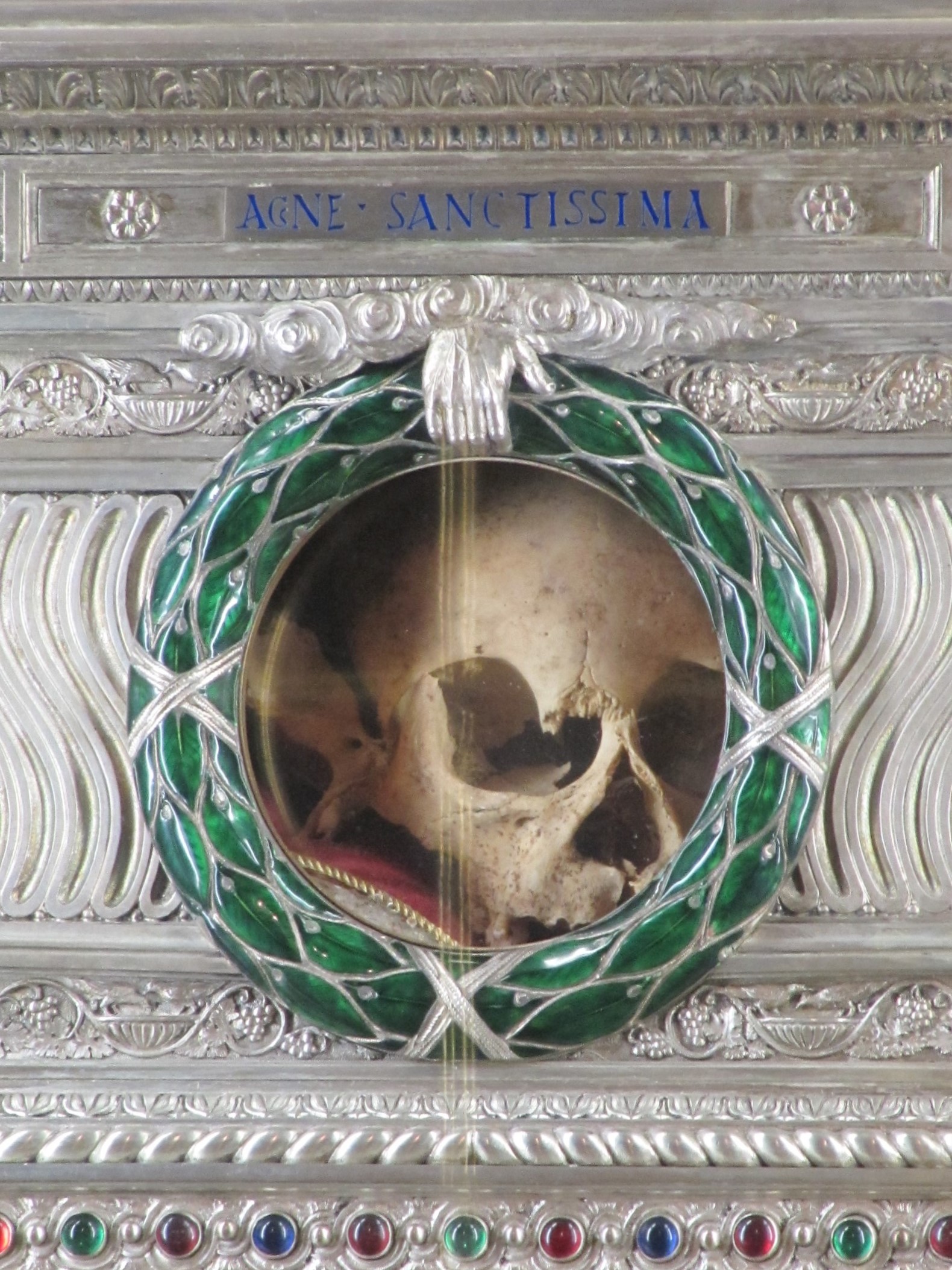
Colorful chapels fill the church. The St. Agnes Chapel in the right arm of the Greek cross houses a relic, her skull, visible in a reliquary above its altar.
Here too stands Ercole Ferrata’ sculpture of St. Agnes, patroness of chastity, with flames licking at her feet, a symbol of sexual temptation. The altar exhibits the effects of trompe l’oeil perspective creating the impression of a barrel vault created by the decreasing heights of its supporting pilasters.

The St. Sebastian Chapel in the left arm is decorated with gilt stucco and polychrome marbles. It contains an altar, designed by Rainaldi and made from a sarcophagus embossed with the Pamphilj dove. The 18th century sculpture of St. Sebastian reflects the neo-Classical style of the age. A staircase on the right-side leads to the Crypt of St. Agnes beneath the church. It contains three chambers, parts of ancient stadium, one, the site of St. Agnes’ torture.

An ostentatious, monumental tomb of Pope Innocent X rests above the main entrance, while his body lies in the crypt to the left of the high altar. Until 1992, when the Pamphylj family donated the church to the Diocese of Rome, Sant’ Agnese remained a private chapel. Today it often hosts marriage celebrations and symphonic concerts.
