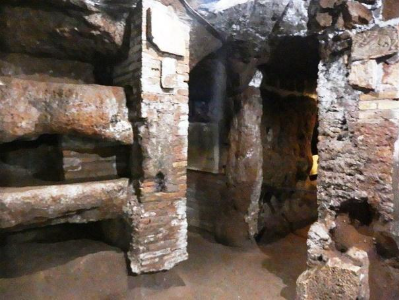
Looming large in myths about the early Christian Church in the City are the catacombs and the alleged mysteries surrounding them. The Catacombs of San Sebastiano play a very important part of that story, the first identifiably Christian underground cemetery on the Via Appia Antiqua. The 4th century term, catacomb, refers historically to this specific locale and originates etymologically from the Greek words, kata cumbas” (around the hollows/quarries). It corresponds to the contemporary topography of the space used at the time for mining volcanic ash (pozzolana) needed for making cement. Gradually the word came to be used generically to describe all underground cemeteries around the City. Underground cemeteries had been used in Italy for hundreds of years before the Jews and Christians arrived in the City.

Following Jewish custom, Christians buried their dead in the ground rather than incinerate them and, as well, because Christ Himself had been interred in a tomb carved out stone. They deliberately chose the Greek word, cemetery (“dormitory”) to describe their burial places because they saw them as temporary resting places for the faithful as they awaited the final resurrection of the dead. All catacombs stood outside of the walls because Roman law prohibited the burial of the dead inside the walls of the City. In addition, vast underground cemeteries easily solved problems for them created by a lack of space in the high price of land. Many lie along the roads of the Appia, Nomentana, and Salaria in abandoned tuffa quarries with their underground tunnel systems still intact. More than 5 million persons were buried in over 60 catacombs scattered along the periphery of the City. T
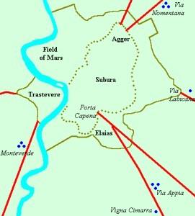
These comprise over 350 underground galleries extending more than 350 miles and create a series of labyrinthine tunnels with grave superimposed over grave and tunnel over tunnel. Initially Christians were buried in pagan catacombs or on private property owned by Christians, but, soon enough, mostly on land owned by the Church, especially after the 2nd century when authorities became more tolerant of these burial activities.
Because the subsoil of the area consisted of soft volcanic material, the tunnels and passageways of the mines were well suited for cutting out rectangular wall tombs (loculi) deep into the ground (seventy-five feet).

In these spaces Christians could bury their own and use their unique Christian symbols without restrictions. During the period of the pre-Constantinian, an era of persecution, these symbols were recognizable as religiously significant only to the faithful in order to avoid detection by outsiders. The most frequently employed symbols included the anchor (hope), dove (Christian soul released from earthly bondage), sheep/shepherd ( Christian disciples and church militant), phoenix (resurrection of Christ), fish (acronym for Jesus Christos Savior), bread (multiplication of loaves an age of persecution, and fish), vine ( Church and life), olive branch (peace), orante figure (saved soul in paradise), flowing river (life and fertility) Jonah in the whale). The very first historic evidence of Christian artistic expression lies in the catacombs in the form of wall frescoes, mosaic panels, stone carvings, and sarcophagus sculpture influenced by Greek and Roman styles.
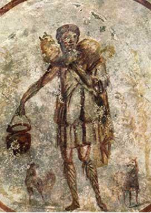
Noticeably absent from these images is that of the Cross due, in part, by the Christian emphasis on the theme on Christ’s resurrection (apotheosis). The closest allusion to the Cross is found in the Chi Rho (Christ acronym) symbol.

San Sebastiano Catacombs contain many dark subterranean passageways , occasionally illuminated by shafts (luminaria), allowing air and light into the tunnels. The catacombs consisted of seven and a half miles of labyrinthine rows of rectangular niches (loculi) into which bodies wrapped in sheets would be placed. Marble or baked clay covers, carved the names of the deceased along with appropriate Christian symbols, sealed the loculi. Most tombs bore inscriptions briefly describing the life of the deceased loved, asking for prayer, or invoking intercession of the saints, at San Sebastiano, often to Peter and Paul. One such reads: ‘ Paule et Petre petite pro Victore’ (Paul and Peter intercede for Victor).

Christians also availed themselves of other burial methods: arcosolia were arched recesses cut into a wall, often inscribed with family names, decorated with colorful symbolic frescoes, and housing either a sarcophagus or even an altar.

Most of the tombs bore inscriptions, sometimes providing specific and interesting details about the life of the deceased or the religious beliefs of the individual or family members. The inscriptions were typically handwritten and often give a clue to the social and educational status of the author. The petition, ‘Paule ET Petre Petite Pro Victore’ (Paul and Peter, pray for Victor) is not only pithy, but, as well, poetic, and perfectly grammatical. Another gravesite has a similar petition. ‘Petrus and Paulus in mente abeatis Antonius’ (Peter and Paul, may you remember Anthony), totally devoid of the features of the former.

They sometimes created chapels (cubicula) large enough to hold several tombs. Tombs frequently were identified by graffiti scratched into external surfaces and, as well, by Greek or Latin inscriptions providing personal information about the deceased. Christians regarded the date of death as the “Dies Natalis” (birthday) of the deceased person because it marked the entry of their soul into life eternal.

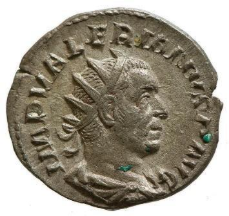
In the early church Christians referred to the cemetery of San Sebastiano as the “Memoria Apostolorum” because, according to legend, the remains of Saints Peter and Paul were temporarily interred here around 258 AD when the emperor Valerian severely persecuted the community throughout the Empire. In an area of the cemetery called the ”triclia”(pergola), a trapezoid-shaped courtyard, Christians regularly came to pray for the dead and celebrate customary funerary banquets.
Archaeologists in the early 20th century discovered more than 600 graffiti
written on the walls enclosing this open space above the graves below. Many fragments in different languages (Latin, Greek, Aramaic) included prayers specifically addressed to the apostles, Saints Peter and Paul, some of which now visible in a glass case on the wall of the “triclia”.

These catacombs are now named for St. Sebastian, a soldier who became a martyr for converting to Christianity and was buried here in the fourth century.

Throughout most of Roman history cemeteries were regarded as legally inviolable and so safe from any kind of external disturbance. In the great mid-3rd century persecution of Christians by Emperor Valerian this prohibition was violated and Christian resorted to disguising the entrances to their cemeteries. Although the Emperors Constantine and Licinius ended the persecution of Christians with the Edict of Milan in 313 AD Christians continued to bury their dead in catacombs until the 5th century.
These quickly became places of pilgrimage for visitors to the City from all over Europe. During the Middle Ages Germanic tribes invaded much of Italy and the catacombs were often looted (Lombards in 756 and Saracens in 846). In response, popes closed these burial sites and transferred many of their relics to churches inside the City. The San Sebastiano, however, remained the only catacomb which pilgrims continued to visit throughout the Middle Ages. The last burial there, that of a gravedigger (fossator) occurred in 508. Over sixty catacombs sit beyond the perimeter of the City. Many still contain thousands of tombs and five are open to the public: San Sebastiano on the via Appia Antiqua; San Callisto on the Via Appia Antiqua where sixteen popes are buried; San Priscilla on the Via Salaria; San Domitilla on the Via delle Sette Chiese; and Sant’Agnese on Via Nomentana.