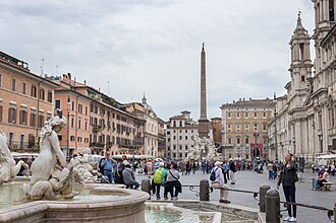
Arguably one of the City’s most popular and frequented open public spaces, the unique charm of the piazza, underscored by its harmonious elegance, warm color, pure simplicity, and sheer monumentality dazzles the senses. In it the best features of Baroque style shine forth, a veritable masterpiece of the two great geniuses of their age, Bernini and Borromini. The piazza sits over the ruins of the stadium of Domitian (“Campus Agonalis”). Athletes contested here in public Greek-styled games (“Agones”) dedicated to the god, Jupiter. Domitian constructed it in the Campo Marzio to provide the Romans with a more sophisticated form of public entertainment than the one provided by the Colosseum. The name, Navona, reflects the medieval corruption of the Latin word from “agonalis” (contest) to “n’agona” and later to the current Italian “navona”. This massive brick and limestone stadium included sectioned seating (cavea) for 20,000 spectators and four entrances: two at each end and two at the center of each side. Races started and finished at the open end (northern). The popular statue of the Pasquino standing just a few yards from the piazza, represents one of the stadium’s many surviving stone artifacts dispersed throughout the modern City.

Not far away stood Domitian’s Odeon, a separate space for musical events located at the north end of the stadium and now buried under the foundations of Palazzo Massimo.

Throughout most of the 15th and 16th centuries, the abandoned stadium became the quarry from which papal, aristocratic and impecunious exploiters later extracted building material for the construction of newer structures throughout the City. Fragments of taverns and houses of prostitution, remain visible in the surrounding area at the far end (southern) of the piazza once encircled the stadium area. In one of these, Roman soldiers tortured and killed St. Agnes, a highly venerated early Christian martyr.

For 2000 years this space served multiple purposes: in imperial times it accommodated spectators attending the games; the Middle Ages used it for horse racing and bull fights; after 1477 when Pope Sixtus IV moved the town market here from the steps of Capitoline, it served as a market place, a popular venue to hold processions and festivals; in the 17th century it served as a summer wading pool and lake for re-enacting naval battles (naumachia) ending only in the 19th-century by order of Pope Pius IX.
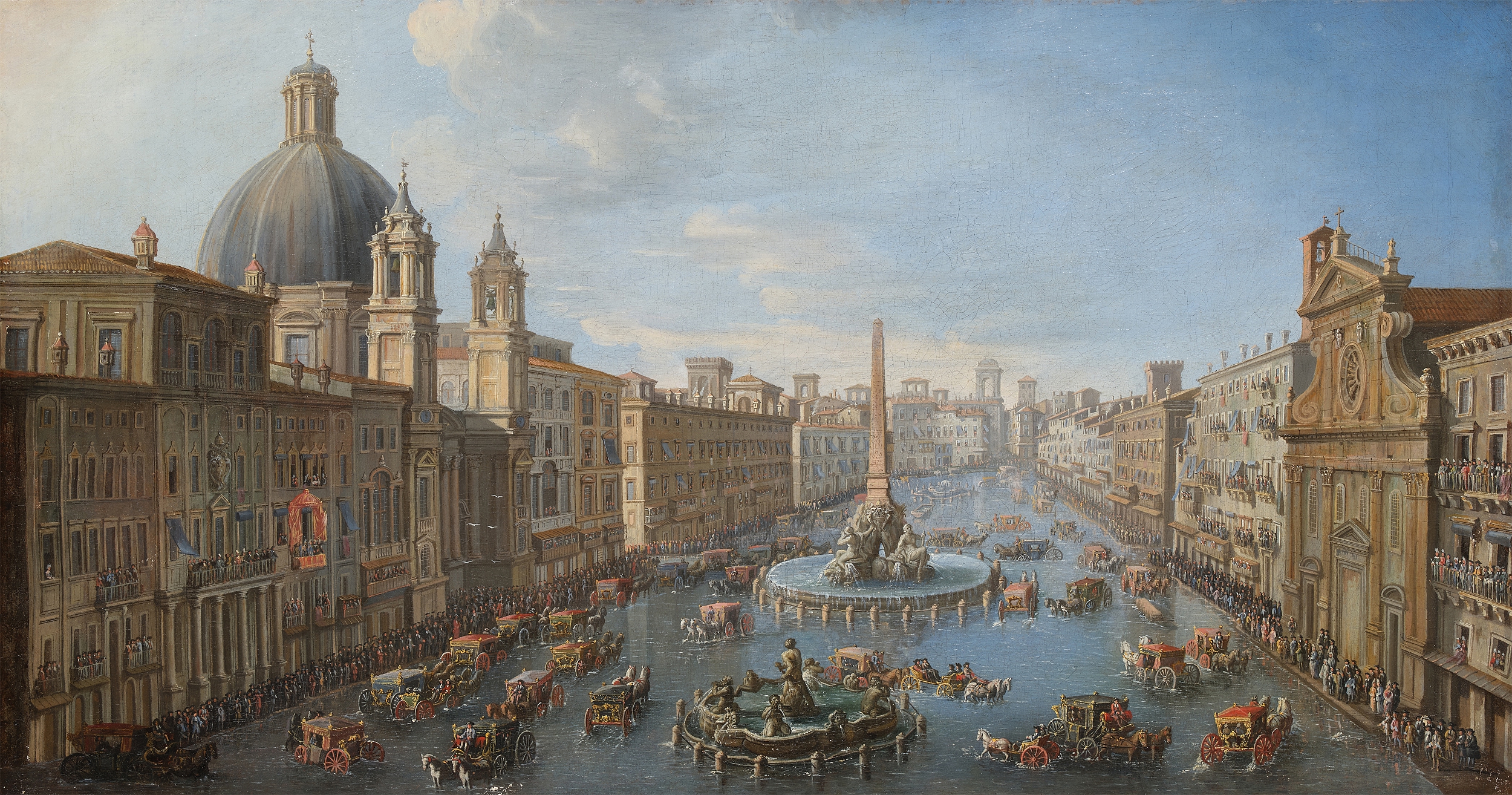
Members of the Pamphylj family had lived in the neighborhood since the 15th century. Gradually they acquired pieces of property on the south side and made it their family precinct. Cardinal Giovanni Battista Pamphylj consolidated these properties into one large and sumptuous palace in the middle of the 17th century, a rival to the Barberini palace across the City on the Quirinal Hill. The final configuration of the piazza occurred in 1664 when the cardinal became Pope Innocent X.

Once elected, the pope sculpted the space around the palace by adding the Church of Sant’Agnese, the Four Rivers Fountain, the Collegio Innocenziano, and refurbishing the two Fountains of the Moor and Neptune. Located in the heart of a densely populated area of the City, the piazza served, then and now, as an oasis which delights tourists and local alike thanks to the contributions of its great architects whose spatial design worked marvels with the great challenge of so narrow a footprint.

Girolamo Rainaldi and his son, Carlo, constructed the Bernini-designed Palazzo built between 1644 and 1650. Francesco Borromini contributed to some interior parts of the Palazzo: its gallery connecting the two facades on Piazza Navona and Piazza Pasquino and, as well, decorations in the main reception room (salone). Since 1962 the Palazzo has housed the Brazilian Embassy to Italy.

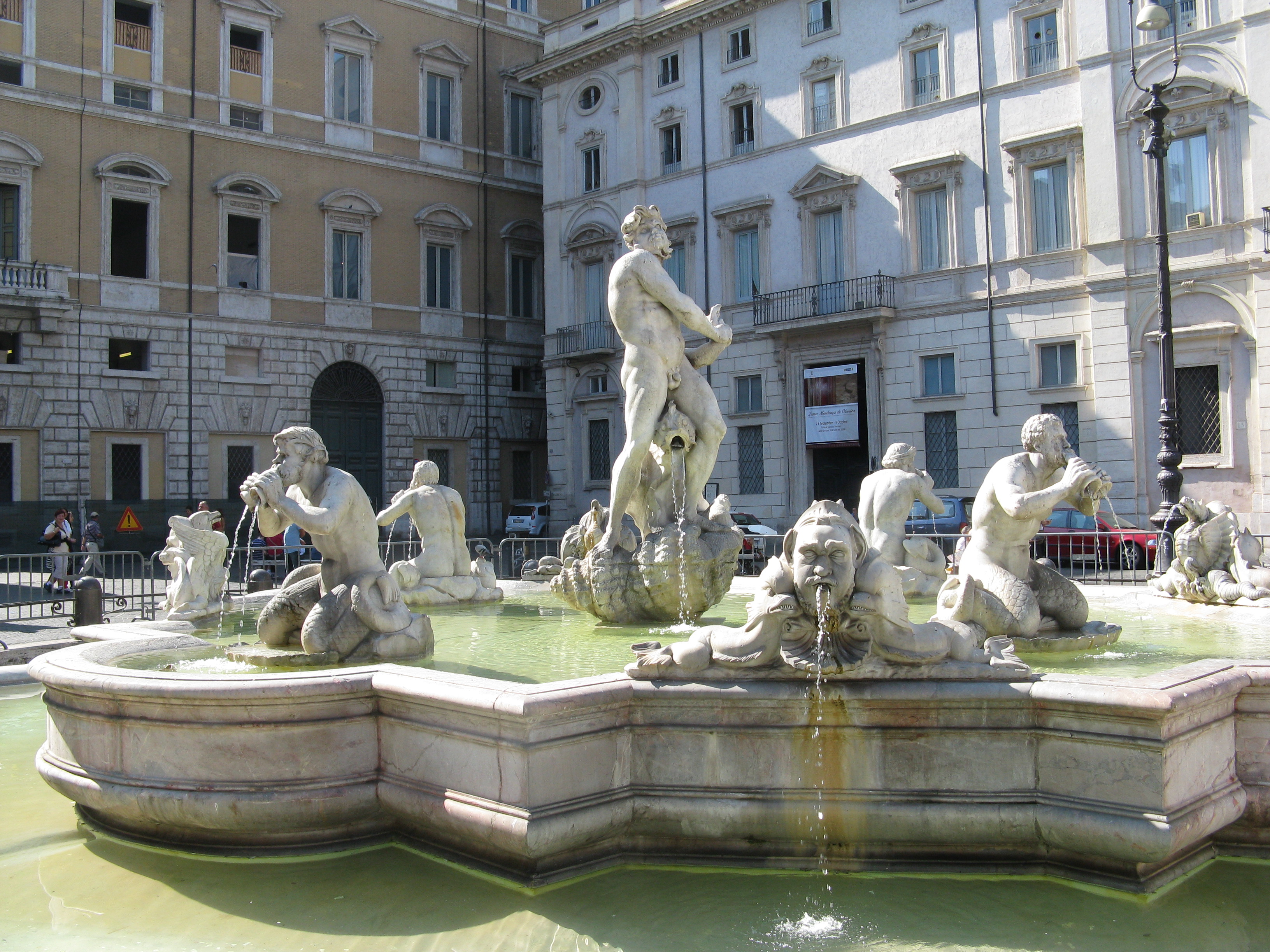
Two earlier 16th century fountains also grace the piazza. In front of the Brazilian Embassy stands Giacomo della Porta’s Moro (Moor) Fountain with a Borromini-designed basin to which Taddeo Landini and Bernini would add statues (the Moor wrestling with a dolphin). In the Moor sculpture, Bernini incorporated the features of a very real, living, and well known figure, Antonio Emanuele, Marquis of Funta, Ambassador of the King of the Congo to the Holy See.
At the opposite end (southern) of the piazza appears yet another della Porta fountain, that of Neptune. Giacomo della Porta sculpted both in the round to make them fully visible from the center of the piazza.

In recent years the area has become an ‘isola pedonale’, a pedestrian zone off limits to vehicular traffic. Piazza Navona stands out as a colorful and busy social space filled most of the day and night with tourists, vendors, painters, musicians, and locals out for a stroll.