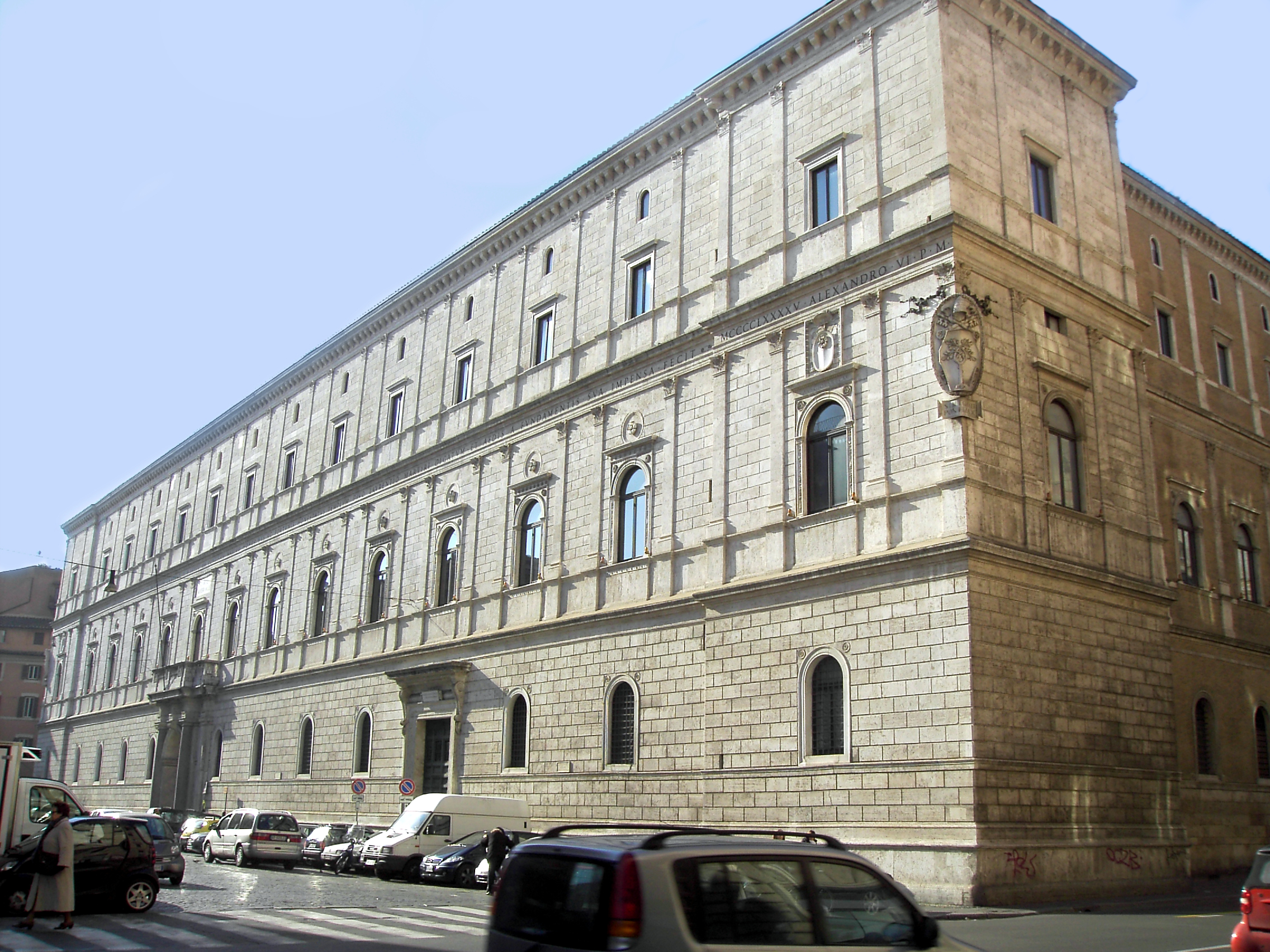
The Cancelleria Palace (chancery), represents one of City’s truest expressions of Renaissance secular architecture. Cardinal Raffaele Riaro, Camerlengo of the of the Roman Church and relative of Popes Sixtus IV and Julius II, commissioned Andrea Bregno to construct this majestic palace which lies between the Corso Victor Emanuel and the Campo di Fiori. It represents the first major Renaissance building in the City, and incorporates classical orders into its façade and courtyards. Completed in 1511, the Cardinal financed its construction with money gained in one night of gambling (14,000 gold ducats/$800,000 circa) against Franceschetto Cybo, the “nephew” (illegitimate son), of Pope Innocent VIII. The palazzo, however, takes its name from Medici family politics. Pope Leo X (Medici) accused Cardinal Riario of plotting to kill him, confiscated the palace, and turned it over to his cousin, Cardinal Giuliano Medici, Vice-Chancelor (cancelliere) of the Pope. People never stopped referring to it as the ‘Cancelleria’.

Art historians regard the Cancelleria as the earliest, complete Renaissance palace built in the City. In fame, notoriety, and architectural history, it rivals its close neighbors, Palazzo Venezia and Palazzo Farnese. In the course of its history the palace has served multiple purposes: private residence, offices of the papal chancery, Tribune of the Roman Republic, and civil law courts in the Napoleonic period (“corte imperiale” inscription on the facade). It has provided hospitality to many important and interesting people. Members of the Stuart family, exiled British royalty, once lived here: Cardinal Henry, vice-chancellor of the Holy See, pretender to the English throne, and Jacobite King Henry IX of England and his relatives, Queen Louise wife of King Charles III (Young Pretender) and Charlotte Stuart Duchess of Albany).

Today the Cancelleria houses the offices of the Roma Rota and the residence of the Cardinal-Vicar of the Diocese of Rome.

The original plans for the palace called for a symmetrical façade, but were modified in the construction process with the addition of bays on the left side. Divided into three horizontal planes, the well-proportioned façade underscores its classical features. Simple, rounded windows and the large main door, added later in the 16th century by Domenico Fontana, break up the ground story of the structure. Windows on the second level, encompassed by rectangular frames and bedecked with the Riario rose, clearly and ostentatiously point to Cardinal Riario as its patron.

On the left side of the palace, the ground floor houses shops, a reflection of ancient Roman customs.

Palazzo Cancelleria enjoys one of Rome’s most harmonious interior courtyards, designed by Donato Bramante. The pure, white, marble cladding comes from the unearthed arch of Emperor Gordian. In its arcades, 44 columns of Egyptian granite from the porticoes of the Theatre of Pompey, cut to fit the space, provide a pleasant contrast to the color scheme of the interior.

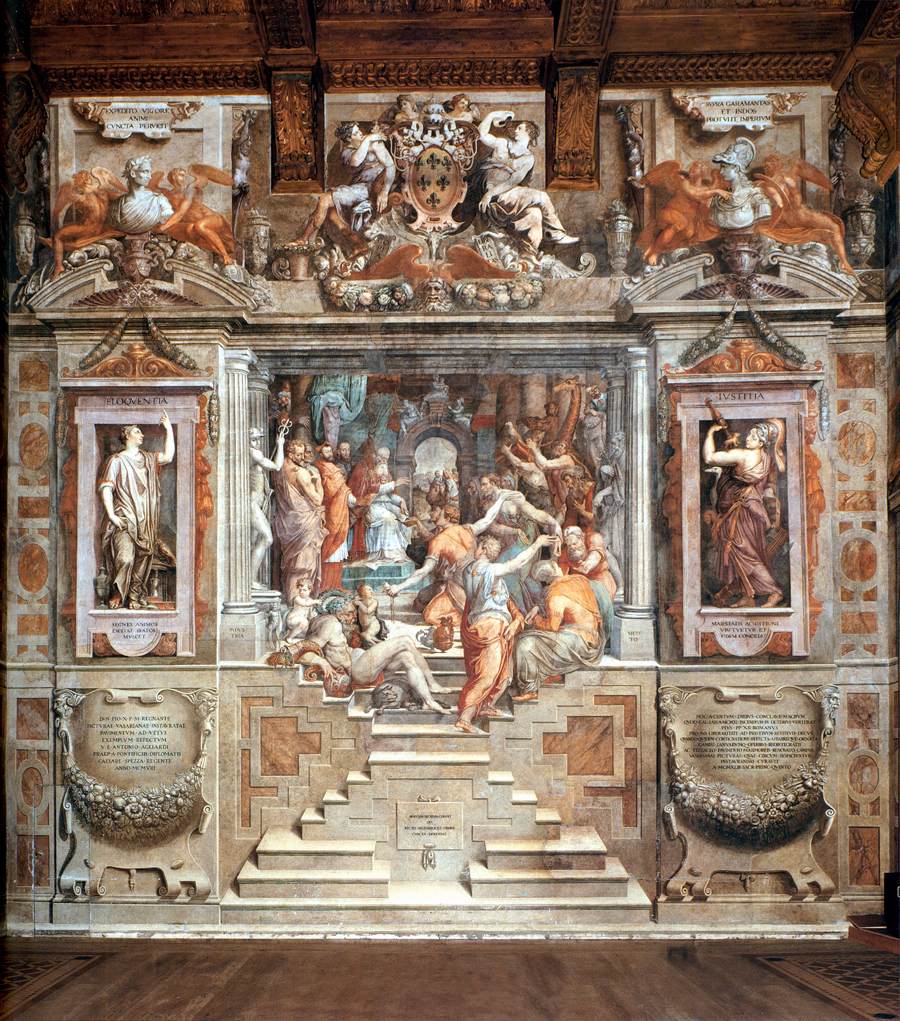
The twenty-one-year-old Michelangelo lived briefly in the palace when he first arrived in the City. His biographer, Giorgio Vasari, painted Mannerist frescoes in the Sala dei Cento Giorni. Commissioned by Cardinal Alessandro Farnese to execute them in honor of his uncle Pope Paul III within one hundred days, Vasari hastily completed the extensive project within the established timeframe. Legend has it that when Vasari told his friend, Michelangelo, about the speed with which the project took place, the quick and pointed reply of ‘Il Divino’ was: “si vede” (‘that’s obvious’). Other residents include Queen Christina of Sweden who gave up her crown in 1654 in order to enter the Catholic Church. In 1988 excavators discovered under its foundations fragments of very diverse ancient structures: a Mithraeum, 1st century AD tomb, and 4th// 5th century AD church walls.