
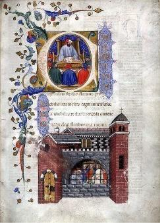
According to legend, St. Benedict of Nursia, the 6th century founder of the Western monastic tradition, arrived in the City as a young man to study. He resided in the house of his relatives, the aristocratic Anicii family.

The Anicia clan, owners of estates in Italy and the throughout the Empire, arrived in the City from Praeneste in the 4th century BC. They settled on the Caelian Hill. Family members enjoyed successful military and political careers, rose in social and political ranks, and soon acquired senatorial status. By the 4th century AD, some had become Consuls and Petronius Maximus, an emperor (455) if only for 70 days before his assassination.
The Anicii family converted to Christianity very early and produced several distinguished Church leaders: Boethius, statesman, scholar and influential medieval philosopher (De consolatione philosophiae); three popes (Felix III, Agepetus I, and Gregory I the Great; and Benedict of Nursia. It was the Anicii villa on the Caelian Hill which Benedect converted into the Monastery of St. Andrew around 574 AD.
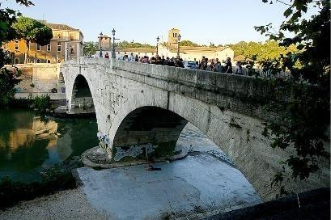
This tiny church first appeared in the 6th century on the site of this property, a villa belonging to the Anicii family, across the Lunghotevere from the Ponte Cestio.
Its name originates from the word, pool (piscina), which stood on the property. The papal chamberlain, Cencio Savelli, in the 11th century, rebuilt it after its destruction during the sack of the City by the Norman mercenaries of Robert Guiscard.
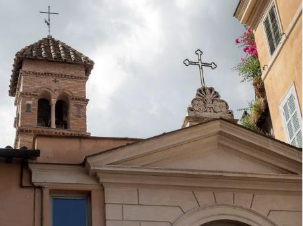
The 17th century façade of the church, embedded within two side buildings, is simple and straightforward. Above the entrance sits a lunette window crowned by a triangular pediment and filial on top. A very small medieval campanile, the tiniest in the City, with two stories and a tile roof and cross rises from the back of the church. It supports two bells. An inscription on one dates from 1019 which makes it, perhaps, the oldest bell in the City. The other dates from 1465. No other city in Europe has as many belltowers as does the City, over fifty in all, most dating from the 11th and 12th centuries. The old St. Peter’s acquired one in the 8th century (Pope Stephen II), and the one attached to the abbey church at Sant’Anselmo on the Aventine, the City’s most recent, was added in the 19th century.
Once a part of the medieval atrium, the current entrance now stands in what was the medieval vestibule. Its doorway includes stone semi-columns supporting a Cosmatesque lintel, cornice, and arch.

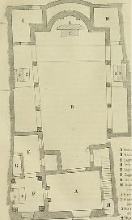
The arcades of the nave contain four assorted columns dating from the 1st to the 5th centuries.

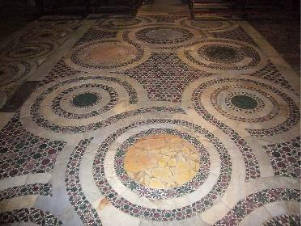
Most of the walls show brickwork except for those with 12th century fresco fragments depicting Old Testament scenes on the right side and of the Last Judgment on the left. The church retains its original Cosmatesque floor, unique in the City because untypically preserved rather than restored. Some of its precious marble pieces, made of porphyry, serpentine and granite from Egypt and Greece, are damaged, many missing and replaced with cement. It also contains medieval floor tombs of members of aristocratic families, the Mattei and the Castellani, who lived in the neighborhood.
The apse contains a simple triumphal arch. Under the altar is a 13th or 14th century, gold table embossed with an image of St. Benedict and over it, in a niche, a 13th century fresco of the Blessed Mother and Child. 16th century frescoes appear on side walls of the presbytery depicting St. Blaise and St. Nicholas of Myra. Off the left aisle sits a small chapel, a part of the adjoining structure and part of the older Anicii house. In this room, it is said, the young Saint Benedict lived when staying with his City relatives during his student days.
