
Nestling between the Palazzo della Cancelleria and Piazza Farnese sits Campo dei Fiori, one of Rome’s most colorful, dynamic, and historic piazzas.

In ancient times it housed stables for horses of “factions”, teams of riders who raced in the Circus Maximus. Some maintain that its name derived from the name of Pompey’s lover, Flora, who lived in the immediate area, but, in great likelihood, its name (Campus Florae), “field of flowers”, harkens back to the Middle Ages when the area flourished, literally, and only as a meadow. This space was uninhabitable throughout most of its history because of its proximity to and frequent flooding of the Tiber. Commercial and residential activities exploded in this zone, profiting from the 15th century urban renewal projects such as the bridge, Ponte Sisto, constructed by Pope Sixtus IV in 1479.

The Campo became a part of the main thoroughfare for pilgrims to and from the Vatican and St. John Lateran when Via del Pellegrino linked the piazza to St. Peter’s. By 16th century the Piazza had emerged as the center of social, political, and commercial activity in the City, the new, but medieval version of the Roman Forum. The ever-expanding business activity in the area explains why so many of the surrounding streets assumed names from the various arts and trades practiced in the neighborhood. Meetings and public discussions took place here, as well as public announcements, the publication of papal bulls, the administration of public torture and executions by hanging or firing squads. The most famous neighborhood inn belonged to Vannozza dei Cattanei, mistress of Pope Alexander VI and mother of four of their infamous children (Juan of Gandia, Cesare, Lucretia, Goffredo).

Taverna della Vacca, one of four buildings she owned after the death of Alexander VI, still stands at the southwest corner of the square on the corner of the Via Cappellari and Vicolo del Gallo near the statue of Giordano Bruno. Very visibleon itsfaçade,(# 13 Vicolo del Gallo), the Borgia bear emblem and the family coat of arms testify to her presence and respectable status in the neighborhood. Long before her death, Vannozza dedicated herself to charitable works among which, the gift of her Taverna to three religious institutions. When she died in 1518, a few blocks away from Piazza Farnese (Via Santa Maria in Monticelli, #5) at the ripe old age of 76, her family entombed her body in a prominent chapel close on the right side of the main altar at the church of Santa Maria del Popolo.

A fragment of that tomb hangs on the right wall of the portico in the basilica of San Marco.

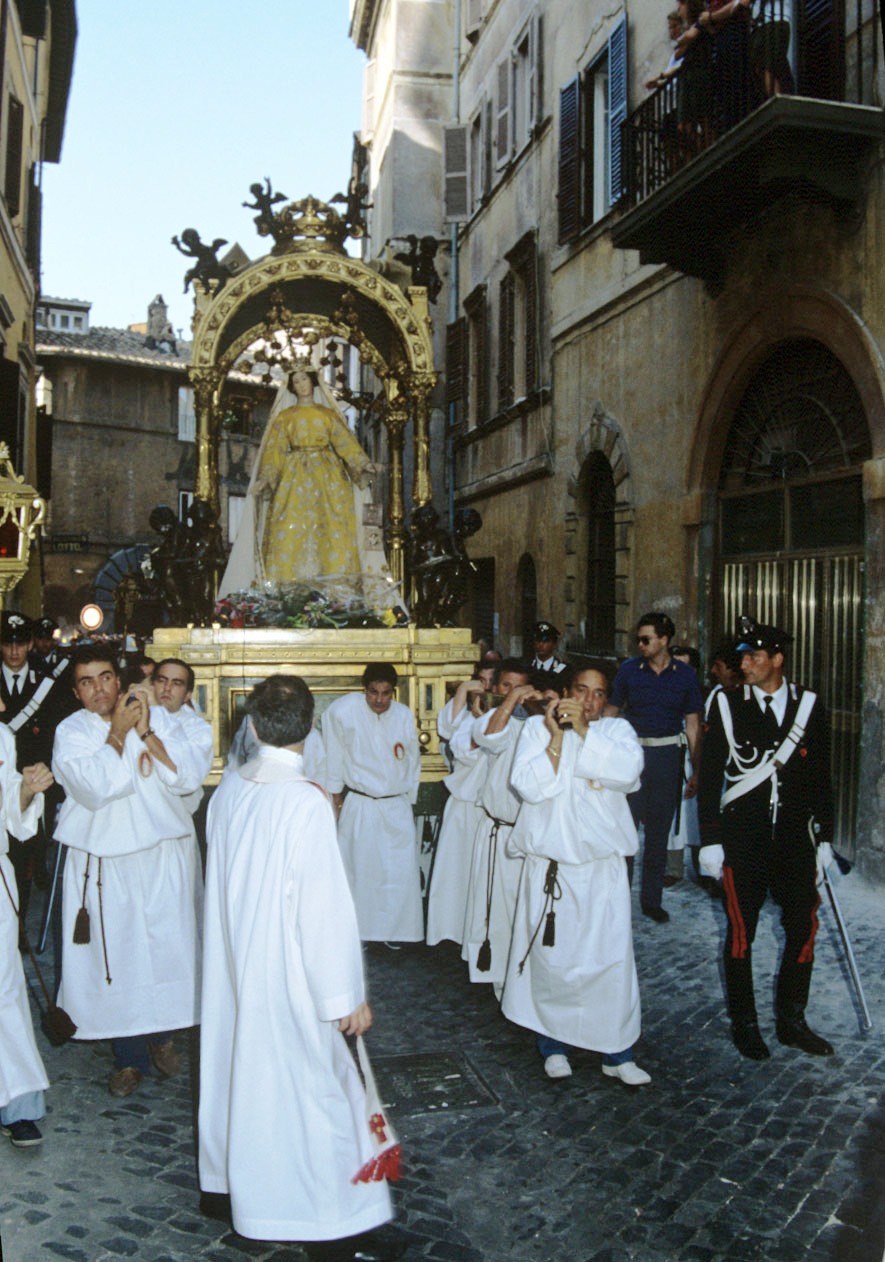
On the corners of many older streets and piazzas all over the City appear small and colorful Marian shrines called Madonelle. These represent a vestige of ancient Roman religious practices tied to the hearth and ancestor worship, but now a tangible expression of pious devotion to Mary or the saints, by people from all walks of life. Varying greatly in size, design, theme, and fabric (fresco and mosaic images and terra cotta statuettes), they typically depict the Blessed Mother with the Child Jesus. Erected to beseech the blessing and protection of God for the neighborhood, Mary usually appears under different titles: mercy, sorrow, humility, sea, roses, and, sometimes, legends say, performs miracles (bleeding, weeping, blinking). These shrines originated in the Middle Ages when once there were as many as two thousand in the City. Most of what remains today, around 1500, derive from the Baroque period. Many have been furnished with silver hearts inscribed the initials PGR (‘per grazie ricevute’: for graces received), tokens of thanks for favors granted through the intercession of the Madonna.

Marian feast days throughout the year, but especially that of the Assumption on August 15, are celebrated with great enthusiasm by Romans on behalf of her, one of their major patrons.
Public executions by hanging or burning occurred in the square from the Middle Ages until the 17th century. In 1600 the Dominican theologian, philosopher, and author of many books on philosophy and science, Giordano Bruno, was burned alive at the Campo for a host of heretical teachings regarding the Trinity, divinity of Christ, transubstantiation, pantheism, and transmigration. Some of his last recorded words were ‘perhaps you, oh judges, condemn me in more fear than I now suffer as the one condemned’. The newly established Italian government (Kingdom of Italy) in the late 19th century erected a bronze statue in his honor. His face gazes toward the Vatican and he stands on the exact spot of his death. On the monument, as well, City officials affixed medallions of religious figures excommunicated for heresy outside of Italy (Jan Hus, John Wycliffe and others).

At his feet is an inscription in Italian: A BRUNO, IL SECOLO DA LUI DIVINATO, QUI, DOVE IL ROGO ARSE (to Bruno, the century foretold by him, here, where the pyre devoured him in flames).

Via del Pellegrino (Pilgrim Road), the main medieval thoroughfare built by Pope Sixtus IV and the street where many jewelers plied their trade, runs from Campo dei Fiori to St. Peter’s.
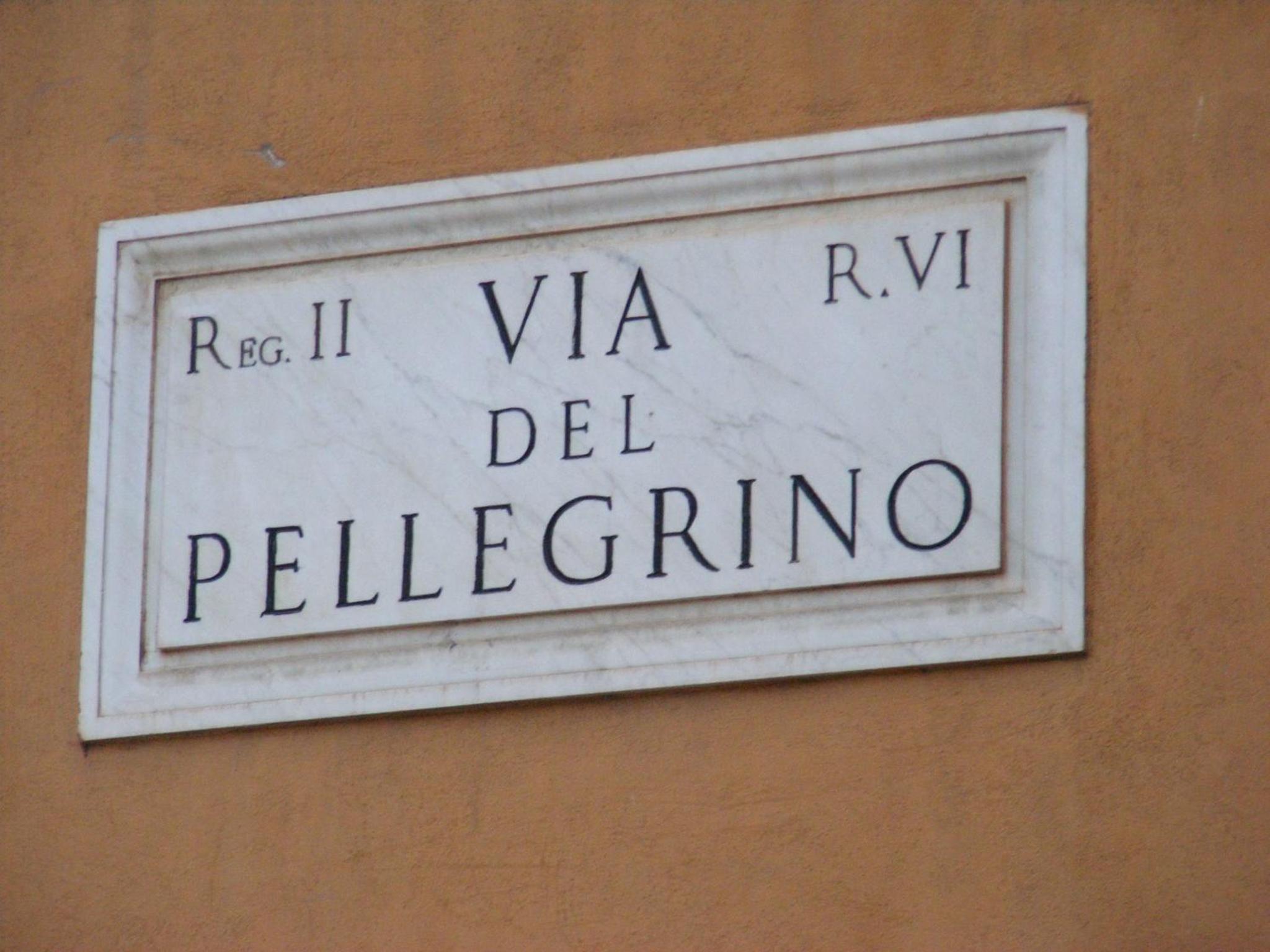
Vannozza dei Cattanei purchased and lived in a house here (#58) where she gave birth to her legitimate son, Michele Angel Gianotti, before she began her long-time affair with Rodrigo Borgia (later Pope Alexander VI). In 1470 Cardinal Borgia built a grand palace nearby on Via dei Banchi Vecchi, a street adjoining Via del Pelegrino. Here Vannozza gave birth to several of their four children, Cesare (1475), Giovanni (1476), Lucrezia (1480) and Goffredo (1482). The huge palace occupies an entire block of City between Via dei Banchi Vecchi and the Corso Vittorio Emanuele, where its modern façade stands, # 282.

At the opposite end of the Piazza stands the Palazzo Orsini-Pio- Righetti over the foundations of the Temple of Venus Victrix constructed by Pompey in 55 BC. The Orsini family converted it into a fortress in the 14th century, and over time it changed hands among elite Roman families: the Condulmer relatives of Pope Eugene IV; the Barberini; House of Savoy; and more recently, the Righetti. In the late 19th century, workers discovered a bronze sculpture of Hercules, a remnant of the Theater, now prominently displayed in the Vatican Museum.

An unusual fountain, La Terrina (tureen), a recycled ancient cattle trough, occupies a colorful and prominent place in the center of the Campo. The current version is a copy of the original, now in front of Chiesa Nuova, moved there in the early 20th century to create space for the Giordano Bruno statue at the north end of the square.

A daily vegetable and fish market, the city’s largest, fills the entire space every morning except on Sundays, and outdoor cafés appear in the afternoons. At night, however, the environment changes once more, and the piazza brims with tourists and young people.
