
Approximately 30,000 Jews currently reside throughout various parts of the City. Trastevere had been home to the Jewish community in Rome from the time of their arrival in the ancient City during the 2nd century BC. Many had migrated from Alexandria in Egypt because of commercial ties binding the two cities. In the Middle Ages the Jewish population clustered around the piazza in Piscinula, the zone of greatest economic and commercial activity along the river. Several synagogues emerged in the Trastevere region. Among the oldest, constructed in 980 AD, stood the one on 14 Vicolo dell’Atleta. In the 11th century it became a Jewish synagogue whose rabbi, the great Nathan ben Jehiel, gained notoriety as a scholar, lexicographer, philanthropist, and author of the Aruhk, an important and influential Talmudic and Midrashim dictionary completed in 1101 AD.

The building’s brick enjoys a wide two arched loggia with small arches resting on ledges. At the base of the central column appears a Hebrew inscription. When Church officials forced the Jewish community created the ghetto on the other side of the Tiber in the mid-16th century, the synagogue shut down. For centuries this house served many diverse purposes: synagogue, convent, foundry, private residence, warehouse, and, most recently, an up-scale restaurant, Spirito Di Vino.
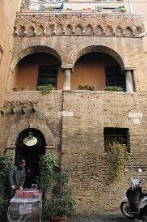
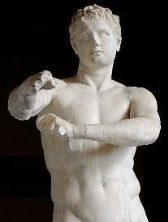
The basement floor survives from Republican times. Archaeological excavations made in 1849 discovered rooms of the first century building with its brick walls and arches intact. These remains now come under the jurisdiction of the Superintendent of Archaeology. Excavators uncovered two museum-piece artifacts in the basement site: a marble sculpture, the Apoxyomenes, and a Bronze Horse. The Apoxyomenes (the scraper) is a Roman copy of the original fourth century BC bronze masterpiece by the Greek sculptor Lysippos. It depicts a young man scraping sweat from his body with a strigil, a curved implement used by athletes to clean themselves after workouts and contests. This sculpture once stood in front of Agrippa’s baths near the Pantheon.
Reportedly, the emperor Tiberius became so enamored of it that he had it brought to his bedroom, but the angry reaction of the Roman people forced him to return it. Now it resides in the Vatican Museum.
A Bronze Horse sculpture emerged from the site, once part of an original equestrian monument created by Lysippos at the request of Alexander the Great in the fourth century BC. The sculptor realistically depicted the horse just before the start of its gallop. The Roman general and statesman Quintus Caecilius Metellus, brought it to Rome and erected it near the Portico of Ottavia. It now graces the Capitoline Museum. In the basement of the house lies an ancient well which still taps into the water of subterranean streams.
