
Because of its rapidly growing numbers, the large Florentine community constructed this 16th century church and dedicated it to their patron saint, John the Baptist. Built on the newly created Via Giulia, it stood at the mid point of the pilgrim route from the center of the City to St. Peter’s Basilica across the Tiber.

Pope Leo X (Medici), himself a Florentine, naturally endorsed the project and invited the leading architects of the City (Michelangelo, Raphael, Peruzzi, and Sangallo) to submit designs. Although Michelangelo provided several sets of designs based on a Greek Cross plan – but regarded as too difficult to execute because of the high-water level of the site – Sangallo the Younger won the commission, succeeded later by the eminent architects, Giacomo della Porta and Carlo Maderno.
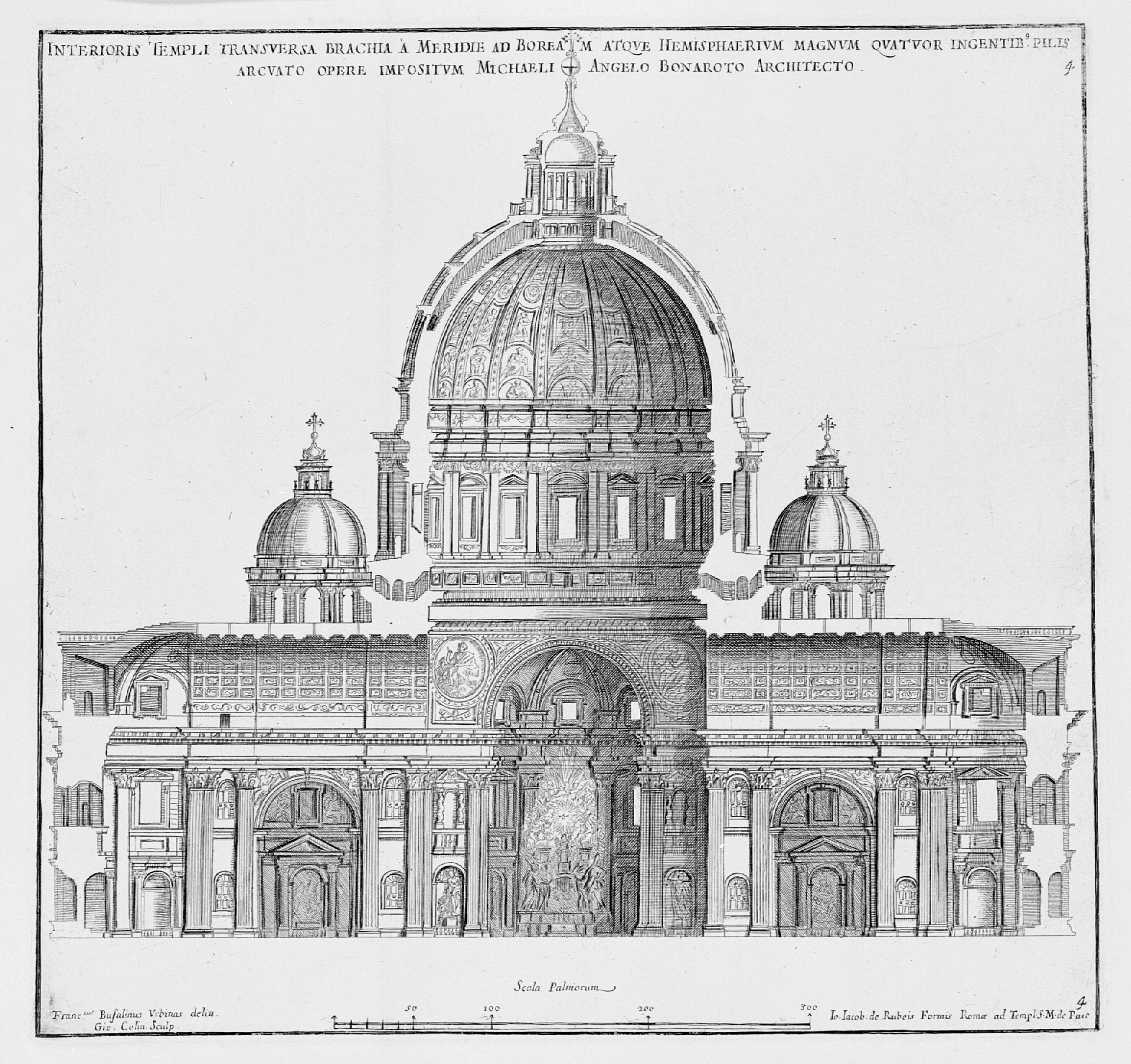
The San Giovanni rectory housed the first members of St. Philip Neri’s newly established religious community, the Congregation of the Oratory. The saint, one of the City’s most popular, even now, regarded San Giovanni as the real first Oratory, long after he transferred his headquarters to Chiesa Nuova a few blocks away.

A sleek and impressive Tuscan-styled cupola, one of the most visible in the City’s skyline, highlights this large, Florentine, Renaissance-styled church. Its campanile rises from the right side of the church and, originally, held four bells, three of which came from England, acquired after the suppression of Catholic churches and monasteries there by Queen Elizabeth I.

Giacomo della Porta first, and then Carlo and Maderno, the last of the great architects of St. Peter’s Basilica, designed the impressive edifice on the plan of a Latin cross.

Construction of the façade, ironically, began in 1773, and then, only at the end of the project, was it entrusted to the architect Alessandro Galilei. Some of the strikingly beautiful marble on the façade comes from the Temple of Juno in the ancient Etruscan city of Vei. A large arched window dominates the upper story with statues of saints mounted on each end.

The spacious central nave, decorated with a white and grey color scheme, contains five bays, with side aisles and funerary chapels on each side. A colorful and geometrically patterned marble floor enhances the beauty and spaciousness of the elegant space.

Carlo Maderno’s imposing dome, elliptical and ribbed, rests on an octagonal drum above which rises a lantern with arched windows. The dome and oculus centered on an image of the Holy Spirit, simple and pure in their grey and white color scheme, fill the nave with light.

Francesco Borromini’s remains, the great architect of the Baroque Age, rest in the tomb of his uncle, Carlo Maderno. His last will and testament expressly stated that this masterful Baroque artist wished to be buried in the vault of Carlo Maderno, his relative, and that his own tomb be unmarked.

The Maderno tomb is located on a pier on the right side of the sanctuary.

A simple commemorative floor tomb slab on the left aisle displays Borromini’s name.

On a nearby pier, an epitaph with his portrait and a Latin inscription commemorates his singular and consummate architectural achievements, specifically enumerating: the Oratory, Sant’Ivo, Sant’Agnese in Agone, the Lateran, Sant’Andrea delle Frate, San Carlo in Quirinale, Palazzo Proganda Fidei, and San Giovanni dei Fiorentini.

The last project before his tragic and untimely death by suicide (1667), included the decoration of the sanctuary of this church with gilded stucco. In it he set two red and grey marble monuments commemorating the Florentine Falconieri family whose relatives included several saints and cardinals.

Ercole Ferrata, friend and pupil of Bernini, sculpted the monument of Orazio Falconieri on the right side.

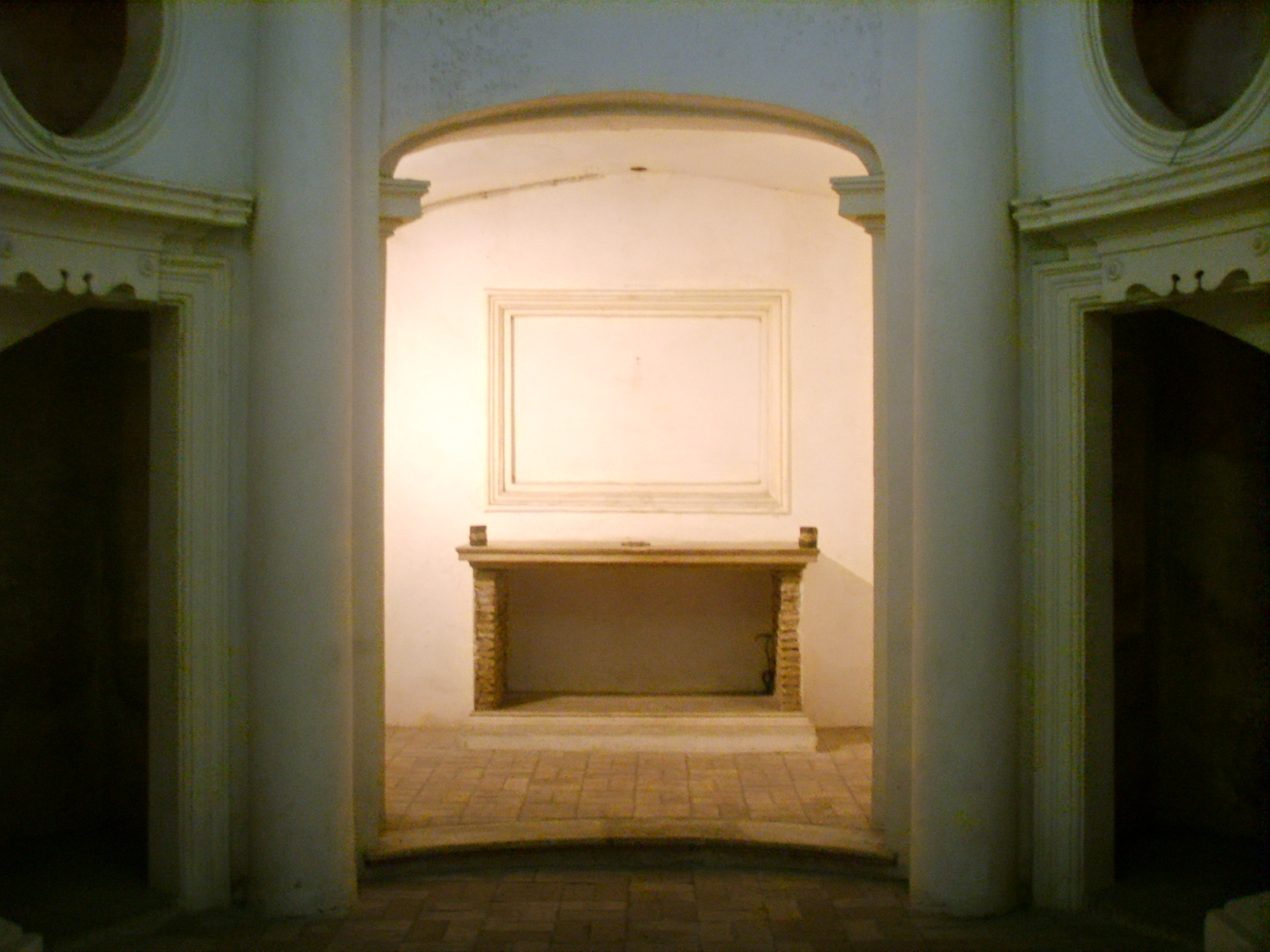
Below the main altar Borromini created the burial crypt for the same Falconieri family, a space forgotten and neglected for many years, but more recently, rediscovered and opened to the public in 1963.
Chapels on the sides of church contain funerary monuments, a baptistry, and memorials dedicated to several saints. In the rear of the church on the second floor, the staff occasionally provides entrance to the Museum of Sacred Art. It contains a collection of discontinued church, artifacts including works of renowned artists: Daniele da Volterra (fresco of Madonna and Child), Bernini (two portrait busts of Antonio Cepparello and Antonio Coppola), and Benvenuto Cellini (silver reliquary), and Luigi Valadier (silver monstrance). Some even attribute its sculpture of St. John the Baptist to Michelangelo.
