
Once the City’s most stylish Renaissance streets, Via Giulia, passes behind the Palazzo Farnese and to this day continues to have historical and architectural importance. Commissioned by Pope Julius II, the 16th century, straight, thoroughfare (originally Via Recta) designed by the pope’s architect, Donato Bramante, runs one mile in length. As part of his extensive and energetic urban renewal program Julius sought to beautify
and expand the City’s road-system and provide another approach to St. Peter’s Basilica. The first street of its kind initiated after ancient times, it represented a radical alteration of the City’s landscape on a major scale to modernize the medieval setting. Throughout both Renaissance and Baroque eras, the Via Giulia area reigned as the posh new neighborhood for the Roman upper class. Julius also initiated another project on the same Via Giulia the construction of the Palazzo dei Tribunali, a building intended, but never completed, for administrative purposes.

To connect Palazzo Farnese to the other family palace, Palazzo Farnesina, across the Tiber River, Michelangelo designed the Via Giulia Arch at the end of the new street.

Nearthe arch sits the Mascherone Fountain constructed for the Farnese Palace complex. Designed from elements of a once colossal ancient Roman mask, the face rests above a porphyry basin and supports the Farnese coat of arms above.

Santa Maria dell’Orazione e Morte Church
During the Middle Ages many unclaimed and nameless bodies washed ashore along the Tiber’s banks. A Confraternity for the Dead recovered bodies and provided fitting burial services for them in the crypt of this 16th century church, restored in the 20th century. In the course of 300 years, more than eight thousand people were buried here. The founders of the church sought ways to remind visitors that all were destined to die, an idea they succinctly inscribed in Latin on the façade of the church: ‘hodie mihi, cras tibi’ (it may be my turn today, your tomorrow it’ll be yours).

Vivid symbols of death carved in stone mark the door.

A well-known alms box appears on the right side of the entrance. It displays on white marble a 17th century carving of Death, in the form of a winged skeleton perched atop a casket and peering down upon an abandoned body. While the Confraternity no longer buries the dead, since the mid-20th century it has functioned as a charitable organization to assist poor families bereaving the loss of loved one

Pope Paul V at the beginning of the 17th century restored the ancient Trajan aqueduct which has been destroyed during the Middle Ages. For hundreds of years it had abundantly supplied water to the Trastevere area. The pope also extended the new aqueduct to the other side (left bank) of the river. On the Via Giulia, he constructed for it a “mostra” (highly decorative front of fountain at its terminal point), the Fontanone di Ponte Sisto. The fountain was set against the façade of the hospice for beggars near the Ponte Sisto. Later, when the new government demolished the hospice in the 19th century to make way for the construction of embankments along the edge of the Tiber, it relocated the Fontanone to the far side of Ponte Sisto where it still stands.

Addresses of some of the more interesting buildings on Via Giulia
include:
# 251 Palazzina Pateras Pescara
Built in the 20th century the Palazzina now houses the French Republic Consulate.

#1 Odescalchi-Falconieri Palace
Adjacent to the church of Santa Maria dell’Orazione e Morte ithe palace was built in the 16th century. It passed through the hands of several noble families, including the Farnese. In the early 17th century Orazio Falconieri commissioned the architect,Francesco Borromini, to enlarge it and in the early 19th century it became the home of, Cardinal Joseph Fesch, uncle of Napoleon Bonaparte. Napoleon’s mother (“Madame Mere” Laetitia lived here for a short time (1815-18) before purchasing on the corner of Piazza Venezia and the Via del Corso the Rinucci Palace where she died in 1836.

A remarkable series of events led to the Cardinal’s discovery and retrieval from oblivion the City’s only Leonardo DaVinci painting, St. Jerome in the Desert. It hangs now in the Vatican Museum collection.

#151 Santa Caterina da Siena a Via Giulia
Santa Caterina Church, built in the 16th century by Baldassare Peruzzi, belongs even now to a confraternity of Sienese financiers. The wealthy Renaissance banker to popes, Agostino Chigi, contributed significantly to its construction.

#14-21 Palazzo Varese
Designed by Carlo Maderno in the 17th century for a Roman Curial official Palazzo Varese remains a private residence owned now by the Mancini Jacobini family.

#9 Via di Sant’Eligio off the Via Giulia
This side-street hosts the tiny church of Sant’Eligio degli Orefici built in 1516 by Roman gold and silversmiths as their guild church. The only church in the City designed by the artist Raphael, Baldassare Peruzzi completed it after the great artist’s early and unexpected death in 1520. The present façade has two stories. Peruzzi’s lead dome, simple and straightforward and decorated merely with a gilt ring around the base of the oculus, rests upon a drum composed of brick.

A Greek cross interior encloses arms of equal length, while the somewhat plain interior, painted in a cream color, exhibits very little decorative detail.

#151 Palazzo del Collegio Spagnolo
Built in the 19th by the Spanish Queen Isabella, the Palazzo del Collegio houses Spanish seminarians and has connections with the nearby church of Santa Maria in Monserrato, national church of Spanish people in the City.

#35 Collegio Ghisleri
Designed by Carlo Maderno in the middle of the 17th century, the Collegio served as a school for children of the papal nobility until the 20th century. The core of the building was gutted during renovation, but the façade left intact. The structure now houses the high school, Liceo Classico Virgilio.
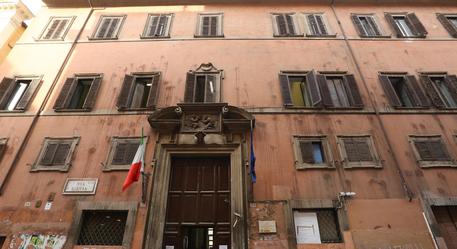
#34 Santo Spirito dei Napoletani Church
This 17th century church has been renovated several times, once by Carlo Maderno. It functions now as the national church for the Neapolitan community in the City and houses the tombs of the last members of the royal family of the Kingdom of Naples, King Francis II and his wife, Marie Sophie Amelie.

#134 (bis) San Filippo Neri in Via Giulia Church
San Filippo, a 17th century church, served as a confraternity of glove-makers. The structure, restored in 2000, operates now as office and residence space.

#52 Carcere Nuove
These “New prisons” were constructed during the reign of Pope Innocent X and replaced the older Corte Savella prison on Via Monserrato. Innocent, some contemporaries whispered, hoped to decrease the values of houses on Via Giulia to increase the importance of the Piazza Navona, the site of his own family residence. The 19th century prison in Trastevere, Regina Coeli, later replaced them and now the building houses the National Anti-Terrorism and Anti-Mafia Agency.

#59 (a) Santa Maria del Suffragio Church
Carlo Rainaldi designed this 17th century church which served as a confraternity church to intercede those deceased and suffering in purgatory.

#63 Palazzo San Biaggio della Pagnotta
The Palazzo consists of remains of an uncompleted 16th century building project of Pope Julius II. The pope commissioned Donato Bramante to design a palace intended as the centerpiece for a new piazza which would house important ecclesiastical and civil offices. After the death of the pope in 1513 his successors abandoned the project so that only parts of the base of the early structure remain visible today.

#64 San Biagio degli Armeni Church
Built in the 11th century, San Biaggio was dedicated to the bishop St. Blaise. The church was originally attached to one of the City’s first abbeys. Pope Gregory XVI transferred it to the Armenian community in the 19th century and renamed it San Biagio degli Armeni.

#66 Palazzo Sachetti
The Palace was constructed for himself by Antonio da Sangallo the Younger, an architectural collaborator with Bramante and Raphael in the 16th century creation of St. Peter’s. One of the chief architects of Palazzo Farnese, he placed conspicuously on the façade of the Palazzo Sachetti the Farnese coat of arms together with an inscription attesting to his gratitude to the pope for his significant patronage.

#86 Casa di Raffaello
The Casa represents remains from the palace designed by Raphael for himself but left unfinished when died in 1520. The inscription above the windows of the first floor memorializes him.

#93 The Relais Giulia
Serving now as a modern hotel, this hotel once was a palace built by Pope Paul III (Farnese) for his daughter Costanza. Today it hosts guests from all over the world. Its façade displays three distinctly different Farnese coats of arms: in the center that of Pope Paul III with the papal tiara and keys; on the left that of Cardinal Alessandro Farnese; on the right that of Ottavio Farnese, brother of Allesandro and Duke of Parma and Piacenza.

#79 Palazzo Medici Clarelli
The Palace is a mid-16th century palace which Antonio da Sangallo constructed for himself.

Over the main door remains an inscription dedicated to the Grand Duke of Tuscany, Cosimo Medici, forebear of the Medici dynasty, humanist, and early patron of Michelangelo.
