
Probably the City’s oldest church, the Basilica of Santa Maria in Trastevere dominates the broad piazza.
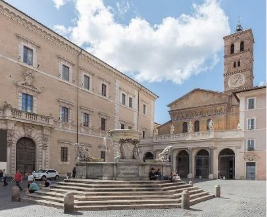
In ancient times most foreigners, former slaves, and the Jewish population made their homes in this part of the City on the right bank of the Tiber.

There existed here in the 1st century BC the Taberna Meritoria, a hospice for soldiers, where, in 38 BC, a gas explosion occurred immediately after which liquid oil mysteriously oozed from the ground below. Because some believed that the unusual phenomenon served as a precursor to the advent of Christianity, they placed there a plaque to commemorate the event.
Around 220 AD Pope Callistus over this the hospice constructed a public oratory, possibly the first of its kind in Paleo-Christian history. When a legal dispute arose between Christians and neighboring tavern owners regarding the use of the oratory, the Emperor Alexander Severus ruled in favor of the Christians and allowed their worship service to continue, remarking that the property was better utilized as a place of worship, irrespective of its god, than as a place of drunkenness and bad behavior. Pope Callistus was martyred (222 AD) nearby on the site where Palazzo San Callisto now stands.
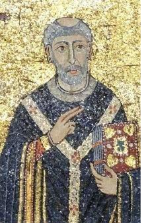
The predecessor of the present church arose in the fourth century during the papacy of Julius I. Its dedication to Mary originates, not in the 4th century as some maintain, but, rather, in the 8th century, when a major renovation occurred during the papacy of Adrian I. The current church stands on its foundations, rebuilt with material from the baths of Caracalla in 1140 under Pope Innocent II (Papareschi) whose family owned a palace in Trastevere.
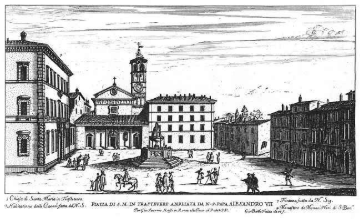
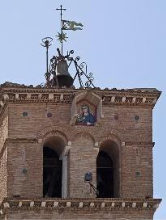
Several major renovations have occurred since then in the 16th, 17th, 18th, and 19th centuries. The church exemplifies the evolution of a structure by way of renovation and remodeling over the course of many centuries. What seems from the outside to be a kind of mini-version of a Constantinian basilica is, in fact, the product of architectural elements from all previous ages: Roman, Paleo-Christian, Medieval, Renaissance and Baroque. A 12th century, brick, campanile (bell tower) rises four stories over the end of the right aisle and holds on the second story a clock over two hundred years old and over the top a fresco the Blessed Mother and Child.
A Baroque narthex with five arches, rebuilt by Carlo Fontana in 1702, stands in front of the entrance. On the parapet above the arches are statues of Saints Callistus Cornelius, Julius and Calepodius. In the narthex itself a large collection of pagan and 3rd century Christian inscriptions hangs on the walls. The pagan ones originate mostly from the tombs on the Appian Way, placed here in the 19th century restoration.

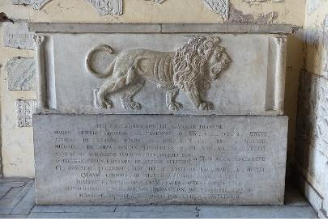
Its many Christian epigraphs derive from earlier restorations of the church. A simple 12th century Papareschi family sarcophagus sits in a corner of the narthex on the left. It displays in relief the lion from their coat of arms.
The lower parts of the walls of the narthex bear carved marble slabs, plutei, decorated with geometric patterns together with plant and animal motifs perhaps carved for the first basilica. Ancient but fading frescoes still adorn the walls above.

Above the narthex the external brick facade contains three identical windows together with faded 19th century frescoes: palms trees in between the windows and images of the two cities of Jerusalem and Bethlehem. Its triangular pediment above the façade holds a 12th century mosaic restored in the 13th century. Its subjects, the Virgin and Child with 10 female figures, are not the wise and foolish virgins of the gospels because only two have no halos and hold different lamps from the others, possibly representing Roman virgin martyrs. The two tiny figures kneel on either side of the Virgin and probably represent donors of the church. A faded 19th century fresco of Christ in glory is still visible in the tympanum of the pediment. The contemporary figure of Pope Pius IX kneels at his feet. Above the angels are symbols of the evangelists Matthew, Mark, Luke and John.

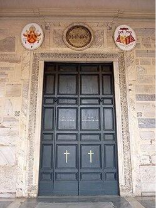
Three doorways with cases made of ancient marble lead into the side aisles.
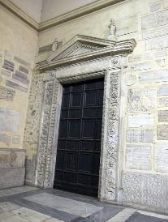
Four times in the past, the central door became a Holy Door in those years when San Paolo fuori le Mura was closed for repairs.
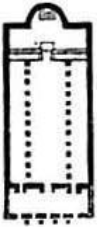
Its classic basilica plan with nave, aisles, and apse at the end ensures its status as one of the City’s best examples of a 12th century church retaining its Paleo-Christian features.
The lengthy, broad, and spacious nave radiates warm colors.
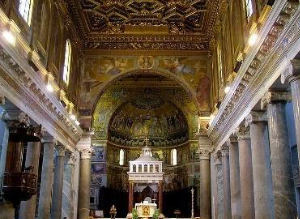
Twenty-one antique granite columns of varying widths and with assorted Ionic and Corinthian capitals separate nave from aisles and, trabeated, support the entablatures above. All originate either from the Baths of Caracalla or the Temple of Isis.

On the nave walls above the columns appear frescoes ordered by Pope Pius IX and executed by different artists around 1866. The backgrounds of these paintings resemble mosaic work. Three windows above the entrance contain stained glass, depicting (left to right) three popes: Julius, Callixtus, and Cornelius.

A 15th century marble ciborium (aumbry) by Mino da Fiesole on the right side of the nave contains holy oil.
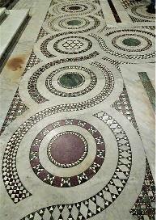
The Cosmatesque pavement, reset in 1870, exposes the original intricately carved bases. From the limestone capitals peer the faces of Egyptian gods.
An 18th century carved wooden pulpit stands midway on the left side of the nave, while the last chapel on the right aisle just before the transept displays a niche containing ancient Roman stone weights and chains bound to St. Callistus when soldiers pitched him into a well. A gilded and coffered-nave-ceiling, designed by Domenichino, displays his painting of the Assumption of Mary in the middle. 19th century frescoes decorate the triumphal arch and depict the Blessed Virgin and Child with angels and the patriarchs Moses and Noah.

The church is best known for the magnificent 12th century mosaics of its
triumphal arch and the semi-dome of its apse.
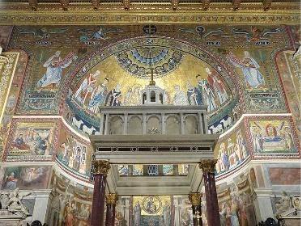
The central images in the triumphal arch consist of the Cross with Alpha and Omega, seven candle sticks and the symbols of the four evangelists. A small, almost unnoticeable image on the left side above the prophets Isaiah and Jeremiah, represents a caged bird symbolizing Christ held captive by the sins of humankind, a visible reference to the caption in Latin under the Jeremiah figure (Dominus Christus captus est in peccatis nostris).

In the apse Christ, enthroned with his mother Mary and flanked by saints and popes, occupies the central part of the semi-dome. Above the head of Christ reaches out the hand of God from a wreath. On Christ’s left stands Pope Innocent II holding in his hand a model of the church, the deacon St. Lawrence, and the contemporary Pope, St Callixtus and on his right, St. Peter, Pope St. Cornelius, Pope Julius and St. Calepodius. Below lies a frieze with the Lamb of God and the Twelve Apostles symbolized as sheep in procession. In the background on each side are symbols of the two holy cities, Bethlehem and Jerusalem. Under the sheep, and on each side of the lower apse, a series of late 13th century mosaics depict scenes from the life of the Blessed Virgin. The central figures of Christ and the Blessed Mother seem more Classical in style than the Byzantine style which ordinarily characterizes a setting like this. A mosaic panel under the central window of the apse shows Saints Peter and Paul presenting the donor of the mosaics to the Madonna and Child.

The Madonna della Strada Cupa Chapel, designed by Domenichino, displays an icon which gives the chapel its name, a gift from Cardinal Henry Stuart, Duke of York, brother of “Bonnie Prince Charlie”. He remained the last of the four Stuart claimants (Henry IX) to the English throne after the downfall of the Stuart dynasty in1688 which explains why the British royal coat-of-arms rests above the door. Cardinal Stuart served as titular bishop of this church until 1761, when he became titular cardinal of Frascati and later of Ostia and dean of the College of Cardinals.

The original, 12th century high altar consists of ancient marble slabs and over it sits a pseudo-medieval styled baldacchino added in the 19th century. Mino dal Reame, a Renaissance sculptor from Naples, signed the attractive, 15th century tabernacle. Relics of Saints Callixtus, Cornelius, Julius and Calepodius lie interred in the crypt (confessio) below the main altar. The 12th century, Cosmatesque, paschal candle on the right side of the altar resembles the twisted columns of St. Peter’s, some of which come from the Temple of Solomon in Jerusalem. A 12th century marble cathedra, the episcopal throne, sits in the center of wooden choir stalls in the apse. It features a pair of griffins as armrests.
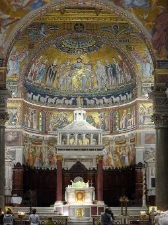
On the floor of the apse between the paschal candle and the baldacchino rests a monument with a small opening traditionally held to be the site of the “Fons Olei“. Its accompanying Latin inscription refers to a legend claiming that a natural oil spring appeared here in 38 BC on the night of December 25, so plentiful that it flowed into the Tiber, a sign that Christianity, would spread throughout the Roman world. This site became a popular oratory and shrine for Christians in the 3rd century and the foundation for the 4th century church.

At the back of the left transept is the Altemps chapel housing the Byzantine styled icon of the Madonna della Clemenza, the prized possession of the church and one of the City’s oldest icons of the Madonna. It dates possibly to the beginning of the 6th century and depicts Madonna and Child enthroned, imperially, between two angels. The chapel, built in 1585, served as the burial place of Cardinal Marco Altemps, nephew of Pope Pius IV and one of 5 papal legates to the Council of Trent.
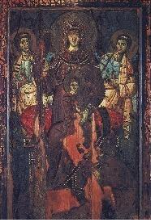
Two large wall frescoes depict scenes from the Council. Over the entrance to the chapel sit the coats of arms of Cardinal Altemps and Pope Pius IV. The altar is Gothic in style over which lies a canopy with a pointed arch. On the right hand of the entrance to the Chapel stands the marble monument to Roberto Altemps, the 20-year-old son of Cardinal Marco, who by the court of Pope Sixtus V was charged with, found guilty of, and executed for the rape of a teen-age girl.
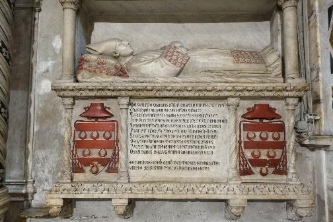
On the wall of the left transept sit two, colorful, medieval, tombs: on the right, the 15th century monument of Cardinal Pietro Stefaneschi, signed, untypically, by its sculptor Magister Paulus Romanus.
The wall tomb opposite belongs to the French Cardinal Philippe d’Alencon, nephew of King Philip IV the Fair, sculpted, as well, by Paolo Romano. The sacristy sits at the far end of the left aisle. Its antechamber houses two 1st century Roman mosaics originally from the town of Palestrina, one depicting birds and the other a seaside scene with boats and dolphins. The wall opposite holds a relief, The Resurrection of the Dead, perhaps designed by Gian Lorenzo Bernini and executed by one of his disciples.
