
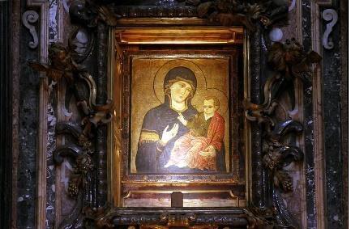
In one of Trastevere’s quaintest and picturesque sectors lies Santa Maria della Scala, an early 17th century, devotional, Baroque church dedicated to the Blessed Mother. It houses a popular and highly venerated icon of the Madonna discovered originally on the staircase (Scala) of a residence nearby. In 1849 the church served as hospital for the troops of Garibaldi defending unsuccessfully the regime of the recently formed Roman Republic (1848) which the year before had overthrown the papal government in the City.
The church has a central dome with a tall lantern. Its large 2 storied façade dominates the tiny piazza in front.
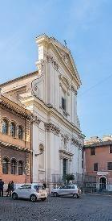
Above the main door is set a lovely sculpture of the Madonna with the child Jesus.

The nave has three bays and three chapels on each of the side aisles. There are also altars at each end of the transept. The sanctuary contains a high altar by Carlo Rainaldi over which is a free-standing baldacchino. In the apse of the choir behind the altar is painting of the Queen of Heaven by the Cavalier d’Arpino, designer of the mosaics in the dome of St.
Peter’s.

In counterclockwise order from the right side its chapels are: Chapel of St John the Baptist with an altarpiece by the accomplished Dutch painter Gerrit van Honthorst; Chapel of St Hyacinth; Chapel of St Joseph; Chapel of St. Teresa of Jesus (Avila); Chapel of Our Lady of the Staircase in the left transept whose altar holds the original miraculous icon; and three others, as well (the Crucifix, the Assumption, and that of Our Lady of Mount Carmel).
The Chapel of St Teresa of Jesus in the right transept, dedicated to this the Spanish reformer, mystic, and foundress of the Order of Discalced Carmelites contains a relic of the her right foot. Another church on the other side of the City, Santa Maria della Vittoria, houses Bernini‘s famous sculpture of her, The Ecstasy of St. Teresa, which, of great interest some art historians, gives great prominence to her left foot.

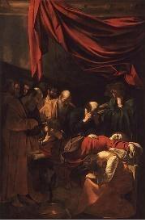
Girolomo Rainaldi designed the Chapel of the Assumption which houses the altarpiece by Carlo Saraceni depicting the Death of the Virgin. This painting replaced Caravaggio’s earlier, but controversial, version of the same theme rejected by the friars who had commissioned it. They insisted that it lacked the proper decorum for a place of worship that, even worse, Caravaggio had used as its model the body of a prostitute drowned in the Tiber. Closer to the truth is the likelihood that the model was Caravaggio’s mistress. The original painting eventually made its way to the Louvre in Paris.
Pharmacy
Adjacent to the church stands a 17th century pharmacy which preserves the original furnishings and equipment of the shop, now closed. It once supplied the papal court and survived as a business until 1954. It remains now as a museum accessible to the public by appointment.
