
The Riario family in the 15th century constructed the imposing late-Baroque palace, the Palazzo Corsini, designed by Ferdinando Fuga. The current palace represents the 17th alteration of the original. Its predecessor, the Riario Palace, had hosted the eccentric Queen Christina of Sweden from 1659 till her death in 1689.

After her conversion to Catholicism Queen Christina abdicated the Swedish throne in 1654 and moved to the City. She lived the last 30 years of here life here and died in a room that is now part of the Corsini Galleria.
Several of Napoleon’s relatives lived in the palace in the late 18th and early 19th centuries: Joseph Bonaparte, Napoleon’s brother during the Napoleonic occupation; Eugene de Beauharnais, Napoleon’s stepson; Cardinal Joseph Fesch, the half-brother of Napoleon’s mother and ambassador to the Republic of Rome.
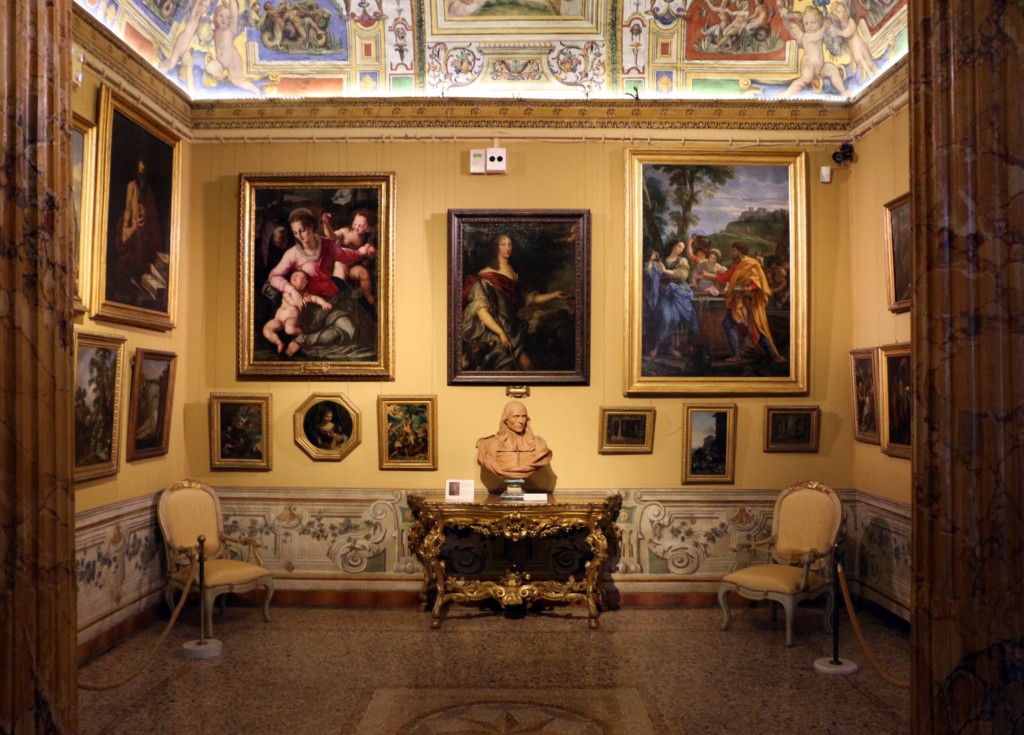
Today, the palace hosts the Galleria Corsini, Rome’s National Gallery of Antique Art (Post-1000 AD art). Most pieces derive from the Corsini family collections of multiple family members including Pope Clement XII. The Italian State acquired in 1883 the palace and its artworks and the pieces of the collection remain in their original places. Most of the art is Italian, from the 15th to the late-18th century, and its most prominent artists include: Cavalier d’Arpino (Resurrection of Lazarus); Annibale Caracci (St. Francis); Caravaggio (St. John the Baptist); Bartolome Estban Murillo (Madonna with Bambino); Guercino (Apollo and Marsyas); Nicholas Poussin (Triumph of Ovid); Guido Reni (Beatrice Cenci, Magdalen, Ecce Homo, Salome, Herod, St.Joseph); Peter Paul Rubens (St. Sebastian).

Palazzo Corsini stands across the street from its even more famous counterpart, the Villa Farnesina, designed by Baldassare Peruzzi and built in 1510 for Agostino Chigi, the very wealthy papal banker. So splendid was it that when Pope Julius paid a visit during its construction, he asked Chigi if the palazzo be more beautiful than that of the Riario palace, the owner replied that ‘his stables would be more elegant than the Riario dining room’. The Villa was acquired in 1577 by the Farnese family whose palace was located across the Tiber River. Michelangelo initiated a project, never fully implemented, to connect the two properties with a bridge spanning the river.
Apart from its unusual splendor and beauty, the palace attracts visitors because of if frescoes, painted by Raphael (Loggia of Galatea) and other eminent High Renaissance artists. A Chigi family member, Pope Alexander VII, in the next century became one the most ardent supporters of the newly emerging Baroque art form and its major representatives, Gian Lorenzo Bernini and Francesco Borromini.
