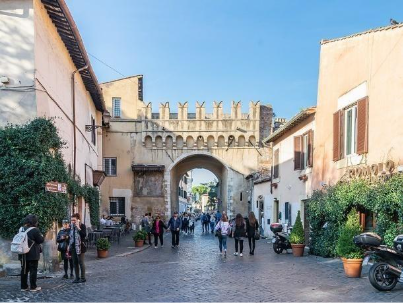
By the third century BC, the ancient, defensive, Republican, Servian Wall had virtually disappeared, testimony to the City’s status as ‘master of the world’ and its confident, self-reliant ability to defend itself against all potential invaders. In the third century AD, however, military situation had radically changed and the growing threat of Germanic invasion caused the emperor Aurelian to construct a wall system capable of repelling the attacks of those foreign forces, a portent of the future and sign of the gradual decline of the Empire. The Porta Settimiana in Trastevere remains part of the Aurelian Wall system and is the only functioning gate of its kind on the right bank of the river. Of the great cities throughout all of Europe only Rome retains its original gates, all 14 of them. They originated with Emperor Aurelian’s construction in 275 AD of his great defensive wall around the City although, even when completed, they did not completely surround all the fourteen districts established by Augustus. Through them passed, then and now, its major roads leading to all parts of the Empire: Porta Flaminia (Porta del Popolo) to the north; Porta San Pancrazio (Aureliana to the west and then north into Gaul); Porta San Sebastiano (Asinara) along the Via Appia to southern Italy; Porta Ostiensis to the port city of Ostia at the mouth of the Tiber; Porta San Giovanni east to the hill town around Albano. Builders incorporated into the wall many structures standing in its way (Caius Cestius Pyramid, aqueducts, and the Castro Pretorio).
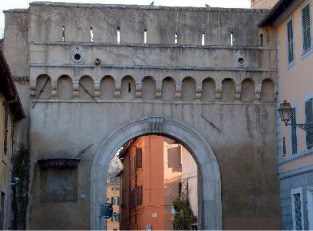
Its wall runs up to and through the Janiculum Hill above it. Built 60 years before the construction of the Aurelian wall and incorporated into it, the name of the gate probably comes from its proximity to monuments constructed in the age of Septimius Severus or his sons, Caracalla or Geta. This gate served as the entrance to an important medieval road, Via della Lungara, running between the river, the Janiculum and the Porta Santo Spirito at St. Peter’s. Because of its importance as a major pilgrim route to the Vatican it was restored by Pope Nicholas V and enlarged by Pope Alexander VI in the last half of the 15th century. Pope Urban VIII in the 17th century replaced virtually the entire Aurelian wall section in Trastevere, but left the gate intact. Its last restoration occurred in the 18th century.
