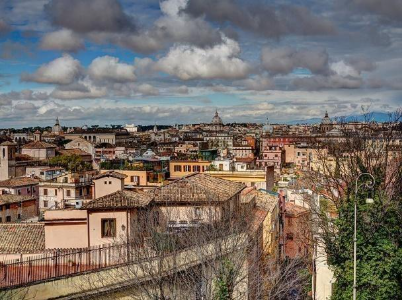
One of the City’s most colorful and historically unique quarters remains Trastevere, the area on the right bank of the Tiber (trans Tiberim) below the Janiculum Hill and the dock area which once belonged to the Etruscans. When the Romans conquered it to maintain control of the river, they had no interest in incorporating into the City. For much of its history the only connection between the two places was a small bridge, the Pons Sublicius (wooden bridge) built in the 7th century BC by King Ancus Marcius, originally situated near where remnants of the Ponte Rotto now stand. This bridge, famous in Roman lore and later Western history and literature, achieved renown for its heroic 6th century defense of the City.
Horatio (Publius Horatius Cocles) and 2 other officers withstood an assault by the Etruscan army of king Lars Porsena on the Trastevere side of the river. They held off the enemy while soldiers under their command escaped to safety over the bridge. Once he had cut the ropes securing the bridge to the riverbank, he swam wounded to the other side and emerged from the river with armor and weapons intact.

The City replaced the Pons Sublicius with a more solid one, Pons Garibaldi, only in 1888.

Excavations in the 1970’s and 80’s have discovered throughout the area several labyrinthine passageways connecting buildings which housed Cohort VII, public officials, police and firefighters, responsible for maintaining public order throughout the City. One of its buildings, the Excubitorium dei Vigili, served as headquarters for the local fire brigade. Now twenty feet underground, the structure contains remnants of mosaic floor tile, decorative pilasters, barracks for rest and sleeping, toilets, and storage of supplies such as grains and oils. Graffiti scratched on walls indicate some of the difficulties encountered by this large band of men whose motto was ‘ubi dolor, ibi vigiles’ (wherever there is trouble, there you’ll find the watchmen).

Trastevere’s highly mixed population consisted largely of sailors who worked the Colosseum awnings, fishermen, dock workers, immigrants from parts of Italy, foreigners, and former slaves. Not until the time of Augustus was it incorporated into the City (District #14), but remained virtually unchanged for hundreds of years, even after its mid-3rd century enclosure by the Aurelian wall. The quarter became the center of an
important Jewish community which lived there in large numbers until the late Middle Ages when city officials forced them to live in a ghetto on the other side of the river. The City’s oldest synagogue, no longer in use, stood in the 11th century on the Vicolo dell Atleta #14. The region also includes two very ancient churches, the Basilica of Santa Maria in Trastevere, and the church of Santa Cecilia.
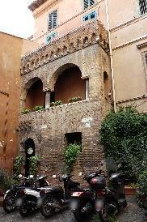
The streets of Trastevere remained unpaved until the reign of Pope Sixtus IV in the late 15th century. Because of its isolation (it was “beyond the Tiber”) and its long-time mixed population, the inhabitants of Trastevere have developed a culture of their own and speak of themselves as “Noi Altri” (“we others”). They annually celebrate the phenomenon in a local summertime event in July called the festival of “Noiantri”.

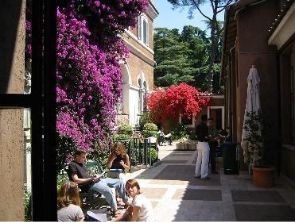
A handful of foreign academic institutions make their home in Trastevere, some of which are American: The American University in Rome, John Cabot University, and the American Academy in Rome.