
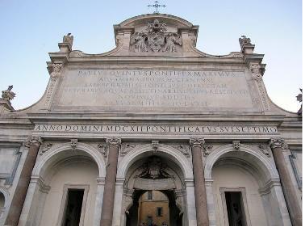
The City justifiably has acquired great fame for its beautiful fountains, over 1,300 in the Imperial Age. Its least visible but most impressive is the “Il Fontane” (Great Fountain) which dominates the Janiculum Hill. For over a thousand years the Trajan Aqueduct (Aqua Traina) had fed the area of Trastevere with water. Pope Paul V restored and extended it and created the grandiose fountain as the face of its terminal point (mostra). In the early 17th century Pope Paul V raised funds for his project in part by imposing a tax upon wine about which the famous talking statue Pasquino complained, describing the pope not as Pontifex Maximus (great bridge builder) but, rather, as “Fontifex Maximus” (fountain builder in-chief). The fountain’s source is Lake Bracciano located in a nearby hill town outside of Rome.

At the top of the fountain rests the papal and Borghese family coat of arms with an inscription praising the benefaction of the water and its benefactor.
The spectacular semi-circular pool, designed and added later by Carlo Fontana, catches water gushing from the basins above providing spectators with aesthetic and practical benefits alike.

Across the street from the Aqua Paola stands the Porta San Pancrazio, a gate of the ancient Aurelian Wall on the southern side of the City.
Constructed in the middle of the 1st century BC and originally called the Porta Aurelia, it opened to the Via Aurelia Antica, the road which led to the Mediterranean and then followed the coastline north to France. It takes its current name from the nearby church of San Pancrazio, an early Christian martyr whose burial site which in the Middle Ages attracted hosts of pilgrims visiting the City. The gate was destroyed 1849 by French soldiers when, in defense of the papal City, they attacked Giuseppe Garibaldi’s Republican soldiers holding the Janiculum Hill. In 1854 Pope Pius IX commissioned Virginio Vespingnani to reconstruct the gate and restore it to its previous state.
