
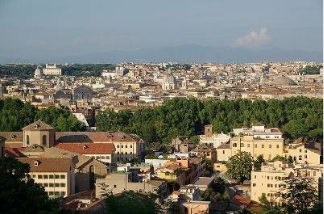
Serenely perched high above the right bank of the Tiber River lies
the Janiculum Hill, one of the City’s highest hills (second only to Monte Mario), but never regarded as one of the seven foundational ones because of its location outside the boundaries of the City. In reality, the City has twelve hills: nine on its left bank (Palatine, Capitoline, Aventine, Quirinal, Caelian, Oppian, Viminal, Esquiline, and Pincian) and three on its right (Janiculum, Vatican and Monte Mario). In addition to these, Romans attach to three knolls in the City the honorific title ‘monte’ (hills of beans in actuality): Giordano, Citorio, and Testaccio.
Virgil, the poet and author of the Aeneid, believed that this hill took its name from Janus, a god of the sun whose followers had established on it a colony called Antinopolis. One of the several manifestations of this god in ancient times was Janus Quirinus, a god of war and of beginnings and transitions, the gates of whose temple were closed in times of peace and open in times of war.

Legend has it that the City’s second king, Numa Pompilius, lies buried under the hill. Ancus Marcius, the City’s fourth king, constructed a citadel on the hill as a defense against neighboring Etruscans and connected the hill to the far side of the Tiber with the wooden Pons Sublicius, the City’s first bridge.

It was from this bridge that Horatius Cochles defended the City in the 6th century against the forces determined to restore to the throne its last king, Tarquinius Superbus. Yellow sand under its surface explains its ancient name, Mons Aureus (Hill of Gold), reflected still in the name of the church, San Pietro in Montorio, perched half-way up the hill to its crest. The Janiculum was incorporated into the City and fortified by a wall during the ancient rule of its seven kings.

Today the top of the Janiculum sits a park at the center of which stands the equestrian statue of Giuseppe Garibaldi, the Italian general who played a major military role in the unification of Italy and is regarded as one of the “fathers of the fatherland” along with King Victor Emmanuel II, Count Camillo Cavour and Giuseppe Mazzini.

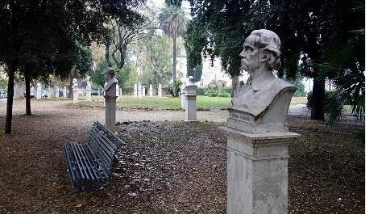
Throughout the park statues and busts of many notable Romans abound, most military figures who fought with Garibaldi in defense of the City. Because it offers a spectacular and peaceful panoramic view of the City, sightseers and tourists frequent it, arriving here on foot and bus.
Other important places located throughout the Hill include the church of San Pietro in Montorio, in legend, erroneously identified as the site of the crucifixion of St. Peter.
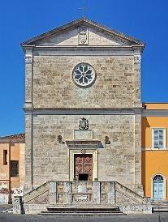
King Ferdinand of Aragon and Queen Isabella of Castile, patrons of the church, commissioned the great architect Donato Bramante to construct his famous shrine, the Tempietto, over the legendary crucifixion site of the saint. Heralded throughout the Renaissance as the City’s purest expression and model of Classical architectural style and form, the shrine houses a chapel with a circular plan. Its cylindric core supports an extraordinarily beautiful dome which would later serve as the model for the one Michelangelo set atop St. Peter’s Basilica.

Also located in the immediate area remain the façade of the House of Michelangelo and the mostra of the fountain (Aqua Paola) built by Pope Paul V in the 17th century. Daily, a cannon fires one shot from the Janiculum to indicate the noon hour, a longtime tradition going back to the mid-19th century.
