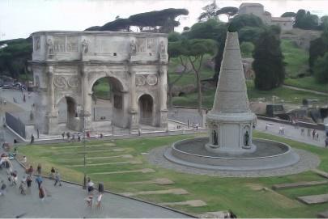
Historians refer to Constantine as ‘Great’ because of the consequential impact he made on the development of Western tradition. He transformed the Roman Empire and extended its life by restoring one-man rule and transferring its ancient capital from the City to his newly created Constantinople. But even more, his accommodation and support of the Christian movement enabled it later to survive the 5th century fall of the Empire and to succeed it as guardian and transmitter of the Classical and Judeo-Christian culture to Western Europe and beyond. The triumphal arch which the Roman Senate in 315 AD erected in his honor symbolizes his role in that process.

Rome’s largest, best preserved, triumphal arch stands 70 feet high and commemorates the Battle of the Milvian Bridge, Constantine’s victory over his rival Maxentius in AD 312. The arch, the most beautiful and harmonious of all arches with three constructed of brick, concrete and marble, displays three grand bays. Much of its decoration consists of spolia, reliefs and sculptures removed from earlier triumphal monuments: Trajan (carved reliefs on the upper part), Hadrian (round medallions) and Marcus Aurelius (top row panels). The appropriation of so much of its material is regarded by historians as a sign of the artistic decline of 4th century Rome. In reality, the arch originally was intended for Maxentius and most of it parts, except the attic, completed when Constantine suddenly emerged as emperor. The fact that the Empire’s capital city was transferred by Constantine in 324 AD to the city he built on the Bosphorus and named after himself, Constantinople, supports this assessment. The arch originally spanned the Via Triumphalis, the ancient route for triumphal marches accorded by the State to military generals victorious in important wars. It survived medieval quarrying because it was incorporated into the Frangipane fortress complex which was not demolished until 1804.

The arch’s only original Constantinian parts consist of the reliefs immediately around 2 smaller arches and the rondels on each end. These depict scenes from the Italian campaign of Constantine against Maxentius: the Milan departure, the Siege of Verona, the Milvian Bridge Battle, the entry into Rome, the possession of the City, the address to the Roman people, the distribution of gifts to victorious soldiers.

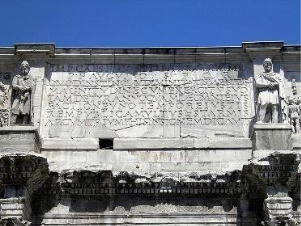
The main inscription on the wide panel above the cornice, originally in bronze letters, contains the famous but religiously ambiguous phrase, “instinctu divinitatis” (through the inspiration of divinity) which has caused much discussion among historians regarding Constantine’s personal religious convictions.
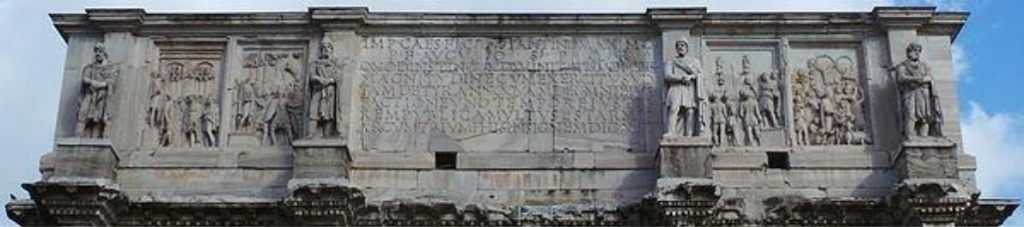
Christian historians (Lactantius and Eusebius of Caesarea) and later commentators speak of a vision prior to the Milvian Bridge victory and the emperor’s subsequent conversion to Christianity. Some interpret the vagueness of the reference as Constantine’s effort to appease both Christian and pagan sensibilities. The inscription reads: “to the Emperor Caesar Flavius Constantinus, the greatest, pious, and blessed Augustus: because he, inspired by divine power and the greatness of his mind, with his army and righteous weapons has delivered the state from tyranny and those who promote it, the Senate and People of Rome have dedicated this arch, a notable memorial of his victories”.
The Domus Aurea, an enormous palace, extended from the side of
the Palatine Hill all the way to where Santa Maria Maggiore stands now on the Esquiline Hill. The residential part of this gigantic complex (300 acres) continued in use by emperors after the death of Nero. Titus resided there for ten years after the death of his father Vespasian.

A large, cone-shaped fountain, the Meta Sudans, stood between the Flavian Amphitheater and the Temples of Venus and Rome. Emperor Domitian erected it as the boundary line and turning point for triumphal processions. Constantine later restored it for the same use near his new arch. Water oozed (metans) out of holes from its sides instead of jetting out from the top. The fountain survived until the 20th century when Mussolini destroyed it to pave the road around the Colosseum. Its foundations have been recently excavated.