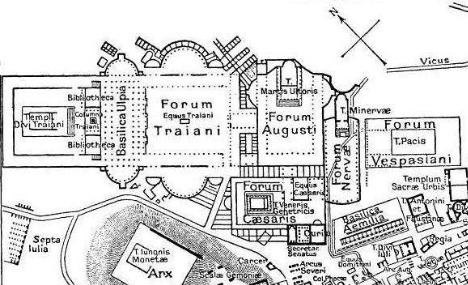
A series of five monumental, interconnected, public squares called the Imperial Fora were constructed successively between 46 BC and 113 AD and lie adjacent to the City’s oldest public space, the Roman Forum. The first of these was built in 46 BC by Julius Caesar to which, as Rome grew, emperors gradually added an additional four. In the Fascist Era Mussolini renovated sections of these to symbolize to the world his intention to restore to Italy the past glories of the ancient Empire. To this end he created a new, broad, ceremonial road, the Via dei Fori Imperiali, which bisected the Fora area and connected Piazza Venezia at one end to the Colosseum at the other. Along both sides of the Via dei Fori Imperiali stand 20th century, bronze statues of the emperors responsible for the various Imperial Fora. In chronological order the Imperial Fora consist of: Caesar’s Forum (46 BC), the Forum of Augustus (2 BC), Vespasian’s Forum or the Temple of Peace (75 AD), the Forum of Nerva or the Transitional Forum (98 AD), and Trajan’s Forum (112 AD). The 1924 excavations managed to unearth only one fifth of the total space of these later Fora. New excavations, underway since 1985, aim to create, eventually, an archeological park.

Forum of Caesar (Julian Forum)

Julius Caesar, flush with wealth derived from the booty and slaves acquired through his conquest of Gaul, built this Forum in 46 BC on the northeast side of the Roman Forum, the first of a series of fora which would arise in the Imperial age. Caesar paid a fortune (one hundred million sesterces) to purchase from private owners the property on which it was built. Constructed as an extension to the Roman Forum, he created it, imitating his rival Pompey, mainly to visibly showcase his growing power. It became the model for all subsequent imperial flora (Augustus, Nerva, Vespasian, and Trajan). Caesar centered the entire structure around a temple devoted to Venus Genetrix. His family (Julian gens) had long claimed ancestry to Aeneas through the goddess Venus and he erected the temple, ostensibly, to thank her for aid rendered in his 48 BC victory over Pompey at the battle of Pharsalus. Completed by Augustus after the death of Caesar, the temple contained important statues, paintings, engravings, and jewels. A statue of Caesar riding Alexander the Great’s favorite horse, Bucephalus, stood prominently in front of the temple, to propagandize his acquisition of absolute power. Inside it, as well, stood a bronze statue of Cleopatra, Caesar’s mistress and mother of his son, Caesarion. In his ambitious plan to restructure the City, Caesar initiated other magnificent projects completed during the reign of his adopted son, Augustus (Curia Julia, Theater of Marcellus, Saepta Julia, and the Basilica Julia in the Roman Forum). Half of Caesar’s Forum lies now buried under the modern road constructed by Mussolini, the Via dei Fori Imperiali, which connects Piazza Venezia to the Colosseum. During the Mussolini era Corrado Ricci excavated the exposed parts of the Forum, opened in 1933 at the same time as the construction of the Via Foro Imperiali.
Forum of Augustus Caesar
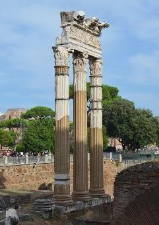
Throughout his career as head of government, Augustus made it his policy to ‘ally religion with the interests of the state’. This explains the large number of temples (twenty-eight) constructed during his reign. Of these, the two most important were the Iulius Divinus Temple built to perpetuate the memory of Julius Caesar, his great-uncle and adoptive father, and his own Mars Ultor Temple constructed to avenge Caesar’s murder. Both temples proved very useful to him as gradually he attained and retained control over the Roman government. At the Battle of Philippi in 42 BC, Augustus and Marc Antony defeated the forces of Brutus and Cassius, the main conspirators responsible for the assassination of Julius Caesar

In gratitude to the gods for avenging Caesar’s death, Augustus vowed to build a temple to honor Mars Ultor, the god of war and vengeance. The temple became one of Rome’s most important, serving as the site of its solemn state ceremonies. The senate, for example, met here to make solemn decisions regarding war and peace. The temple, constructed with high walls, served as a shield to protect the Forum area from fires which frequently broke out in the surrounding Suburra section of the City.

The magnificent temple, built over eighteen years, served as the centerpiece for his new forum, an expansion of that of Caesar adjacent to it.

Mostly this forum functioned as a venue for courts of law. Spectacular both in size and the richness of its materials, it contained the rarest of lapis lazuli gems from the city of Gabii, marble from Africa, wood from Rhaetia (Switzerland), and sculptures and art from Greece. Hundreds of statues filled its spaces including those of Romulus and many other national heroes. These served as visible symbols pointing to Augustus whose divine destiny would be to rule over the State and usher in a golden age of peace and prosperity to the whole world. Behind the Temple stood a museum containing Julio-Claudian artifacts including a sword of Julius Caesar. Set at a right angle to Caesar’s Forum, the square is rectangular in shape with long and deep porticos and large semicircular exedras. Three fluted columns and four partly reconstructed Corinthian ones remain from the original structure.

Temple of Peace (Vespasian’s Forum)
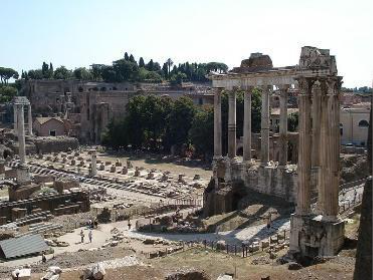
In 75 AD Emperor Vespasian built the Temple of Peace to celebrate the conquest of Jerusalem five years earlier. Technically no forum at all, it serves, rather, as an appendix to the others joined to the Forum of Augustus by a passageway called the Transitorium. It once housed a library, works of art, and a temple which held the booty from the Jewish Wars including, according to some, the Menorah from Herod’s Temple.

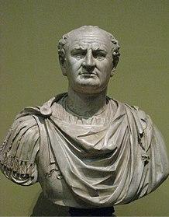
Vespasian was an avid builder, so much so that he joined the work force in the renovation of the Temple of Jupiter. He took pride in providing practical amenities for the City including the installation through its streets of tiny stalls containing uncovered terra cotta jars used by pedestrians to relieve themselves when needed. These were maintained by public workers and paid for by the imposition of a small tax. When one of his sons complained about their foul odor, Vespasian replied that ‘pecunia non olet’ (money doesn’t stink). Right up until the 1970’s small facilities of the same sort stood along many of the City’s streets and locals still called them ‘Vespasiani’. Famous for his terse witticisms, it is said that as he lay dying his last words were, ‘oh my, I think I’m about to become a god’. Many Romans regarded him as ‘the love and light of the human race’.
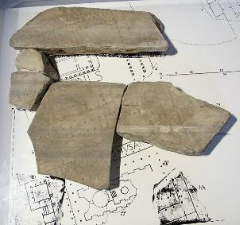
One wall of its library was decorated with a large map of marble blocks, the Forma Urbis, which illustrated in detail the external plan of the City. Some fragments of the map have been discovered and are on display at the Crypta Balbi, a small 1st century BC theater on Via delle Botteghe Oscure, # 31.
At the corner of Via Cavour and Via dei Fori Imperiali stands the remains of a medieval tower, the Torre die Conti, built in the 13th century over the remains of part of the Temple of Peace. Constructed by the brother of Pope Innocent III from spolia removed from the Fora, in the High Middle Ages it dominated the area and served, among other things, to safeguard the route of papal processions between the Lateran and St. Peter’s. An earthquake in 1348 toppled its upper two stories, and in the 16th century, it was further diminished when Michelangelo stripped its cladding to construct the Porta Pia.

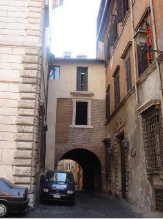
During the Middle Ages virtually all Roman noble families acquired fortresses and fortified towers throughout the City (more than 1000). Some of these were constructed specifically for those purposes, but others were adaptations of pre-existing monuments and older structures. The Colonna family occupied the Mausoleum of Augustus; the Orsini, the Theater of Pompey; the Pierleoni, the Theater of Marcellus. Even some churches were fortified, such as those of Santi Quattro Coronati and San Nicola in Carcere. Traces of some of these fortified structures, like the Arco de’Cenci in the Jewish Ghetto area, are still visible in arches which bedeck the side streets and alleys of the older City.
Forum of Nerva (Forum Transitorium)

Emperor Domitian built a new forum to connect (Transitorium), an open area to the existing Fora of Vespasian, Augustus and Caesar.
Unfinished at the time of Domitian’s assassination in 96 AD, his successor completed the project and named it after himself. It included the Temple of Minerva, razed later in the 17th century by Pope Paul V to provide marble for the fountain, the Aqua Paola, which he constructed on the Janiculum Hill.

Forum of Trajan
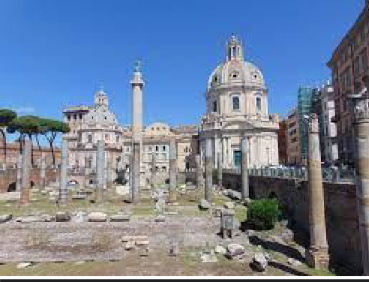
Around 122 AD the Emperor Trajan constructed Rome’s last, most magnificent, and largest of the City’s fora.

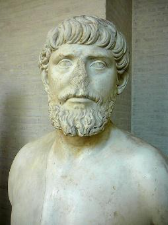
Some historians regard Trajan as the best of all Roman emperors. In his own day, many referred to him as the ‘most good’ ruler, a title usually accorded to Jupiter. Such was his reputation that in the Middle Ages Pope Gregory I, according to the popular legend, asked God that he be saved, and in his Divine Comedy, Dante gives him a place in Paradise.

In its day many regarded this forum as the finest in the entire City. Emperor Constantius II, son of Constantine, travelled from Constantinople to visit the old imperial Capital in 357 AD and returned East convinced that it outshone all other structures including the Pantheon, Colosseum, Baths of Caracalla, and Temple of Peace.
Its construction alone required the removal of twenty million cubic feet of earth, so vast its size. Trajan built the magnificent complex to symbolize both the eternal glory of the Empire, which had brought about a world-wide Pax Romana, and of the emperor, a god subject inevitably to be apotheosized. Its outstanding beauty emanated from the strict application of Vitruvian principles of architecture: order (integrated parts), symmetry (strong central axis), and proportion (dimensions tied to a round number of Roman feet). Its construction by the world’s best contemporary, architect, Apollodoros of Damascus, played an important, mostly unheralded, role in the legacy of wonderful and often-imitated Roman stonework. Exotic marbles from the world over (Numidia, Phrygia, Africa, Turkey, Greece, Pisa), knit together to create extraordinarily colorful patterns, an artistic tradition handed down to the Middle Ages in the form of Cosmatesque inlay, to the Renaissance in its use of pietra dura in lapidary gem work, and to the Baroque Age in the flamboyant application of polychromatic stone to diverse decorative surfaces. Much of this forum lies buried under the surface of the roadway leading to Piazza Venezia. Its many integrated parts consisted of a central forum area centered by the equestrian statue of Emperor Trajan, the Basilica Ulpia, two libraries (Greek and Latin), the Temple of Trajan, a portico with two hemi-cycles, and the world’s best and most famous monumental columns. The first modern excavation of the site occurred in the 16th century during the papacy of Paul III while the most recent took place in 1812 during the French occupation of the City. The furthest extent of Roman boundaries peaked Trajan’s reign and his conquest of Dacia provided the spoils to pay for this very expensive project. Its execution required the work of the Empire’s most skilled engineers who had to remove virtually a significant portion of the abutting Quirinal Hill which then rose in height to the level of the top of the current column of Trajan.
Parts of Trajan’s Market still remain, a large complex of ruins and an integral part of Trajan’s Forum, the equivalent today of a modern mall and super-market and, as well, one of the best and most unique examples of ancient city planning. Constructed against the excavated side of the Quirinal Hill as a retaining wall (thirty million cubic feet of earth removed and dumped behind the Pincian Hill), it consisted of a six-storied structure serving many purposes: imperial administrative offices, apartments, library,
and shops. Designed by Apollodorus of Damascus (probable architect of the Pantheon), it was created to provide a public market space for local and international goods coming to the City from markets all along the trade routes controlled by the Empire. Goods from Asia, India, Africa, and all of Europe were sold here, including highly sought-after silks and spices from the East. Two subterranean stories served as passageways to transport produce sold in the markets to and from the complex. The four stories above ground housed over 100 shops organized by types of goods sold: wine, oil and flowers on the 1st floor; spices and perfumes on the 2nd; the state welfare office on the 3rd; fresh and saltwater fish on the 4th. Two large halls on the lower level became the venue for concerts. In the Middle Ages it became a fortress for the powerful Colonna family and later converted to a monastery. The Mussolini regime restored it to its current condition in the 1930’s

Via Biberatica (Latin for drinking or pepper), an ancient street that ran through the middle of the market area (excavated in 1928), emerged as a locale for taverns and grocery stores.

The beautiful and famous Column of Trajan, dedicated to the emperor by the Senate in 113 AD and restored now and virtually intact, represents a magnificent artistic example of early narrative sculpture. Its height was dictated by its proportions set against the backdrop of the nearby market and it rises over seven hundred feet in length into the sky. Nineteen hollow drums made from thirty-four blocks of luna marble, each ten feet high and eleven feet wide, display over 2,500 figures in marble relief. For visibility purposes, each figure increases in size as it rises from the bottom to the top of the cylinder (two feet to three). Egyptians and Greeks used columns primarily for architectural purposes, but Romans employed them, as well, for decorative purposes. They placed them in gardens, planted them as mile markers on their major roadways, and put them to use as pedestals for statues. As early as 338 BC Romans erected such a column and statue in honor of Gaius Maenius in gratitude for his military successes against the Latin League, especially at the naval Battle of Antium, after which he removed rostra (rams) from enemy ships and set them up at the orator’s stage (Rostrum thereafter) near the Curia Hostilia in the Forum. This one undoubtedly served propagandistic as well as aesthetic purposes.

Trajan’s Column displays several thousand carved figures unfurled as a banner in twenty-three spirals. These depict, the two victorious military campaigns of Trajan and his army over the Kingdom of Dacia (modern Romania). The lower drums describe the first campaign (101 AD) and the upper the second (105 AD). All were originally painted. An internal, carved, staircase made of 185 steps rose to the pedestal on which the statue of the emperor rested. Forty-three, camouflaged, windows, slotted into the shaft, fill the interior columns with light.

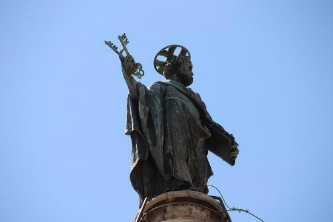
The statue of Trajan on top disappeared sometime in the Middle Ages but in 1586 Pope Sixtus V commissioned Domenico Fontana to put in its place Giacomo della Porta’s bronze statue of St. Peter holding in his right hand the keys of the Kingdom. Its counterpart, St. Paul, sits atop the Column of Marcus Aurelius in Piazza Colonna.
Two libraries set on either side of the column allowed for “reading”, parchment-like and at close hand portions of the episodes depicted in the column as it spiraled upward. Holes, still visible on their walls, once supported many hand-written scrolls
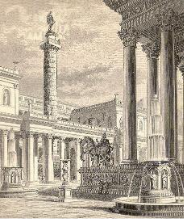
Internal spiral steps rise to the summit topped with a statue of Trajan, replaced in 1588 with that of St. Peter. Below the Column in a golden urn rested the ashes of the emperor and his wife Plotina.

Uniquely in the history of the City, in 1162, the Roman Senate decreed publicly the protection of one of its ancient monuments, when it declared that the Column of Trajan ‘remain whole and intact for as long as the world lasts’. Segmented casts have been made of its 19 drums, against the day, possibly, when it would need replication.

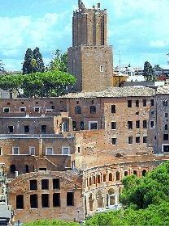
Torre delle Milizie, a medieval fortified tower, one of many in the City (Scimmia near the Pantheon, Anguillara in Trastevere, Capocci on the Esquiline, Moletta near the Circus maximus), stands next to Trajan’s Market. Constructed around 1200 AD, it passed through the hands of several powerful medieval families for the next 100 years. The Caetani family of Pope Boniface VIII significantly enlarged around 1300. The Conti family owned it shortly thereafter for over 300 years. A legend says that this was the tower from which Nero fiddled as he watched the City burn in 64 AD.
Domus Romana di Palazzo Valentini is an archaeological area recently discovered and unearthed under a Renaissance palace in the heart of the City. Palazzo Valentini, a 16th century palace, trapazoidal in shape, was originally built for the nephew (Cardinal Michele Bonelli) of Pope Pius V. Located near Piazza Venezia, the back of it overlooks the Forum of Trajan. For several centuries it has served multiple purposes: private residence, musical theater, private and public library, government office space.

Excavations which took place between 2005-2007 brought to light a series of remarkable, 4th century AD, patrician structures: two private residences and a complex of baths (Small Baths of Trajan) consisting of a central pool, calidarium, frigidarium and tepidarium. The owners of the structures were more than exceedingly wealthy, able, for example, able to supply water to the baths via a private water system maintained and operated by slaves.
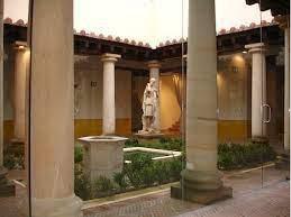
These spaces have been re-assembled and visitors are provided with virtual tours through the complex during which they can see firsthand the layout of the structures and various parts: private (bedrooms and staircase) and public rooms (peristyle, library and kitchen), frescoes, mosaics, pools, and fountains.
One of its treasures is an extraordinarily large, hall floor mosaic, designed with geometric patterns and floral images.
