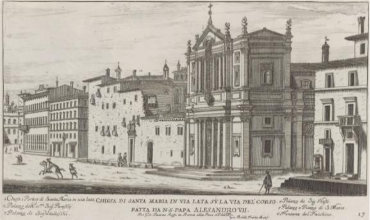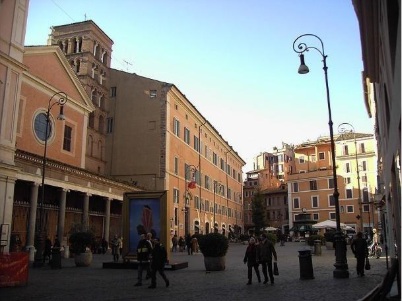
A few blocks away from Piazza Colonna, San Lorenzo Basilica, a very early Christian worship space and one of the City’s many ‘titulus churches’, stands on property originally owned by a 3rd century Roman matron, Lucina, where Christians regularly prayed and worshipped. Replaced later in the 4th century by a paleo-Christian basilica, the church witnessed the important 366 AD election of Pope Damasus whosepapacy played a decisive role regarding Sacred Scripture: it fixed the New Testament canon at twenty-seven books and encouraged St. Jerome to create the Vulgate Bible, the standard Scriptural text for the next fifteen hundred years.
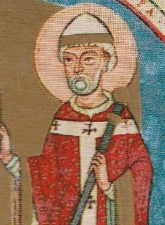
Restored many times in the course of its history, it took on its current appearance after restorations in the 17th (Pope Paul V) and 19th centuries. During the Mussolini Era the government restored the façade to a medieval appearance, but left untouched the Romanesque campanile, still reflecting the features of a much earlier 1112 restoration.
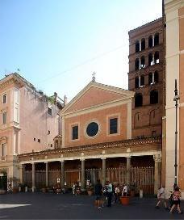
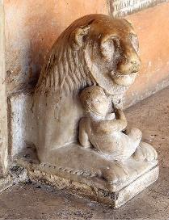
The narthex and its doorway date from the 12th century restoration by Pope Pascal II. Six ancient granite Ionic columns support the tiled roof. Stone lions flank the entrance door: one holding a lamb, the other a human baby.
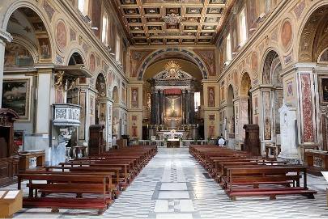
Interesting 12th century artifacts fill the church: Cosmatesque tombs, monuments, reliefs. The flat coffered nave ceiling displays a painting of the Apotheosis of St Lawrence and 18th century floor gleams with geometrically patterned tiles of black and white marble.
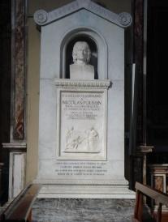
Nicolas Poussin’s tomb and monument rest on the right side of the church. Chateaubriand, the well-known French writer, diplomat, and historian dedicated the monument to him and authored the encomium to this important and influential French painter. Poussin, though he spent most of his life in Rome, represents one of France’s best regarded painters of the Baroque style, serving for a short time as official painter for King Louis XIII (The Arcadian Shepherds) and Cardinal Richelieu. Other patrons included Marie de Medici, Cardinal Mazarin, and Pope Urban VIII. Poussin’s artistic style – ordered, brightly colored, and linear – directly influenced many later painters such as David and Cezanne.
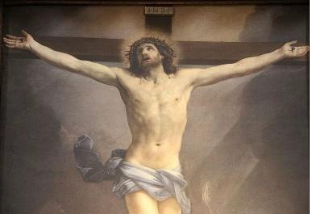
Guido Reni’s highly dramatic Crucifixion provides the altarpiece in the sanctuary. Copied many times throughout Europe, the popularity of its image surged throughout the period of the 16th century Counter-Reformation.
A 11th century marble throne in the apse behind the high altar belonged to Pope Paschal II. Visible through the grating below the altar in the first chapel on the right side, dedicated to St. Lawrence, rests the gridiron on which he died in 264 AD during the persecution of Emperor Valerian. Lawrence sacrificed his life because he refused to betray the Church and turn over to the state its sacred books and goods.

Although he was born in Spain in the 3rd century, Lawrence became one of the City’s most beloved local saints. His former teacher, Pope Sixtus II ordained him deacon and appointed him archdeacon of the Roman church in charge of its treasury and its distribution to the needy. Apprehended during the persecution of Christians by the emperor Valerian and ordered to surrender the Church’s wealth, he pointed to the City’s poor and suffering and declared that these were its real treasury. The Prefect of the City condemned him to death, burned on a gridiron set up by his soldiers.
Many churches in the City, dedicated to him, claim connectedness to the events of his life and martyrdom: San Lorenzo in Damaso where he served as deacon; San Lorenzo in Miranda where he was condemned to die; San Lorenzo in Fonte where he was imprisoned; San Lorenzo in Panisperna where he perished; San Lorenzo fuori le Mure where he was buried; and this church, San Lorenzo in Lucina, where his relics, gridiron and chains, are preserved.

Bernini designed the Fonseca Chapel (fourth on the right side), dedicated to the Annunciation, for Gabriele Fonseca, personal physician of Pope Innocent X. While it contains busts executed by Bernini’s school, Bernini himself carved the portrait sculpture of Gabriele Fonseca as well as the angels around the dome.
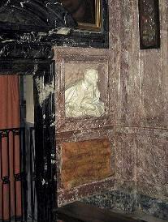
Artists credit the Fonseca sculpture as one of Bernini’s most memorable accomplishments in portrait sculpture because it exemplifies so well his special genius of imposing on stone the internal states of his subjects.

A private memorial to Umberto II of Savoy, Italy’s last king (thirty-four days) who died in Geneva in 1983 and buried at Hautecombe Abbey in Savoie, France, stands in the right transept chapel. After World War II and the emergence of the Republic of Italy in 1946, the Italian government required his exile. The former king spent the remaining years of his life in Portugal.

Around the corner from the church on Via del Corso (#418) stands the Renaissance structure, the Palazzo Ruspoli. Built in the 16th century, the palace passed through the hands of several families, among whom the Caetani, until the 18th century when they lost it in a poker game to the head of the Ruspoli family whose descendants still own a part of it. One of its unique features is the huge marble staircase designed by Martino Longi the Elder. One hundred fifty steps rise over four flights, each step, ten feet wide, consisting of a separate block of marble. Paintings aligned its walls and statuary of emperors and Roman deities stood at the head of every flight overlooking Largo Goldoni below. Among its many notable residents was Hortense Bonaparte, wife of Napoleon’s brother, Louis, King of Holland. One of her three sons who lived with her in the palace would later become the French emperor, Napoleon III. Part of the building now houses a luxury hotel, the Residenza Napoleone III.
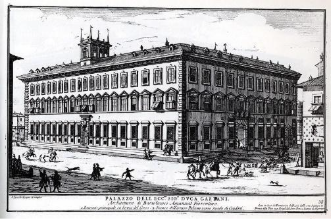
Another palace nearby on the Corso (#374) is the Palazzo Verospi Vitelleschi. Percy Bysshe Shelley, one of England’s best known Romantic poets, resided here in 1819 and wrote part of his Prometheus Unbound on its premises.