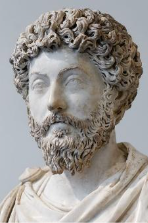
Historians describe Marcus Aurelius Antoninus as one of the Empire’s most unusual rulers: an able military commander, one of the best men of his time, the last great Roman ruler, and a genuine Stoic philosopher strongly influenced by the noble ideals of Seneca and Epictetus. His death in 180 AD brought about what they call the end of the line of ‘five good emperors’. With it disappeared the Pax Romana initiated by Augustus (27 BC-180 AD) with its Ages of Gold and Silver when the ‘Time of Happiness’, of the Empire gave way to the ‘Time of Troubles’.
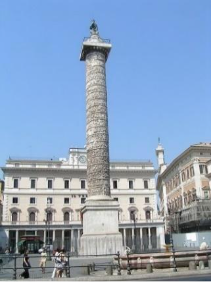
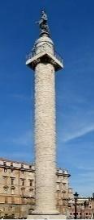
In his honor, the Seante erected the spectacular late 2nd century Column of Marcus Aurelius modelled on that of Trajan and erected in Campo Marzio. It stands in the center of Piazza Colonna and celebrates his military victories in the Danube campaigns of 172-174 AD against Germanic tribes such as the Marcomanni. Made entirely of Carrara marble, the column rises almost 100 feet into the air and consists of 28 hollowed-out blocks,12 feet wide.
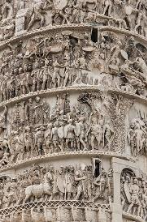
Episodes carved in bas-relief on the column begin with the crossing of the Danube River by the Roman army and recount in its many spiral panels the details of diverse skirmishes in the two separate expeditions initiated by the emperor over the course of 16 years.
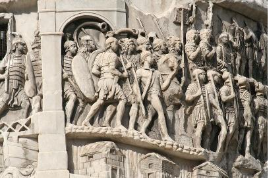
Originally the column stood as one part of a much larger temple complex. The stairs inside the column lead to the platform at the top. Some of the sculptures at its base disappeared in the 16th century when Pope Sixtus V ordered its refurbishment by Domenico Fontana and the placement at its summit of the bronze statue of Saint Paul holding a sword, a twin of the St. Peter statue on Trajan’s Column in the Imperial Fora.
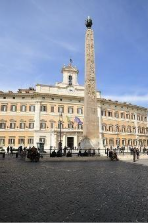
In the piazza directly behind the Column of Marcus Aurelius stands the Palazzo Montecitorio with a magnificent and imposing, Baroque, convex façade. Gian Lorenzo Bernini and Carlo Fontana designed this grand, 17th century palac: Bernini for the nephew of Pope Gregory XV, cardinal Ludovoco Ludovisi and, later, Fontana for Pope Innocent XI. In 1789 Pope Pius VI installed in front of it, the Horologium of Augustus, a sun dial in the form of an obelisk brought to the City from Egypt by Augustus after his defeat of Antony and Cleopatra in 31 BC. It stood originally outside of his Ara Pacis.
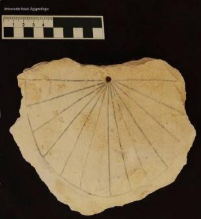
Sun dials served as the first Roman clocks from the 3rd century BC until the arrival of the water clock in the mid-2nd century BC. These dials, invented by the Greeks, as well as the water clock, passed on to the Romans and served as their timepieces right up until the Middle Ages. The Romans divided the day into twelve hours measured from dawn to dusk. On the shortest day of the year (December 21), an hour measured forty-five minutes, but seventy-five minutes on the longest day in mid-summer. When mechanical clocks appeared in medieval Europe, they had an hour hand only and needed adjustment every two weeks to allow for the diverse length of daylight hours.
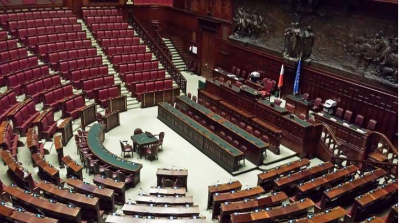
For almost two hundred years the building housed various offices of the Roman Curia, but in 1870 the newly created state, the Kingdom of Italy, expropriated it and converted it into the Chamber of Deputies, the lower house of the Italian Parliament. In the early 20th century, the government remodeled, essentially gutted, the entire structure leaving untouched only the façade.
A block away from the Aurelian Column (west) at Piazza di Pietra sits the Temple of the Deified Hadrian built by Antoninus Pius and dedicated to his adoptive father. Eleven of its original fluted columns remain embedded in the exterior walls of the structure which serves as the City’s Chamber of Commerce Building. This triad of Emperors (Hadrian, Antoninus Pius, and Marcus Aurelius) belongs to the string of illustrious imperial rulers to whom historians refer as the ‘five good emperors’ who include, as well, Nerva and Trajan.
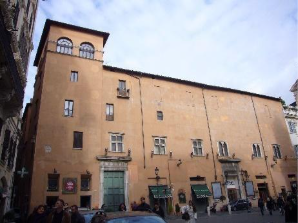
In the nearby Piazza Capranica, located between Piazza Montecitorio and Piazza del Rotonda (Pantheon) stands the lovely Gothic-Renaissance-styled Palazzo Capranica. Constructed in the middle of the 15th century, it served as the family home of Cardinal Domenico Capranica until his death. Part of it was later converted by his family members into a house of studies for students of few financial means who wished to pursue an ecclesiastical career. For the last several decades it has served as a conference center which includes musical venues. Two marble-encased doorways led to the College (tower door) and to the family residence (right side). The first floor houses a series of interesting and diverse windows: three in Gothic style on the left and three in Renaissance on the right. Windows on the upper floor have been sealed with brick.