
Although Piazza Colonna takes its name from the ancient, marble, Column of Marcus Aurelius erected there in the second century, it has served the City as an open public space for over two millennia. The piazza includes several very diverse palaces, one of which, the 16th century Palazzo Chigi, has, since 1961, houses the seat of the Council of Ministers and residence of the Prime Minister of Italy, the head of the government of the Republic of Italy.
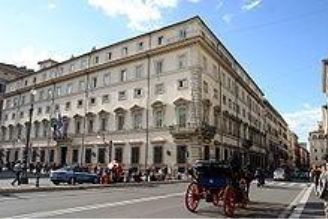
While the prime minister, de facto chief executive of the state is appointed by the President of the Republic, he must have the official support (confidence) of Parliament to remain in office. During the Fascist regime the palazzo housed the Office of the Foreign Ministry whose head was Mussolini. He delivered his first major speeches from its balcony until he moved his headquarters to Palazzo Venezia.

Giacomo della Porta designed the Palazzo Ferrajoli in the 16th century where, in the early 19th century, Cardinal Fesch, the uncle of Napoleon Bonaparte resided.

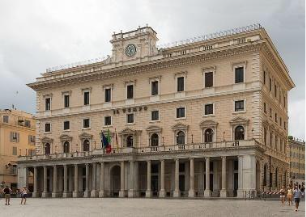
Palazzo Wedekind, a 17th century palace built over the ancient Temple of Marcus Aurelius and later re-designed in the 19th by Giuseppe Valadier. Sixteen Ionic columns transported from the Etruscan city of Veii conquered by Romans in the 4th BC make up its colonnade. Since its construction, it has served many purposes, including that of a papal post office and, in the mid-1940’s, it became the first office of the National Fascist Party in the City.
The fountain of the piazza, designed by Giacomo dell Porta and commissioned by Pope Gregory XIII in the 16th century, delivered potable water from the Aqua Vergine to the residents of area. Its original pink, Greek, marble basin, repaired by Bernini in the 17th century, was damaged in the 19th century and replaced by the current one with the addition of dolphins and seashells.
