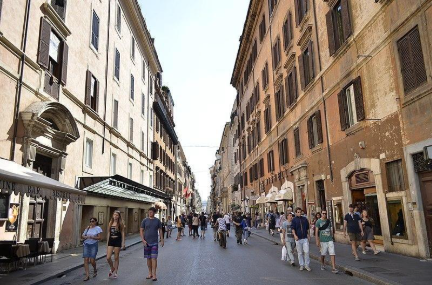
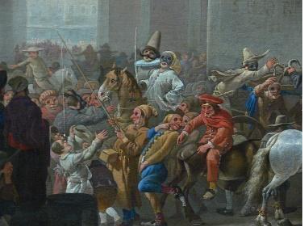
In antiquity the Via del Corso did not yet exist. Instead, the Via Flaminia began at the foot of the Capitoline Hill and and ran North towards the Milvian Bridge. During the Middle Ages this same road became known as the Vita Lata (wide) because of its great breadth. From the 15th to the late 19th century the Via Lata served as the center for the City’s hugely popular, pre-Lenten, 10 day, Carnival, activities (Mardi Gras). These focused on races of diverse kinds: horse races, some with riders, other riderless; donkey races; buffalo races, foot races by individuals or groups of boys and men of different ages, and float parades. During the 15th century reign of Pope Paul II (Barbo) it became known as the Via del Corso in honor of these annual Carnival races conducted up till the late 19th century.
The road stretches for one mile in a straight line from Piazza Venezia to Piazza del Popolo. In the Imperial age many triumphal arches, now buried or lost, lined this major thoroughfare through the City: those of Claudius, Marcus Aurelius, Domitian and Gordian. Balconies for spectators of the races became a common feature of many buildings along the route and along it several Renaissance palaces appeared: Palazzo Colonna di Sciarra, Palazzo Chigi (residence of the Prime Minister), and Palazzo Specchi.

Close to Piazza Venezia lies the Church of Santa Maria in Lata which houses in a crypt the tombs of several members of Napoleon’s relatives. The church now rests upon the foundations of the guardhouse attached to the Saepta Julia, constructed by Julius Caesar in the 1st century as the place where Plebeians assembled to cast their votes. This large porticoed structure spread over an immense space stretching from the area of the Pantheon to to Via Flaminia (the present Via del Corso). Legend has it that the guardhouse served as the place of St. Paul’s imprisonment before his execution around 65 AD at Aquae Salviae outside the City walls.

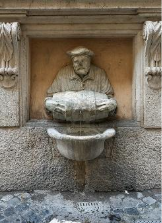
On a side street (current Via Lata) which runs along the side of the church stands a very old City fountain and one of its five ‘talking Roman statues’. Il Facchino (porter), stood once on the Via del Corso as a monument to Abbondio Rizi, a 16th century porter (aquarolo), famous in his day for the amount of weight he could carry, and head of their guild (corporazione) which commissioned it. For a long time many, erroneously, believed that it was a caricature of Martin Luther, which explains the damage done by stones to his face. Only in the 19th century was it moved to this side street.
On the other side of the street stands the Church of San Marcello whose architects included the Fontanas, Carlo and Domenico. From its façade hung the body of Cola di Rienzo before its incineration outside the Mausoleum of Augustus. Cola rose to the City’s mid-14th century office of Tribune, Senator, and dictator. After a failed attempt to unify Italy’s city states, the City’s aristocracy and populace finally turned against him and slew him at the Capitoline Hill in 1354.

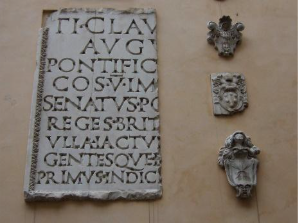
Down the street, located near the corner of the Corso and the Piazza San Lorenzo in Lucina, and buried under the road, remains virtually intact the Triumphal Arch of Claudius, completely covered over by the debris of the past. It was discovered in 1641 during the papacy of Urban VIII, stripped of its friezes, inscription and the medallion of the emperor (now in the Vatican Museums) and then filled over again where it still rests.