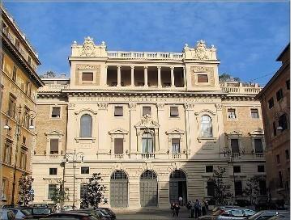
A small, now almost indistinguishable, Piazza Santi Apostoli, lying in the shadow of Piazza Venezia, once served as the neighborhood of members of the City’s most distinguished families: the Colonna, della Rovere, Odescalchi, Guglielmi and Stuarts (former British royal house). At its center stands the Basilica Santi Apostoli.
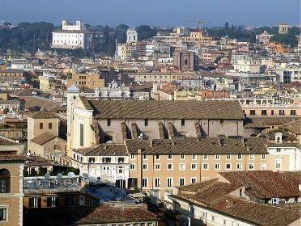
Origins of the basilica date back possibly to the papacy of Julius I in the 4th century and to an earlier church dedicated to the Apostles James and Philip by Pope Pelagius in the 6th century. It served the Colonna family in the 15th century as their chapel after its restoration by Pope Martin V, one of their number. At the end of that same century, the Riario and the della Rovere families became its patrons. Cardinal Guliano della Rovere (Pope Julius II) built the portico, added the palace attached to the church, and, in the 16th century, rededicated the basilica to the Twelve Apostles. The current version of the church represents an early 18th century reconstruction which left intact only the exterior portico and interior crypt.
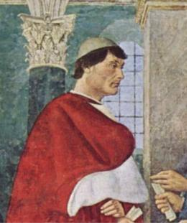
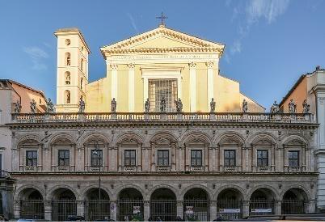
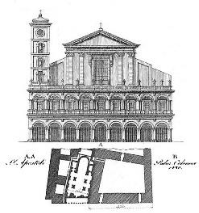
Quite unusually, the basilica’s facade has the appearance of a palace rather than a church, and it combines a mixture of distinctively diverse styles: Renaissance in the double loggia and arches (1502 ca); Baroque in the windows (1665); and Neo-Classical in the upper façade (1827).
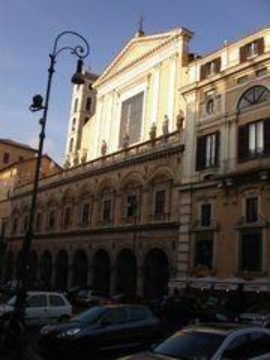
The campanile with its five stories rises over the near end of the left aisle.
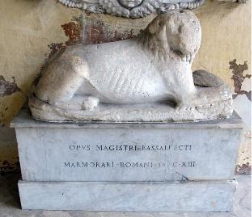
Fragments from the mediaeval church in Baccio Pontelli’s late 15th century the portico include a 2nd century AD Roman bas-relief of an eagle recovered from Trajan’s Forum and donated by Cardinal della Rovere before he was elected pope, Julius II; a 12th century stone lion by Pietro Vasselletto; a pair of 12th century red marble lions flanking the doorway; and to the left of the entrance, a neo-Classical memorial executed by Antonio Canova in the early 19th century.
The Renaissance loggia showcases two stories with matching arches designed by Baccio Pontelli. Above the loggia perches a balustrade with statues of Christ and the 12 apostles. On the pedestals of each apostle written letters appear (FLDLCSOTCECVB), an inscription with reference to the donor of the statues: Frater Laurentius De Laureolo Consulta Sancti Officii Theologus Cardinalis Episcopus Custos Vaticanae Bibliotecae (Brother Laurence of Laureolus, Consultant of the Holy Office, Theologian, Cardinal Bishop, Guardian of the Vatican Library. Giuseppe Valadier in 1827 added the upper, neoclassical, pale orange façade.
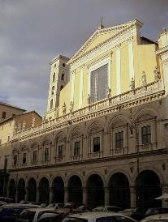
Carlo and Francesco Fontana designed the church.
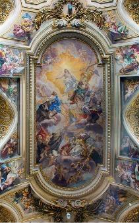
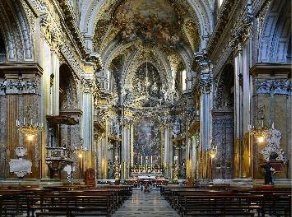
Its Baroque interior glows rich in colors of white and gold accentuated by its wide nave, three arcaded piers, and a barrel- vaulted ceiling.

In the center of the vault Bacciccia (Giiovan Battista Gaulli) painted the
fresco depicting the triumph of the Franciscan Order (OFM).
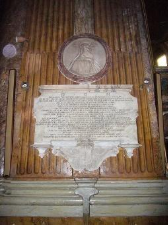
The wall tomb of Cardinal Basil Bessarion lies on the 2nd pillar on the left aisle, containing portrait in red marble relief with a fulsome epitaph below.
Besarion represents the highest level of Renaissance humanist scholarship and played a major role at the 1438 Council of Ferrara, a protagonist for the re-union of the Greek Orthodox and Roman Catholic Churches.
The second pier on the right side of the nave supports a monument containing the heart of Maria Clementina Sobieska, wife of James Stuart (“Old Pretender”), British royals who resided in the nearby Palazzo Muti (Balestra).
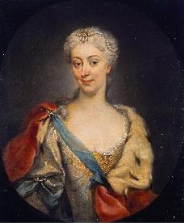
When her husband, former King James III, died in 1776, his body lay in state here for five days before his burial in St. Peter’s.

The black and white marble floor dates from the late 19th century. Above the triumphal arch of the apse appears an 18th century fresco depicting Rebel Angels Defeated by St. Michael. The high altar rests against the wall of the apse once decorated with frescoes painted by Melozzo da Forli in the 15th century but lost, however, in the latest renovation of the church. Fragments of the frescoes now reside in the Vatican Museum and the Quirinal Palace. The 18th century altarpiece in oil painted by Domenico Maria Muratori remains the largest painting of its kind in the City. It measures 65 feet by 32 feet and depicts the martyrdom of Saints Philip and James.
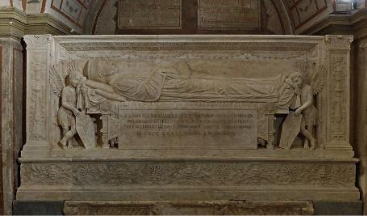
To the right of the high altar lies the tomb of Cardinal Raffaele Riario, one of Michelangelo’s earliest patrons in Rome (died 1521). Some art historians theorize that it is the work of Michelangelo himself. Early in his sculpting career in Florence, but before his works had gained him notoriety and profitability, the twenty-one-year-old Michelangelo carved the figure of a sleeping Cupid, disguising its age to make it seem ancient. With the help of a local art dealer, Cardinal Riario, an avid connoisseur of classical antiquities, purchased the forgery. When later he discovered the ruse, so impressed by was he by the artist’s skill that he allowed him to keep his share of the profits (while making the dealer return the rest). He invited him to the City where he could more readily find commissions for his artists skills. Within three years, commissioned by the French cardinal, Jean Bilheres, Michelangelo sculpted the first of his many masterpieces, the Pieta. Thereafter, “Il Divino” never again lacked for patrons throughout his long and storied career.
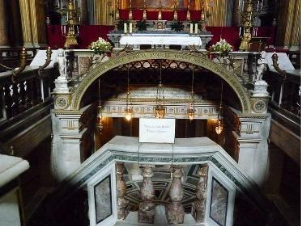
19th century excavations under the altar uncovered the relics of Saints James and Philip in their original 6th century resting place. Their relics now rest in a marble sarcophagus in the confessio (crypt) created to house them.
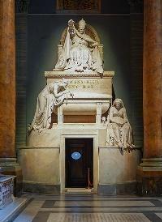
The tomb of Pope Clement XIV stands in the last chapel on the left side. This pope made the decision to suppress the Jesuit Order in 1773 (restored in 1814). His neo-classical tomb executed by Antonio Canova depicts the pope seated on a granite throne with allegorical figures of Temperance and Clemency on either side.
The nearby Piazza della Pilotta hosts the Pontifical Gregorian University, Rome’s most prestigious Catholic university conducted by the Jesuits.
Coincidence or supreme irony?