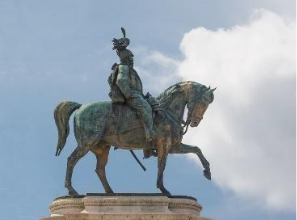
Italy’s largest civic monument, the Victor Emmanuel II National Monument (Vittoriano), visibly and dramatically imposes itself on the northern side of the Capitoline Hill next to the Church of Santa Maria in Aracoelii. This national monument stands in the center of the City overlooking Piazza Venezia. Constructed between 1885 and 1935 and designed by Giuseppe Sacconi, it celebrates the unification of Italy achieved by the seizure of Rome in 1870, pays tribute to the role of Victor Emmanuel as Father of the Fatherland, symbolizes national patriotism, and represents the civil and secular counterpart to St. Peter’s Basilica whose size, grandiosity, and visibility it very intentionally and ostentatiously reflects. Neoclassical in style, within its several levels appear the equestrian statue of Victor Emmanuel, Altar of the Fatherland, altar to the goddess Roma, the Tomb of the Unknown Soldier and the Eternal Flame.
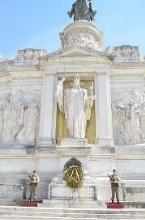
Its diverse features include stairways, Corinthian columns, two fountains (symbols of the 2 surrounding seas, (Tyrrhenian and Adriatic), bas reliefs of all the regions of Italy, the equestrian statue of King Victor Emmanuel II, (the largest monument in the world to a state leader),a portico, 16 statues representing the provinces of Italy, a statue of the goddess of victory on two chariots, the Museum of Italian Unification (Risorgimento), and terrace for visitors.
From the very beginning the monument aroused great controversy because of its size, ostentation, and the off-setting bright white color of its Brescian marble. Quickly, it acquired nicknames such as “wedding cake”, “typewriter” and “the dentures”.

At the base of the monument once marked the starting point of the Via Flaminia, an important ancient consular road leading from Rome northward to Rimini on the Adriatic coast.
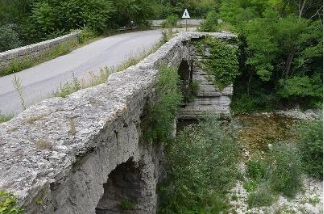
Along its path just outside the City, Constantine experienced his famous vision of the Cross in the sky which resulted in his conversion to Christianity and ultimately to the Christianization of the Roman Empire.
Constructed in the 3rd century, it opened to the north at the Porta del Popolo and by way of the Via Lata (modern Via del Corso) del Corso connected to the base of the Capitoline Hill where the Victor
Emmanuel II monument stands today. Roman Carnival racehorses finished their races at this spot.

Two of its original Via Flaminia milestones, the major Roman to the north, decorate the balustrade of the Capitoline Hill.
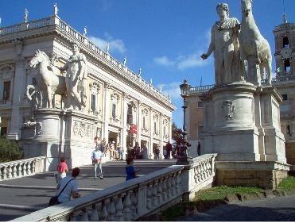
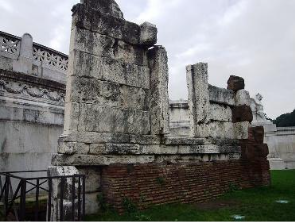
In the grassy area on the left of the base of the Victor Emmanuel II Monument remains the highly unusual fragment of the Tomb of Gaius Publicius Bibulus, a 3rd century BC plebeian aedile who by an exceptional Senate decree was permitted burial within the confines of the city walls. It once stood on the east side of the Via Flaminia outside of the Porta Fontinalis, the edge of the Roman boundary line.