
People inhabited this imposing hill during the Bronze Age (1300 BC) long before the City’s foundation because of its strategic location: an elevated space, easily fortified, looking over Forum Valley (East) and the Tiber River (South). Until the 6th century BC the hill had the name Mons Saturnus in honor of the mythological god Saturn who, with his sister and consort Ops, ushered in a Golden Age of order and plenty in pre-historical times.
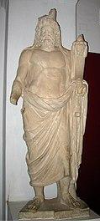
The ideal version of Roman state embraced two essential components: the element of imperial rule (imperium), dominion over the world, and constitutional rule (Res Publica), government of the Senate and Roman people (SPQR). Whereas the Palatine best symbolizes the former, it is the Capitoline which does so for the latter.

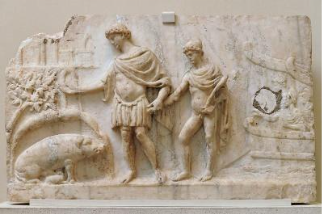
Though the smallest, the Capitoline (Mons Capitolinus), one of Rome’s legendary seven Hills (Palatine, Capitoline, Aventine, Quirinal, Esquiline, Viminal, Caelian), stands out as the most important of all seven, particularly during the monarchical and republican phases of the City. Its great significance derives from its three practical and symbolic functions essential to civic life: military (Arx), religious (Capitoline Triad), administrative (Tabularium). Throughout its Roman history, this hill symbolized the essence of the state itself, its very purpose and divinely ordained destiny. As in other parts of the City, the Capitoline constitutes a palimpsest, many levels of historic structures lying on top of one another and moving backward in time. Its origins tie it inextricably to the legendary tale of the Trojan prince Aeneas and his son Ascanius who, after the destruction of the city of Troy, a colony of Greece in Asia Minor, landed on the shore of Latium. Their descendants, Romulus and Remus, ultimately founded the City of Rome.
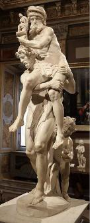
Romans believed that under Jupiter’s protection their destiny, divinely guaranteed, would prevail, and their religious center would survive all trials and tribulations. The Latin word, Capitolium, from which the English word, capitol, derives, originally referred to this grand temple of Jupiter and only later applied to the entire hill. Because Romans believed that Jupiter represented the source of their military and political success, no other temple in the City exceeded it in size, setting, and decoration.

Latins on the Palatine Hill and the Sabines on the Quirinal fought for control over the Capitoline. During a successful, 6th century military campaign against the Sabines, the Roman king, Tarquinius Priscus, vowed its construction. Legend has it that he consulted augurs to determine the location most favorable to the gods. The augurs learned that all but two of the divinities consented to its placement on crest of the hill and interpreted as good omens the dissent of the gods, Terminus, god of boundaries, and Iuventas, goddess of young men. No cause, they agreed, could ever suffice to move the boundaries of the City or to impair its youthfulness and so the king incorporated shrines to these gods into the temple precinct.
The first stone temple in the City, stuccoed and whitewashed, rose, preeminent among all others in scale and adornments (sculptures by Vulca of Veii and Lisyppus of Greece). So colossal was the figure of Jupiter in his chariot set on the temple gable that it was visible from the Alban Hills, 12 miles away.
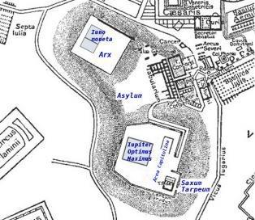
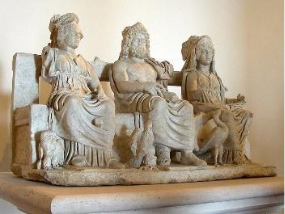
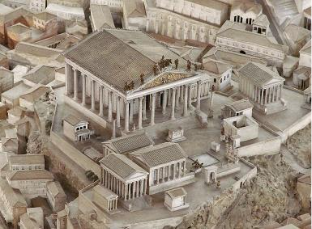
Standing one hundred feet and covering an area half the size of a football field, this huge temple stood on a podium within a walled enclosure containing other shrines and altars and, as well, the colossal statue of Jupiter and two bronze statues of Hercules including one designed by the Greek sculptor, Lyissipus, seized from Greek colony of Tarentum in southern Italy. Enclosed within a portico (pronaos) with six columns on each side, three rows deep, the temple housed three cells, the middle and largest one dedicated to Jupiter, with those of Juno on the left side and Minerva on the right, all of whom constituted thereafter the Capitoline Triad. The sides and door of the shrine, gilded with gold, shone like the sun, so much so that the entire hill became known as the ‘Capitolium Refulgens’ (shining-light hill). The basic form of the temple consisted in a modified version (Tuscan) of a Greek Doric temple which the Romans never changed throughout time, despite its many subsequent iterations.
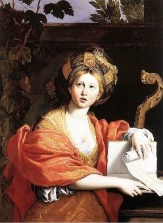
According to legend, the Temple housed statues, each representing all peoples under Roman control, the ‘salvatio civium’ (City’s salvation). Inscribed on their chests were the names of each country and hanging from their necks, small bells. Priests guarded the statues night and day and when the bells rang, temple officials informed the Senate which would send out an army to crush the rebellion (Mirabilia Urbis Romae). Among the many treasures maintained in the Temple and entrusted to the Capitoline Triad were the Sibylline Books. Sibyls were priestesses of Apollo one of whose several shrines was a cave at the Bay of Naples. These soothsayers possessed prophetic powers and their utterances, made in riddles and cryptic sayings, were recorded in sacred books.
Of the many temples in the City, this was the most richly endowed. It overflowed with offerings made by Consuls and Emperors, and it sheltered the assets of the government. Rebuilt many times (83 BC, 69 BC, and 80 AD) because of fires, it always emerged more grandiose than before, making it the symbol, par excellence, of the power and majesty of the invincible Roman state.
During its construction diggers unearthed the bloody head of a man. Roman priests summoned an Etruscan augur to interpret its meaning. He replied prophetically that the City would one day rule over the entire Italian peninsula. In myth, Roman destiny from the beginning was to rule over and bring civilization to the whole world. In Virgil’s account, the Cumaean Sibyl prophesied the fulfillment of the City’s divine mission beginning with the reign of Augustus and progeny (“tu regere imperio populos romane memento”).

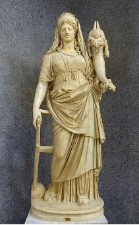
Historians today still speculate as to the exact causes of the City’s spectacular success. Many point to the unique character of the Roman people tied historically to qualities connected to their pastoral origins (tenacity, courage, love of the soil and simple pleasures, appreciation of manual labor, desire for orderliness and structure, optimism, fun-loving dispositions, respect for tradition, and reverence of the divine). All combined, these tended to breed good and loyal soldiers together with a capable and talented class of leaders and administrators. Add to these opportunity and more than just a dose good luck (Dea Fortuna) depicted
always as blind), and the future can be open-ended for those who seize it.
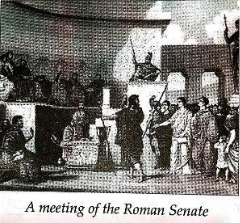
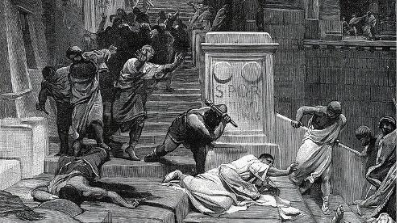
At the Temple of Jupiter, the first annual meeting of the Senate took place, where new members of the Senate swore their oath of office. As well, it served as the temple where victorious generals received their imperium (command) and offered sacrifice to the gods at the end of their Triumphal March into the City. Afterwards guards executed their royal captives in the Mamertine prison below the hill. Here, on the hill in 131 BC, the senatorial class murdered the City’s first real political reformer and Tribune, Tiberius Gracchus, a political assassination that did not bode well for the future of the republican constitution.
The hill’s strategic position together with the steepness of its slopes made it
a natural bulwark against attacks from outsiders.
Part of it, the Arx, a walled citadel on the north side of the hill, protected its citizens as the last point of retreat in times of war. Because of its clear view of the distant Alban Hills it also served as the place from which the Augurs of the City took watch to observe the flight of sacred birds. The middle ground between the Arx and the current Palazzo dei Conservatori was called the ‘inter duos lucus’, the place where Romulus established a sanctuary for foreign refugees in order to increase the population of his City.
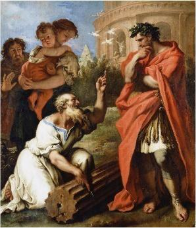
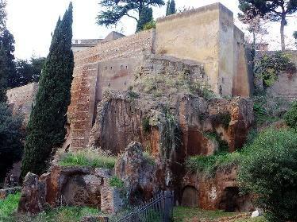
At the Arx during the Sabine conflict, Tarpeia, a Vestal virgin and daughter of the Roman commander, had betrayed the City and gave entry to the Sabines in exchange for the reward of a piece of jewelry. Instead, the Sabines crushed her to death with their metallic shields and tossed her body from the southern cliff of the hill.

Thereafter, the site, named after her, the Tarpeian Rock, rising 160 feet above the ground, became one of Rome’s places of execution for political crimes. The last person put to death at the site was Simon bar Gora, a Jewish insurrectionist and prisoner of the First Jewish-Roman War, executed during the reign of Emperor Vespasian in 71 AD.
When Gauls raided Rome in 390 BC, the Capitoline Arx remained the only section of the City safe from the barbarians. Alerted to the presence of the invaders by the honking of geese sacred to Juno at the nearby temple, Romans successfully defended the garrison. In popular language the temple became known as Juno Moneta (having been warned). The English word money originated from the Latin word ‘moneta’, associated with the mint and the warning of the geese. The mint, located in the vicinity of the temple, later moved to the Esquiline Hill area, its ancient
foundations resting now near a Mithraic shrine under San Clemente Basilica.
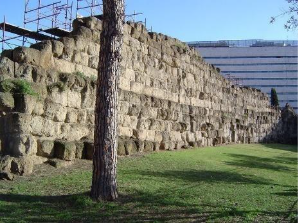
The Sack of the City by Gauls in 390 BC created among Romans a ‘crisis mentality’ which resulted in the construction of an extensive defensive wall in 387 BC (Servian), often misnamed and mistaken for the Servian Wall of the 6th century Etruscan King, Servilius Tullius. Remnants of these 4th century ramparts appear near the entrance of Stazione Termini. Once, seven miles in length, thity-four feet high, and twelve feet thick, they enclosed a City with one thousand acres of land and a population of fifty thousand people, which would grow even larger with the passage of time.
In the Middle Ages the original sacred function of the Capitoline devolved from its original religious purposes to purely political ones, when the civil government of the City came under papal control. Throughout most of the Middle Ages, until the mid-11th century, control of the City seesawed between the papacy and Byzantine government officials or the papacy and leading, local, aristocratic factions. In the 12th century, however, revolts by the aristocracy and populace turned against papal control. Arnold of Brescia, an Augustinian monk and prior, succeeded in 1144 in the restoration of the Senate of the Roman People and the creation of a new government, the Comune di Roma. A power struggle among the populace,
aristocracy, and papacy ensued, lasting for four decades, until a compromise was concluded in 1488. Papal sovereignty with authority to appoint the City prefect was recognized in exchange for papal recognition of municipal autonomy controlled by the Senate. The Comune, an autonomous republic under the papacy, survived until the end of the 14th century. Its history includes the construction of four new churches (San Bartolomeo on the Tiber Island), the repair of two bridges (Cestio), and the creation of two hospitals (Santo Spirito in the Borgo near St.Peter’s).

The oldest building on the Capitoline, the Tabularium, became home of this Medieval senate and even today the Palazzo Senatorio serves as Rome’s City Hall and office of the mayor. At its lowest level, the palazzo provides, as well, a passageway which connects the two Capitoline Museums, the Palazzo Nuovo and the Palazzo dei Conservatori.
As the only building on the Hill never destroyed by earthquake, fire, or plunder, it continues to link the contemporary City to its ancient Republican origins.

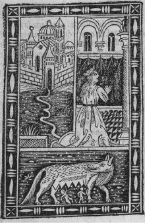
Below the steps leading to the mayor’s office on the left side of the Palazzo stands a column supporting a copy of the Etruscan bronze statue of the Capitoline Lupa whose original is in the Museum (Capitoline). The Lupa was the only animal sacred to the god, Mars. She came to the rescue of twins Romulus and Remus whom she found abandoned on the shores of the Tiber and suckled them until rescued by the shepherd, Faustulus, and wife, Acca Larentia.

Palazzo dei Conservatori, another civil government structure, built later, in the 13th century, rises over the site of the Jupiter Temple.
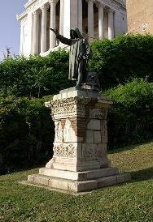
The Capitoline frequently enough became the scene of dramatic movements of political turbulence, such as Cola di Rienzo’s short-lived attempt to revive the Roman Republic in the 14th century during the Avignon Exile of the Papacy. As Tribune of Rome in 1348 he ordered the construction of the steps to Ara Coeli in thanksgiving for the City’s escape from the Black Death in the spring of that year. A bronze statue of Cola, erected by the Italian government in the 19th century, stands now in the grassy space between the Capitoline and the Church of the Ara Coeli where an angry Roman mob cut him down in 1354.
Many cities and states throughout the world have adopted animals as their symbolic representatives to the world at large. The Wolf and the Eagle serve as the City’s most ancient and visible examples. The She-Wolf suckled and nurtured the twins Romulus and Remus at the beginning of the City’s. Her image appears, virtually everywhere, on monuments, ancient and contemporary. For virtually a hundred years, two live wolves lived, caged on the Capitoline slope just a few yards away from the bronze statue of Cola di Rienzo. This practice ended in the early 1970’s when concerns over animal cruelty convinced the City government to remove them as well as that of the eagle maintained in a cage near the Teatro Marcello.
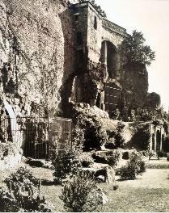
At the Capitoline in 1341 Francesco Petrarch received his poet-laureate crown. A prolific writer and poet, many regard him as the herald of the Renaissance. Attracted to City and its monumental ruins, he was its visitor five times in his lifetime, seeing in them an explicit connection to the history and literature of its ancient past. He was the among the first scholars to promote the need for serious study of Roman antiquity.

Here too 1764 Edward Gibbon received inspiration to write his renowned history book, The Decline and Fall of the Roman Empire.
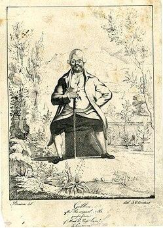
By the 16th century, however, diverse but decaying civic buildings surrounded the small piazza in the middle of the hill. It had become a meadow used for grazing goats and had acquired the name, Monte Caprino (the goat hill).
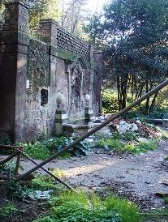
The Campidoglio represents not only the modern City’s first planned public square but, as well, architecturally, one of the most famous and beautiful metropolitan hubs in all the world. In anticipation of the 1538 visit of Emperor Charles V, Pope Paul II commissioned his architect Michelangelo to redesign the piazza and the surrounding palaces. The emperor had recently defeated Muslim forces in North Africa and the pope wished to fete him with a triumphal march to the Capitoline. During his two-day visit to the City, the emperor visited the Pantheon and was escorted to the roof and the top of the dome. As he leaned over the edge to peer at the floor below, one the papal officers in his entourage was suddenly seized with the violent impulse to push him into the abyss. The officer reportedly told his own father later that he did not understand ‘how I resisted the urge’.

Michelangelo’s design for the piazza and remodeling of the two surrounding (Palazzo Senatorio and Palazzo dei Conservatori) buildings reversed the classical orientation of the Capitoline toward the Forum.
Instead, he redirected it towards Papal Rome and St. Peter’s Basilica. The shape of the piazza seems square but is, actually, trapezoidal.
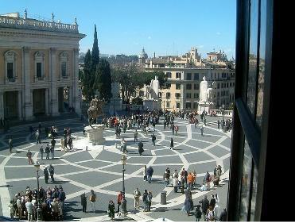
Its centerpiece remains the statue of Marcus Aurelius, the only perfectly intact, ancient, equestrian statue in the world. Symbolism pervades the sculpture. The gilded and oversized figure of the emperor astride the horse, the outstretched right hand, the lack of armor on a military leader, all serve to underscore the universality and benevolence of Roman imperial power. Set at the very center of the oval shaped center of the square, the statue symbolizes the shift of power from the Roman Forum, the umbilical center of the Republic and Empire, to its new Renaissance seat at the Capital.
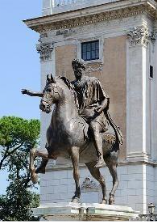
Michelangelo designed the simple but elegant pedestal which he carved from a huge block of marble from Trajan’s Baths. When Emperor Charles V first viewed the statue in 1536, he commanded it to speak. A Roman anecdote has it that when the gold coating on the statue is worn away, the work will come to an end. Some of its original gilding remains still. This famous sculpture, the prototype of later equestrian statues, survived destruction in early Christian history because Christians thought it erroneously a statue of Constantine, author of the Edict of Milan and first Christian Emperor. Its prominent status, however, did not always preserve it from abuse. In 1347 Cola di Rienzo, self-proclaimed Tribune of the City, used it as a prop during a banquet he hosted in the square when wine and water flowed from the nostrils of the horse.
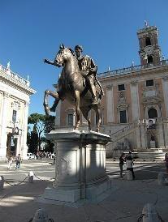
The bronze statue, now in the Piazza, is a very recent copy whose original stands (since 1990) in the nearby Palazzo dei Conservatori, a part of the Capitoline Museum.

Michelangelo’s pavement consists of herringbone lines with an oval in center. Only much later during the Mussolini regime was its star added. Interpretations about the symbolism of the patterns are numerous: astrological signs, the apostles, Twelve Tables of the Law, a shield, even an egg – all with allusions to the future.
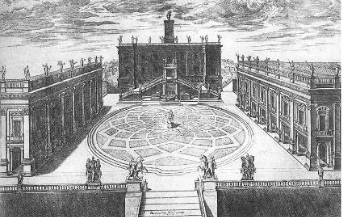
At the far end of the piazza and constructed over the remains of the Tabularium in the 13th century stands Palazzo Senatorio. The palace housed the Senate, an elected body responsible for the administration of justice. Around 1543 Michelangelo renovated it re-orienting the façade, moving the medieval campanile to the center, adding the double ramp staircase, and creating the setting below for the placement of the statues of the river gods, the Nile and the Tiber, both holding cornucopia, (looted from the ancient baths of Constantine on the Quirinal Hill) and in the center, in porphyry stone, the goddess Minerva (Dea Roma). Most of Michelangelo’s original design for the square was executed by over three hundred successive architects following his basic plan. The campanile (bell tower), nicknamed the ‘Patara”, rings a bell plundered from the city of Viterbo and until 1871 when Rome became capitol of the Italian state rung only at the death of a pope and at the beginning of each Carnival season and January 6.
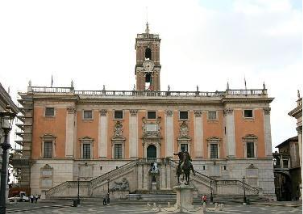
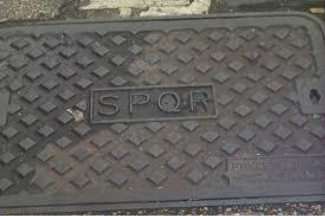
Today the palace serves as the seat of the City’s government and houses the offices of the mayor of Rome, the oldest existing city hall anywhere in the world. Its ancient cipher, SPQR (Senatus Populusque Romanus), turns up on government property throughout the City, emblazoned on signs, churches, fountains, drain covers, buses, and metro stations.
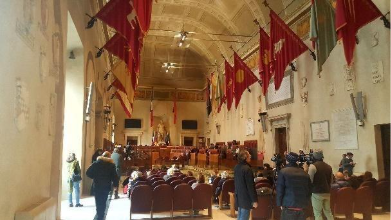
The City Council Room stands on the second floor and houses a Julius Caesar sculpture, the only extant ancient (Trajan era) statue of the dictator in the City.
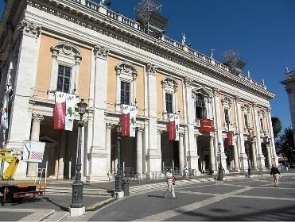
Palazzo dei Conservatori set over the remains of the Temple of Jupiter on the right side of the piazza appeared in the 13th century, constructed for the local magistrates (Conservatori). Michelangelo renovated the façade which he intended to complement the façade of a new building across from it, the Palazzo Nuovo.
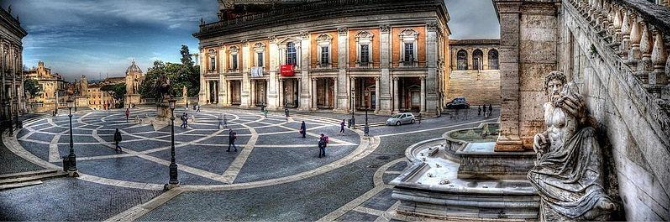
To complete the piazza’s symmetry and camouflage the tower of the Aracoeli, Michelangelo designed the Palazzo Nuovo (new), a replica of Palazzo dei Conservatori across the piazza. The newer palace, constructed in 1603, sits at an angle to its partner, producing a trapezoid shape. Its portico housed offices of various guilds where tribunes adjudicated business disputes.

The Palazzo Caffarelli-Clementino, an annex to the Palazzo dei Conservatori, appeared in the mid-16th century built from the remains of the Temple of Jupiter Maximus Optimus. The municipality hosts here short-term exhibitions.

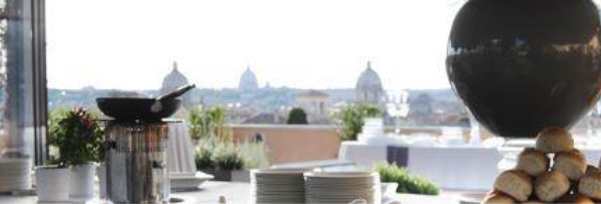
It houses, as well, a coffee bar on its terrace with a charming, panoramic view of the city.
Michelangelo’s wide-ramped stairway, the Cordonata, executed by the architect, Giacomo della Porta in 1578, gradually ascends to the Renaissance piazza above, in sharp contrast to the older and much steeper stairs leading to the adjacent Medieval Church of Santa Maria in Ara Coeli. The differences reflect well the spiritual and cultural changes which occurred in Western Europe over the course of 200 years. One staircase built in 1536 to celebrate the imperial visit of Charles V to the City symbolizes the Renaissance spirit of worldliness and the importance of the here and now. The other, constructed in 1348 during an epidemic of the Black Plague emphasizes the view that life is a wearying journey through a vale of tears. The Cordonata accommodates pedestrians and in the past, as well, horses and riders.
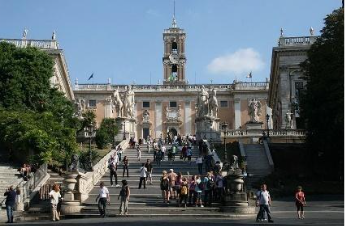
Despite the failed efforts of Michelangelo to transfer the sculptures of the Dioscuri Twins from the Quirinal Hill to the Capitoline, on the balustrade at the top of the stairs proudly stand statues of Castor and Pollux, twin protector deities of the City, sons of Zeus and Leda, and the brothers of Helen of Troy. They fought in the Latium War of 496 BC against the Etruscan king and allies and first announced victory of Romans to its citizens. At the top of the Cordonata remain two Milliaria, milestone markers (first and seventh), taken from the ancient Via Appia, the City’s first major road and great thoroughfare to the southern Italian port city of Brindisi.

Lying at the base of the railings stand two Egyptian lions in black basalt, 1886 copies of originals, and the Trophies of Marius, sculpted triumphant symbols of Emperor Domitian’s victories and relics from the Theater of Balbus nearby. At the right side of the Cordonata rises the Tre Pile Road, a 19th century carriage road that winds its way to the top of the hill behind the Palazzo dei Conservatori.

At the foot of the Cordonata remain ancient ruins of atop floor 2nd century AD Roman apartment house (insula), one of the few surviving in the City. Its five stories, shops, and parts of a Medieval church (San Biagio) with a belltower are visible today from the street. The lowest level now lies about eight feet below the ground. Most apartment houses like this had shops (tabernae) on the ground floor and on the floor above, a one room, one windowed, apartment where shop owners lived. Many shops specialized in ‘carry out’ food for apartment dwellers, most of whom lacked cooking facilities and running water in their quarters. Only the top floor of this structure was above ground in the Middle Ages when the structure was converted into the church, remnants of which are visible now.

Facing the Roman Forum at the base of the Capitoline Hill sits the ancient Mamertine prison located under the church of San Giuseppe dei Falegnami. The prison, the City’s first, and for many years its only one, includes two levels. The lower, 7th century BC, level (Tullianum) originated as a spring-fed, cistern (tullius) consisting of a small circular space (6.5’ x 30’ x 222’) carved out rock and tufa blocks held together with large iron clamps. The upper (Mamertine), created over the Tullianum in the 4th century BC, functioned as a retention center for criminals awaiting execution. A circular hole cut through the upper floor served as the only entrance to the Tullianum. This airless dungeon without any amenities, a dark, filthy, stench-filled place, was reserved for those condemned to death by strangulation or starvation. A metal door on one of its walls opened to the Cloaca Maxima where bodies could be tossed. Most prisoners were chained to rings embedded in its walls. Some, however, were laid out on the floor secured by their legs enclosed in stocks. A small number of captured foreign rulers waited here before being paraded in the conquering Roman general’s triumphal march through the City to the Capitoline Hill.

Except for Vercingetorix of Gaul, captured by Julius Caesar, and Jugurtha of Numidia, most of these sorts of prisoners died elsewhere.

In the Middle Ages the legend arose that the spring appeared miraculously at the time of St. Peter’s incarceration when he needed water to baptize his jailers.
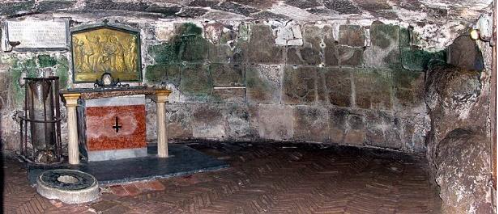
The pillar to which he was chained still stands next to the altar constructed by Christians to commemorate the event.

A marble marker inside lists the names of many of its famous prisoners including the apostles Peter and Paul and Simon bar-Giora, the last defender of the city of Jerusalem besieged by Romans in 70 AD.
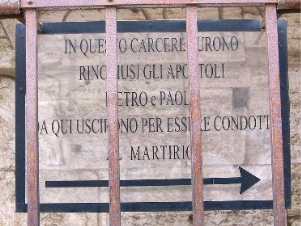
Political figures died here as well: Catiline’s co-conspirators in 63 BC and, in 31 AD, Sejanus, friend and ally of Emperor Tiberius.
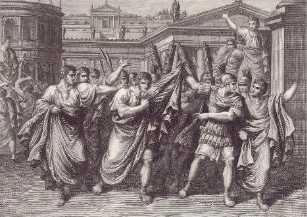
On the Gemonian Stairs (Stairway of Tears), steps outside of the prison leading from Capitoline summit to the dungeon, Romans placed the bodies of executed prisoners on public display, scavenged by dogs and wild animals, and eventually thrown into the Tiber.
