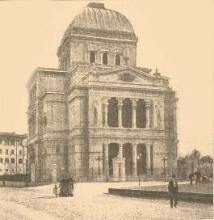
In the Imperial age there were fourteen synagogues in the City, ten in the Medieval period, five in the Ghetto and now only the Tempio Maggiore which unifies the Jewish community of the City. This unusual looking, modern, 20th century structure is located along the Lungotevere Cenci. The synagogue was constructed after the unification of Italy in 1870 when the Roman Ghetto was demolished, and the Jews given full rights of citizenship. Its architectural elements, designed by Osvaldo Armanni and Vincenzo Costa, are, symbolic of its historic, middle eastern beginnings, a combination of Assyrian, Babylonian, Egyptian and Greco-Roman forms.
When its construction was completed in 1904, the King of Italy attended its consecration and most recently it has been visited by Popes John Paul II, Benedict XVI and Francis.
Because the earliest (1492) of the City’s five medieval synagogues was that of the Spanish (Sephardic) rite, it was decided in 1932 to include in the building a small synagogue reserved for it. Some of its appointments were transferred from the older Cinque Scole. Rectangular in shape, at its center, sits the polychromatic marble aron (Torah scrolls chamber) from the Catalana Scole and opposite it, the marble tevah (reader’s platform), from the Cinque Scole. Pews on both sides of this synagogue look toward the center and face each other.

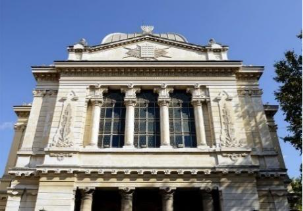
A large aluminum covered dome and square base give the synagogue an architecturally distinctive and unique structural style in the City.

The two-storied façade displays the Menorah set over the tympanum at the top containing the Tables of the Law.
On the first floor, the main temple space, long and rectangular, has a central nave and two smaller lateral sides. The Major Aron, a remnant from the Scola Nova, and the Torah from the Scola Castigliana, are located at the end of the nave in a polygonal apse. Beautiful stained glass windows, designed by Cesare Picchiarini and Duilio Cambellotti, fill the interior with light.

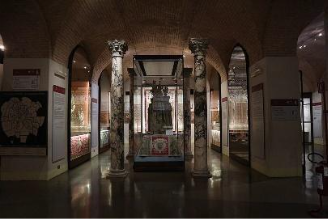
The underground floor houses the Jewish Museum which holds a collection of four hundred silver pieces, nine hundred textiles, one hundred marbles as well as documents and parchments which survived the Inquisition. The Synagogue, besides it’s worship space, house the offices of the City’s Chief Rabbi as well as cultural center for the Jewish community in the City (Communita Ebraica di Roma). Since 1982, when terrorists attacked the building during the Lebanon War, the Synagogue remains under continual police surveillance.