
Not the first of its kind in the City, this four-sided porch, however, remains highly novel in the story of the City’s architectural scheme. Augustus intended it, not merely as a functional pedestrian passageway, but more as an attractive multi-purpose complex to serve the leisure and entertainment needs of the general population. It represents the first large public structure in Rome made entirely of marble, contained three hundred columns, and covered an area one hundred thirty by one hundred forty-five yards. In its center stood two temples dedicated to Jupiter and to Juno. The Portico is an architectural novelty of its age, later often replicated in other parts of the City and Empire, twenty-five in Rome and fifteen in Campo Marzio. Although its origins go back to 146 BC when Quintus Cecelius Metellus constructed it as a portico for the nearby Circus Flaminius, it was reconstructed by Augustus in 23 BC and dedicated to his sister Octavia. mother of Marcellus, the presumed heir of the emperor. The Portico provided a pedestrian passage through multipurpose spaces (museum, two libraries (Latin and Greek), shops, amusements, and two temples (Juno Regina and later Jupiter Stator). Destroyed by fire in 191 AD, the Portico was restored and partially rebuilt in 203 A.D. by Septimius Severus to serve as a foyer for the Theater of Marcellus.
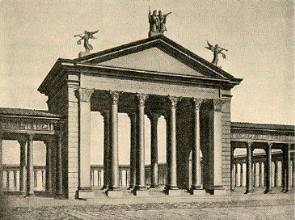
Despite its original grandeur and immense size (four hundred forty-five feet by three hundred seventy-five feet) and composition (three hundred columns), only the south-eastern corner and vestibule of the complex remain today, preserved, luckily, because of its use, from the Middle Ages to the 18th century, as a fish market.

In the 8th century, a church, Sant’ Angelo, was built on the structures of the Portico and nearby monuments. In the 12th century when the remains of the Portico were used as a fish market, the name of the church became Sant’Angelo in Pescheria. From this church on Pentecost in 1347, Cola di Rienzo marched forth to seize the Capitoline. On Saturday afternoons from 1584 until 1849 sermons were preached to the Jewish community of the Ghetto from this church.

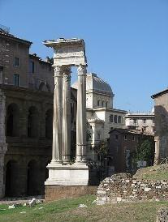
Remains of the Temple of Apollo Medicus are located near the Portico. It is one Rome’s first temples dedicated to Apollo and was built in 32 BC by the Roman general Gaius Sosius after a plague had struck the City.
Sosius, once a friend of Octavian, chose the side of Antony at the Battle of Actium in 31 BC and was defeated, though he was later pardoned when Octavian became Augustus in 12 BC.
The Circus Flaminius was once located in the area between the Portico Ottavia, theTiber Island, the Theater of Marcellus and the Via Arenula.

It was built by C. Flaminius Nepos around 220 BC. It was not a circus in the strict sense but, rather, a circular open area with no seats and used mainly for games, horse racing, public meetings, markets. Its best-known purpose, however, was as the assembly place and point of departure for Roman triumphs. Around its margins were built eleven victory temples. The area was abandoned in the 4th century such that in the Middle Ages the ruins at Piazza Navona were often mistakenly identified as the Circus Flaminius.

In the 16th century the Jewish Ghetto encompassed much of the former Circus Flaminius. In the 16th century the Jewish Ghetto encompassed much of the former Circus Flaminius. Today the Great Synagogue, constructed after the unification of Italy in 1870, stands in the area of its southern arena.
