
This unusual, colorful, and lovely small piazza consists of a block of five 16th and 17th century Carlo Maderno palaces on Via Funari, Via Michelangelo and Piazza Mattei.

The wealthy and powerful noble Mattei family created the Isolae Mattei, part of a complex of five palaces in the Ghetto beginning in the 14th century and yet another in Trastevere. The family was powerfully connected to the papacy for over three hundred years and controlled a significant part of the City along the banks of the Tiber. In the 16th century, although they lived in the Roman Ghetto, they held the keys to and controlled the gates of the enclave. Fontana delle Tartarughe remains the centerpiece of the piazza. Giacomo della Porta designed it in 1580 with a Renaissance style bowl, pedestal, and basin. After Gregory XIII restored Aqua Vergine (Agrippa) around 1583, officials had the incentive and means to construct this Fountain of the Four Turtles and many others like it throughout the City. Like Trevi Fountain and the Fountain of the Four Rivers in Piazza Navona, the same aqueduct (Aqua Vergine) feeds it. Because Muzio Mattei paid for its construction and maintenance, this fountain remains one of the few Roman fountains built by a private family.

One of the City’s first public fountains exhibits a Florentine influence visible in its highly decorated, dynamic, and delicate features. A long-held story holds that the fountain’s origins began with a young aristocrat, the fiancée of a Mattei family member. The Matteis called off marriage when the suitor’s family finances collapsed. As a farewell gift to his beloved, the suitor constructed the fountain in one single night. Impressed greatly by the gesture, the father of the erstwhile bride relented, and allowed the wedding to take place as planned. The boarded window which now overlooks the piazza commemorates his success.

Tadeo Landini added the four boys (ephebes) and eight dolphins and conches to the fountain in 1586.

Bernini replaced dolphins with turtles in 1658, a restoration necessitated by lack of sufficient water force to reach and flow from the dolphins. In 1979 thieves stole one of the turtles. Subsequently, the surviving turtles were replaced with copies and now reside in Capitoline Museum.

During World War II the fountain was disassembled for its protection and its pieces went missing. Fortunately, after the war, these were recovered in diverse antique shops and the fountain, mercifully, was restored.

Via della Reginella remains as one of the few roads of the Ghetto to survive intact to the present. Its name derives possibly from the ancient temple of Juno Regina located in this part of the City. The street runs from the Via del Portico di Ottavia on the Tiber side of the Ghetto to Piazza Mattei on the other side. The configuration of the street is characteristic of the narrowness of the roads which runs through the area where so many people once were forced to live. Pope Leo XI as late as the early 19th century added one of several gates to the Ghetto.

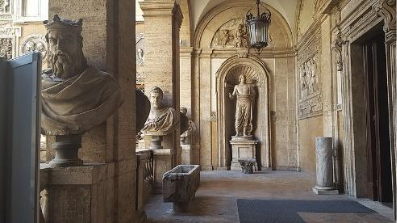
Carlo Maderno created the Palazzo Mattei di Giove, the most elaborate of the five palaces.

It remains one of few Roman palaces to retain all its ancient sculptures
because these were incorporated into its courtyard, stairs, and loggia.
Palazzo Mattei di Paganica, built around 1541 and named after a family fiefdom in the Kingdom of Naples, enjoys decorated Roman reliefs like its neighbor, Palazzo Mattei di Giove.

The Caetani family bought the complex from the Mattei in 18th century.

Caravaggio, the great early baroque artist, lived here for a short time (1601-1602) as a guest. In this palace he completed the Supper at Emmaus commissioned by the Ciriaco Mattei.

One of Italy’s most prominent political figures of the 1960’s and 70’s, Aldo Moro, Prime Minister of Italy for five terms and head of the powerful Christian Democrat Party, was kidnapped enroute to the Parliament on March 16,1978 and had captive by the terrorist group, the Red Brigade, for fifty-five days.

On May 9 his body, riddled with bullets, was discovered in the back of a car on Via Michelangelo Caetani, near Palazzo Mattei di Giove. A bronze portrait plaque of him hangs now on the wall diagonally across the street from the palace.
