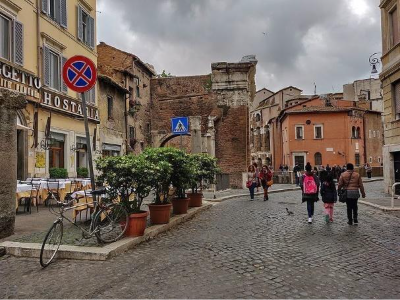
The origins of the City’s Jewish population extend back to the second century of the Republic when some migrated from Alexandria in Egypt for commercial reasons. Others arrived after Judas Maccabeus led a Jewish revolt in 167 BC against the Seleucid rule over Judea followed by a treaty with the Roman Republic in 161 BC. After the Jewish Revolt against the Republic (63-135 AD) and the destruction of the Temple in Jerusalem in 70 AD, many Jews were brought to the City as slaves, a large number to work on the construction of the Colosseum. In its early history the Jewish community were clustered across the river in the Trastevere area. The larger community was made up of merchants, freemen and former Palestinian slaves. Julius Caesar and Augustus allowed Jews to observe the Sabbath and, as well, exempted them from military service and taxes owed to Roman deities. Caesar especially favored the Jewish community. In one of his military campaigns, 1500 Jewish soldiers came to his support in an especially difficult moment, a debt to them he never forgot. The Jewish population rose to as many as 40,000 in the Early Imperial period.
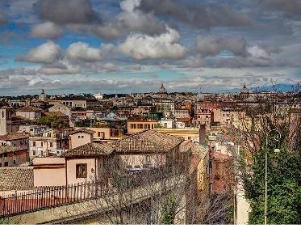
Throughout most of imperial and medieval history relations between the Jewish community and general population were peaceful and remained so until the 16th century Counter-Reformation movement. The City’s Ghetto, the oldest in the world, came into existence officially because of a papal bull of 1555 (Cum nimis absurdum) issued by Pope Paul IV in July 1555, and published as a reaction to Protestant Reformation (Counter-Reformation). It legalized the ghetto, an official form of segregation, and enclosed the Jewish population within an 8 acre-walled space containing only 130 houses with 3 ports of entry (Porta Rua, Porta Pescheria, and the gate at Piazza Guidea). It placed many restrictions upon the Jewish population: a strict curfew under lock and key (6:00 PM until 6:00 AM), no Jewish wholesale stores; no medical treatment of Christians by Jewish doctors, and many more. Eventually the entire Jewish community was moved into this medieval section of the City across from Trastevere.

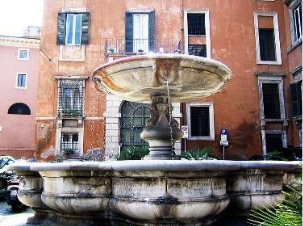
During the reign of Pope Sixtus V (1585-1590) the area was enlarged by the addition of two gates. During the papacy of Leo XII (1823-1829) three other gates were opened. Two years after his election in 1846, Pius X ordered the opening of all eight gates to the Ghetto together with the destruction of its walls. Via Reginella is all that remains today of the 1555 Ghetto even though it did not really become a part of the Ghetto until 1825 when Pope Leo ordered its enlargement because of growing numbers of its inhabitants. The Fontana del Pianto, once the Ghetto’s only source of water, was located outside of the gates of the earliest Ghetto and thus inaccessible to its residents once its gates were locked at sunset. It was located at the crossroads between Via del Portico Ottavia and Piazza Maria del Pianto. After the Ghetto was closed, the fountain was moved to Piazza Cinque Scole where it remains today.
Jews were required to wear yellow hats, to sell their properties to Christians, to engage only in certain types of work (scrap iron and old clothes), to observe hours of curfew, to pay for their own guards, to listen to weekly compulsory sermons preached by local priests who hoped to convert them in churches such as Sant’Angelo in Pescheria.

In Piazza Costaguti stands a small semi-circular shrine, the Tempietto del Carmelo. Attached to the House of Lorenzo Manilio, the Tempietto was originally constructed in the mid-18th century to shelter a local devotional image of Santa Maria del Carmine. This was one of the sites where Jews were forced to gather and listen to sermons urging their conversion to Christianity.

To the left of it is the Vicolo Costaguti, a narrow passageway, leading into a small courtyard which presently has no exit. When the ghetto was in full operation, however, this passageway was called Vicolo “In Publicolis”, (from the name of the nearby church). It led to a second, covered passageway at the opposite end and leads to the main thoroughfare, Via della Reginella. It was through these that many escaped the Jewish round-up organized by Nazis on October 16, 1943.
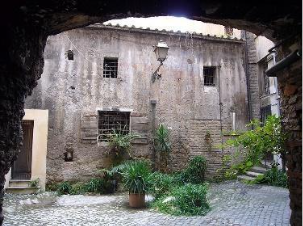
The gates of the Ghetto (three initially and later eight) were guarded and open and closed at fixed hours.
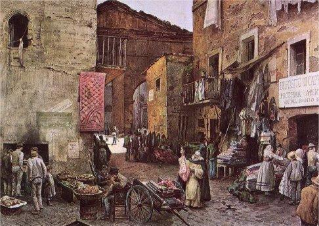
Although the walls of the Ghetto were torn down in 1848 by order of Pope Pius IX, the Jews were required to stay in the zone until 1870 (end of papal rule in the City) when all legal restrictions were removed by the new Italian government and the Jewish population was given full rights of Italian citizenship. By 1885 most (ninety percent) of the old buildings were torn down and replaced. The only street that remains intact from the Ghetto period is the Via della Reginella.
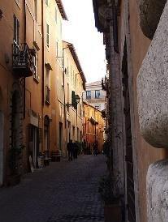
German Nazis raided the Ghetto in 1943 where the Jewish population numbered thirteen thousand, rounded up over a thousand, and housed them temporarily at the Military College near the Vatican. One thousand twenty-two of these men, women and 200 children, were transported from the Tiburtina Train Station to the gas chambers of Auschwitz, the infamous Polish concentration camp, where virtually all, except sixteen children and one woman, mercilessly lost their lives.

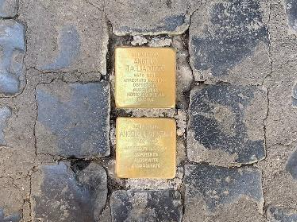
Today bronze plaques embedded in the streets in front of the houses from which Jews were seized commemorate individually these many victims of the Holocaust. The markers are called Stolpersteine (“stumbling stones”) and on each is engraved the name of the victim, birthdate, and the place and date of their deaths. These stones reflect the Jewish belief in the importance of remembering the names of those who have died.