Pliny, an early Roman historian, regarded the the Cloaca Maxima as the City’s ‘greatest achievement’ because it enabled it to transform itself from a modest hill town to a genuine city. In a very real sense it can be said that Roman history commenced with the construction of the Cloaca. It began as a drainage ditch dug through the Forum in the sixth century BC King Tarquinius Priscus. Dedicated Venus Cloacina, the goddess of life and purification, a shrine in her honor stood near the Basilica Aemelia in the heart of the Roman Forum. The Cloaca served originally as a series of open channels carrying the Forum’s wastewater to the nearby Tiber River until covered over, four hundred years later.
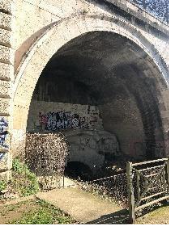
Much of the Cloaca was reconstructed and enlarged by Agrippa during the reign of Emperor Augustus and soon thereafter it was connected to the aqueduct system of the entire City. Parts of the sewer were made from different kinds of stone, such as peperino and concrete and tufa.
Manholes covered the sewer lines placed a few yards apart and decorated with marble reliefs.
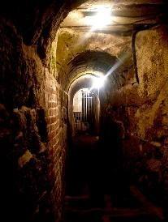
The City’s aqueducts fed into the sewers after supplying many of its public baths (terme) as well as the public fountains, palaces, and private houses. This continuous supply of running water helped to flush away waste and cleared the sewers of obstructions. The Cloaca originally had some kind of religious significance. Shrines were placed over it such as the small sanctuary of Venus Cloacina, near the Basilica Aemelia in the Forum.
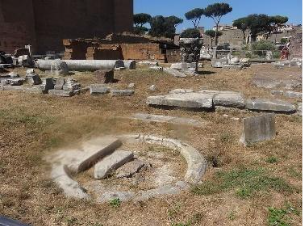
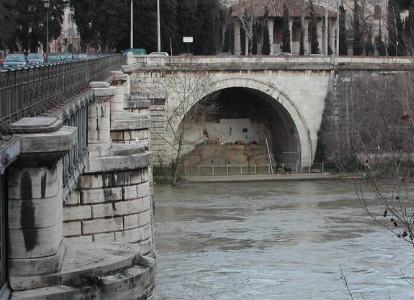
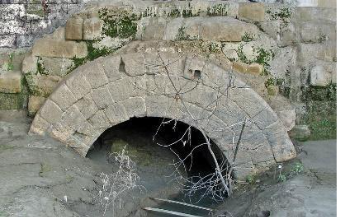
Occasionally and sacrilegiously, the Romans threw bodies into the sewers instead of giving them a proper burial as with Emperor Elagabulus in 222 AD. In recent times many passages have been connected to the City’s modern sewage system to prevent backflow from the Tiber. While today the Cloaca does not function at full capacity, it still drains some of the City’s street water into the Tiber. Parts of the system are visible today in places like the Velabro area. An arch made of tufa was built for the sewer’s mouth at the embankment of the river and is visible from the Tiber Island. In Imperial times, the mouth measured twelve feet in diameter, large enough contemporaries said, to ‘drive through it a wagon load of hay’.
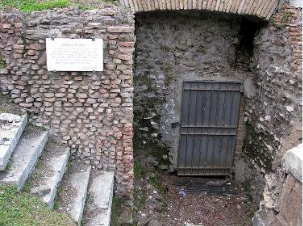
There are stairways leading to it next to the Basilica Julia and the Vicus Tuscus at the Forum. Some of it is also visible near the church of San Giorgio al Velabro behind the Capitoline and Palatine Hills.
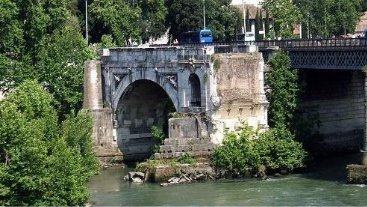
Not far from the Cloaca Maxima is the Ponte Rotto, remnants of the City’s oldest stone bridge built in the 2nd century BC to connect the Foro Boario to Trastevere. From it was tossed the body of emperor Heliogabulus (Marcus Aurelius Antoninus and cousin of his predecessor emperor Caracalla). After a short reign of four years he was assassinated in 222 AD at the age of twenty-two because of his incompetence as a ruler and his violation of traditional Roman religious taboos. Frequently damaged by floods over the course of centuries and many times repaired, much of it was washed away in two great floods in the 16th century and never again completely restored. Today only one arch of the original structure remains.