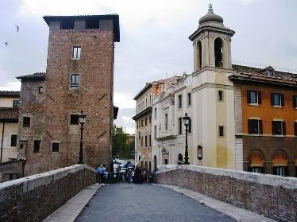
In the 10th century the powerful, aristocratic, Pierleoni family constructed a fortified residence on the Island. But, in 998 AD, the newly crowned Holy Roman Emperor Otto III arranged with the family to build a small church on it in honor of St. Adalbert of Prague, his recently martyred, bishop friend.
He constructed it on the foundations of the Temple of Aesculapius.

For about 100 years, beginning in the 11th century until 1124, this church became the cathedral of the diocese of Santa Rufina (Silva Candida). Santa Rufina bordered the City along the Via Aurelia and its boundary line included the Vatican, Trastevere, and the Tiber Island. When ninth century, Sarcen raids on the City drove the bishop of Rufina from his church in Caere, he established his cathedral on the Island. The Roman diocese incorporated these areas on the right bank of the Tiber in 1124, united the dioceses of Santa Rufina and Porto (at the mouth of the Tiber) and established the cathedral at the city of Caere (Cerveteri).
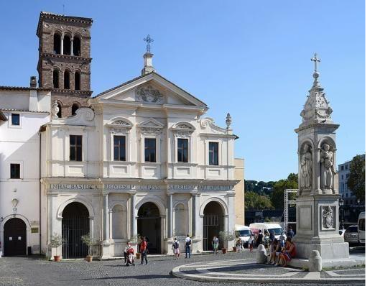
San Bartolomeo’s location in the middle of the powerful river has created flooding problems for the church many times over the centuries, the source of its multiple renovations over the years. Romans later dedicated the church to the apostle Bartholomew about whom the historical record provides scant information. Legend speaks of his martyrdom somewhere in the Near East, grotesquely flayed alive. In his Last Judgement fresco above the altar in the Sistine Chapel, Michelangelo immortalized Bartholomew by depicting him holding in his hands his own skin, but bearing the facial likeness of the artist himself. The Baroque façade and portico were later 17th century additions. Its portico has three doorways. A 12th century mosaic fragment of Christ rests above it, and behind, Romanesque campanile on the left side of the portico added in 1118.
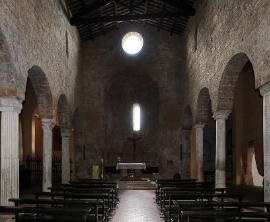
The church, spacious and lightsome, contains a nave with fourteen ancient marble columns of different types of Egyptian stone: alabaster, marble, granites of different colors. The bases of two of them (fifth on the left and right sides) probably removed from the Aesculapius Temple. A carved and painted ceiling dates from the early 17th century.

The floor of transept and sanctuary rises above the crypt below.
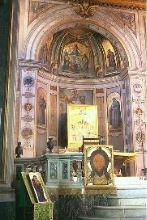
On the second step leading to the altar rests an 11th century wellhead covering a thirty-five foot deep well. The well, as old as the church, served as the focus of its structure right from the beginning. Presumably it came from the earlier Temple of Aesculapius. The wellhead made from the base drum of an ancient column displays four figures: Christ holding an open book, a bishop (St Paulinus or St Adalbert), Emperor Otto III holding an image of the church, and St Bartholomew.

Made from an imperial porphyry tub from the Baths of Caracalla, the altar contains the relics of St. Bartholomew with ring handles in relief and a lion’s mask on its front.

Imbedded in a wall rests an iron cannonball, fired from a cannon during the French siege of the city in 1849, when the Roman Republic was fighting for its life. It smashed through the outer wall of the chapel and landed on the top of altar. It was later inserted into the wall as testimony to a miraculous event. In a small glass reliquary is the arm of St. Adalbert displayed in a nearby chapel dedicated to him. In 2000, the Church was dedicated by Pope John Paul II in memory of 20th and 21st century martyrs. Side chapels display artifacts relating to these modern international Martyrs.

Attached to the church sits a building, once the convent of the church, but appropriated by the State in 1870. It served as a Jewish hospital until 1970 when, after restoration, it became a museum. In the center of the piazza in front of the church lie a 19th century stone monument, the guglia (spire), in the form of an aedicule with four niches containing statues of Saints Bartholomew, Francis of Assisi, Paulinus of Nola and John of God, the founder of the community now in charge of the hospital operating on the other side of the church. Pope Pius IX commissioned the monument to commemorate the First Vatican Council which began in 1869.
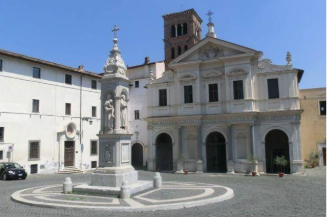
The 12th-century tower (Torre dei Caetani) near the church represents the only remains of the medieval, Pierleoni fortress.