In the very heart of the City remains one of its oldest churches, the Basilica of San Marco, originally constructed by Pope Mark in 336 A.D. and dedicated to St. Mark the Evangelist. According to ancient legend, St. Mark wrote his Gospel while living in a house on the Capitoline and established an oratory over which the alter church was built. In the 15th century, Pope Paul II (Barbo) renovated its 9th century iteration constructed by Pope Gregory IV to which, later, he added his magnificent, Renaissance Palazzo Venezia. This remained the papal residence until the middle of the 16th century. His architect, Leon Battista Alberti, regarded as the forerunner of Renaissance architecture, provided the church with its current second story loggia used for papal blessings, and the coffered ceiling, Cosmatesque floor, windows above the arcades, and the side chapels.

A Romanesque belltower (campanile) provides an interesting contrast to its Renaissance portico and loggia. The portico contains fragments and monuments from earlier versions of the church. The central door incorporates a 1446 relief of St. Mark the Evangelist by Isaia of Pisa.

The façade includes a portico with three arches.

The portico contains a variety of medieval artifacts. In the middle of the floor stands a 9th century wellhead carved out of an ancient column), its rim well-worn from the rubbing of ropes drawing its water. A Latin inscription on its base invites the faithful to share its waters but anathematizes those who take it to sell: (“Omnes sitientes, venite ad aquas et si quis de ista aqua pretio tulerit anathema sit”.)

Set into the right wall of the portico remain pieces of the defaced epitaph from the tomb of Vannozza dei Cattanei, relocated from the church of Santa Maria del Popolo. Cattanei, for many years the mistress of Pope Alexander VI, gave birth to their four, well-known, Borgia children: Caesare, Juan, and Lucretia and Goffredo.

In front of the entrance lays a pair of recumbent lions, symbols of the city of Venice, original home of the Barbos (Pope Paul II), patrons of the church.

The mid-15th century, coffered, wooden ceiling, one of the oldest in the City, consists of blue squares and gilded rosettes and, in its center, the coat of arms of the Barbo pope, Paul II.

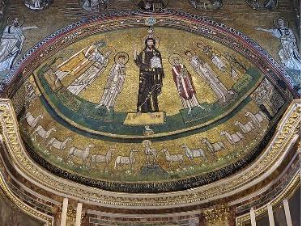
Inside the church, 9th century Byzantine-styled mosaics commissioned by Pope St. Gregory IV, adorn the sanctuary and are especially visible on the triumphal arch and apse. These depict the central figure of Christ as light, life, and resurrection. At his left side stand two popes associated with the church, Pope St. Mark whose hand rests on the shoulder of Pope Gregory IV (holding a model of the 9th century church) in a gesture of introduction: Gregory to Christ. Pope Gregory’s square halo indicates that he was alive when the mosaic was set.
Near the apse on the right aisle a set of stairs ascends to a neo- classical monument carved by Antonio Canova. It belongs to Leonardo Pesaro, sixteen-year-old son of Pietro Pesaro, Venetian Ambassador to the Papal States. The pair of lion faces carved on the plinth refers to the family connection to Venice.

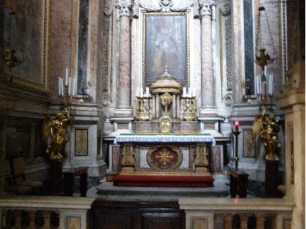
The remains of St. Mark the Pope rest in a porphyry urn under the main altar. Works of important artists such as Mino da Fiesole (sacristy fresco, St. Mark writing Gospel), Melozzo da Forli (sacristy altarpiece, Pope St. Mark)) and Antonio Canova (Pesaro monument) decorate the interior church.
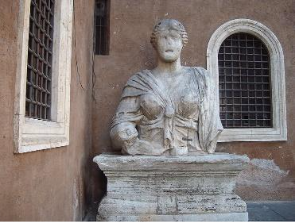
The bust of Madame Lucrezia, a fragment from the Temple of Isis Campense near the Pantheon, sits on the outside corner of church. Historians believe that the figure represents Isis herself and this because of her hair style, dress, and the amulet resting on her breast. The Madame achieved great renown as one of the City’s six famous talking statues (Pasquino, Abbate Luigi, Babuino, Marforio, Facchino), and the only female among them, who spoke frequently to the Capitoline’s Marforio and to Piazza Navona’s Pasquino figure. Originally, she sat on a pedestal but, in the late 18th century, vandals toppled her over and broke her into pieces to which, reportedly, she declared, ‘I’ve had enough’. Later restored, she now rests on a much shorter perch.