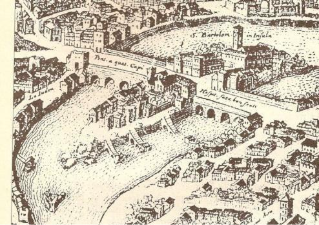
Strategically situated, the important Tiber Island sits in the middle of the river close to the Palatine Hill. The river’s powerful currents run dangerous and swift throughout its length, but the proximity of hills along its banks creates conditions allowing for the emergence of an island making a crossing possible. Downstream from it, the City’s earliest bridge (Pons Sublicius) spanned the river around 642 BC.

Although its location became a decisive factor for the establishment of the Roman colony on the Palatine, historians know very little about the island during the ancient period of Roman history. In 293 BC, however, after the City had suffered badly from a serious epidemic, an official embassy, at the urging of the Sibylline prophetess, travelled to Greece to ask help from the god of healing, Aesculapius, at his shrine in Epidaurus.

Greek mythology describes Aesculapius, son of Apollo and Coronis, as the god of medicine, instructed at an early age his father and others in the art of healing. A sacred snake he had encountered and whose life he had spared gifted him with knowledge of medicine and the power to restore life to the dead. Temples for his worship (Asclepia) spread across the Greek world. The most prominent of these arose at Epidaurus in southern Greece, on the island of Kos where the ‘father of medicine’ practiced, and at Pergamum in Asia. The ill ritually achieved healing through the offerings of sacrifice to the god, the priestly interpretation of dreams experienced by patients, and the application of therapies revealed in those dreams.
Aesculapian snakes played a prominent ritualistic role in the healing process.

Modern medical professions still employ the caduceus symbol of Aesculapius, winged snakes wrapped around a wooden staff. The caduceus, the staff associated with Aesculapius and the snake, became his constant companion. The Hippocratic oath which medical doctors still take, once began with an invocation to Apollo and Aesculapius.
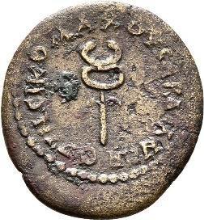
When a great plague struck the Roman populace in 289 BC Roman priests consulted the Sibylline Books whose oracle instructed them to bring the statue of Aesculapius from its home in Epidaurus to the City. Priests of Aesculapius gave the Roman visitors a sacred snake to take back to the City as a totem. When the ship approached the City, the snake escaped, slithered into the river, swam to the island and vanished. Romans saw this as a portent that Aesculapius desired that his temple be built on the island. The Temple of Aesculapius stood on the current site of the Church of San Bartolomeo. Emperor Augustus reshaped the island to regulate the flow of the Tiber and diminish its frequent flooding. He configured the entire island in marble to make it look like a ship. An obelisk was raised in its center to resemble a mast with the Temple serving as the stern. Parts of it (prow) remain visible today at the far end of the island near the Ponte Rotto in the form of Aesculapius’ symbol, the rod with an entwining snake.
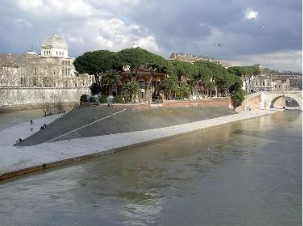
The porticoes around the Temple served as a hospital until the fall of the Empire in Rome. A hospital of some kind has remained continuously on the island right up to the present day. Its current iteration, the Fatebenefratelli Hospital, founded in the 16th century staffed by the Hospitaller Order of St. John of God stands directly across the San Bartolomeo church.
After the Nazis occupied Rome in 1943, they began to round up Jews for transport to concentration camps in Germany. The head of the hospital created a subterfuge to camouflage Jews hidden on the island. He tricked SS soldiers into believing that a highly contagious disease infested the island and succeeded in keeping them away even though Jews lived hidden among the wards, just a stone’s throw from the Ghetto.

Romans were the first ever to construct permanent bridges, a skill they acquired early on from Etruscan engineers. Their first bridge, the Pons Sublicius, a pontoon bridge constructed in the 6th century BC, consisted of a series of inter-connected boats strung across the river. Later they built wooden bridges, and in the 2nd century BC, around 150, Romans engineers created the first stone bridge, Pons Aemilius, whose remnants (Ponte Rotto) visibly protrude from the river downstream from the Tiber Island on its south side.

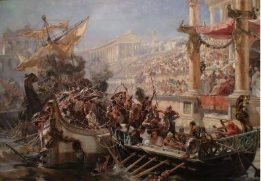
On the right bank of the river just below the Aemilian bridge, Julius Caesar carved out a huge basin filled with river water. He, and later, Augustus, sponsored on special occasions naumachia, spectacular mock naval battles involving the group combat of thousands of sailors aboard ships fitted for the occasion in a space as large as five football fields.
The Fabrician bridge, built in 62 BC by Lucius Fabricius, the curator of the roads and a member of the patrician Fabricii family, spans half of the Tiber and rests on two wide arches supported by a central pillar in the middle of the river. The Pons Fabricius, the City’s oldest extant bridge, has functioned uninterruptedly and unmodified, from its construction until today.

On the island towards the Ghetto side of the river, stands the 11th century Torre della Contessa, a medieval tower constructed by the Pierleoni to protect its river interests and defend the island which then constituted one of its several compounds in the City. The tower takes it name from Matilda, Countess of Tuscany, a close ally of Pope Gregory VII during the Investiture Controversy involving Emperor Henry IV of Germany. She resided there briefly in 1087 and in 1115 was buried in St. Peter’s, one of only six women entombed there. Later in the Middle Ages the tower became the property of aristocratic families: the Savelli in the 13th century and the Caetani in the 14th.

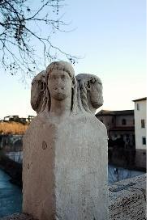
At the entrance of the bridge stand two marble posts with two-faced Janus herms (Quattro Capi) on each pillar giving rise to the alternative name sometimes used for the bridge, Ponte Quattro Capi.
The 1st century BC Pons Cestius connects the right bank of the Tiber to the middle of the Island where it joins the Ponte Fabricius. Romans replaced it in the 4th century with a new structure made of building material from the portico of the Theater of Marcellus. Over the centuries the bridge, restored several times, underwent a complete reconstruction in the 19th century. Only one third of the present structure contains material from the ancient bridge, its central arch.
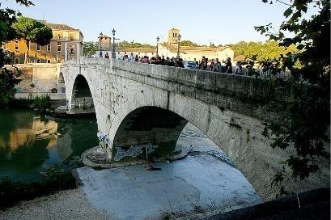
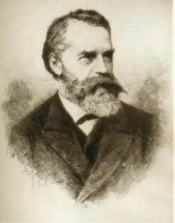
It was from this bridge in the 19th century that the German historian
Ferdinand Gregorovius was by his own account inspired to write his
multi-volume study of the City (The History of Rome in the Middle Ages), a monumental 16-year project for which he became the first German to be awarded an honorary citizen of the City.
During the Middle Ages a many (twenty) floating flourmills operated on the Tiber River. Five of these were docked along the banks of the Island and a chapel in the church of San Bartolomeo belonged to their confraternity until the 17th century. Well into the 19th century much of the City’s flour came from these mills.