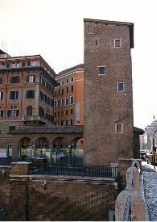
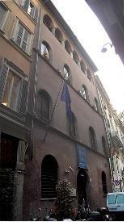
This unique and unusually situated, bustling, traffic-ridden, public square, Largo Argentina, located in the Campo Marzio area of the City, takes its name from the moniker, Argentinus, given to a 16th century resident, Johann Burchard, who built a palace nearby, the Casa del Burcardo, on the Via del Sudario (44). Burchard, a priest and bishop, gained great notoriety as a chronicler of the Renaissance papacy. He spent his entire career in service to the papal administrations of five popes from which he observed meticulously the most important events of the period. Burchard, an avid diary keeper whose writings now serve as primary sources for 15th century history and the papal courts of Popes Innocent VII and Alexander VI, continues to provide good color for those today researching and writing about the Renaissance City and papacy.
In 1927, after Benito Mussolini ordered the destruction of the 16th century church of San Nicola dei Caesarini, excavations unearthed four Republican temples, some of the City’s oldest ruins, and the remains of the Theater of Pompey, the site of Julius Caesar’ assassination during a meeting of the Senate held there.

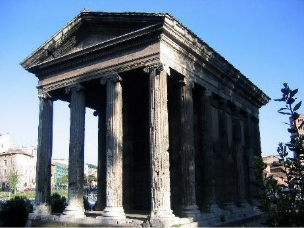
The four temples, designated by archeologists as A,B,C,D arose close to one another over the course of two centuries. Their floor levels vary, however, indicating differences in their respective ages. The general Gaius Lutatius Catullus after his victory over the Carthaginians in 241 the 3rd century BC, built the second oldest of the group, the Temple of Juturna (Temple A), in honor of the goddess of fountains. In the Middle Ages Christians converted it into a church (San Nicolo da Tolentino) whose apse remains visible even now as well as some fresco remnants. A circular temple (Temple B), the most recent of the four and dedicated to the goddess of good fortune, Fortuna Huiusce Dieie (daily luck), appeared in the late 2nd century. Six of its columns remain. The most ancient of the four temples (Temple C), dedicated to Feronia, an ancient goddess of fertility, dates to the 4th century BC. In the second century BC, M. Aemilius Lepidus constructed the largest of the temples clad in travertine(D), and dedicated it to the Lares, protectors of sailors. Parts of it remain buried still.

Many Republican temples arose as ‘victory temples’, created to fulfill vows made in times of battle by victorious Roman generals who constructed them in gratitude to the god who procured their successful campaigns. These temples followed typically Etruscan (Tuscan) models, set low to the ground with pediments supported by simple, tapered Doric columns. Made of volcanic stone material, Romans did not employ marble in temples until the mid-2nd century BC when they dedicated their first to the goddess, Juno.
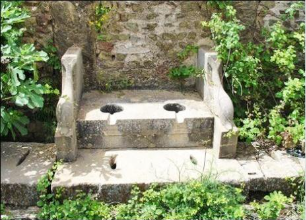
Vestiges of ancient public lavatories (forica) remain in a narrow passageway on the Teatro Argentina side of the temple area. These are among the earliest known public latrines in the City and date only to the first century AD. Remains of five of others have been excavated by archeologists dating to the 2nd century AD, including the Cripta Balbi in a neighboring area.
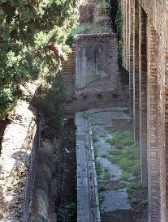
Typical features of public latrines include: sturdy stone structures often made of travertine; ground floor location close to a water supply; multiple
open seats with no partitions (up to 60); windows for lighting and ventilation; construction resting over sewer lines; hiddenness from public view, location close to large structures such as baths, theaters, and fora; sponge sticks; malodor.
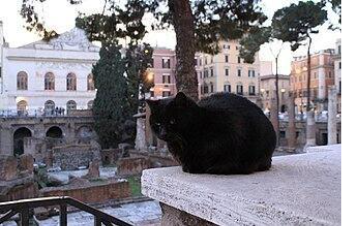
Nearby, a cat refuge operates to care for feral cats which populate the zone.
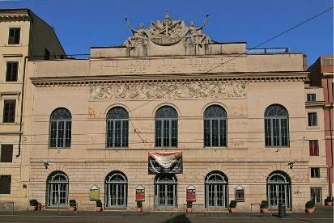
Located in the square, across from the Temples, stands the Teatro Argentina, an 18th-century theatre and opera house where several well-known operas premiered.
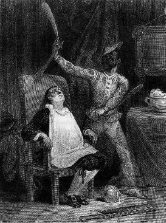
Gioachino Rossini’s, The Barber of Seville, opened there in 1816. The audience booed and hissed at the performance on its first night, but on the
second, it was met with the greatest positive feedback by the audience such that the composer was paraded through the streets of the City on the shoulders of his supporters.
Diagonally across the street from the Teatro remains the Torre del Papito, a tower discovered inside a building razed during 20th century excavations. It served as a 12th century fortress for the anti-pope Anacletus II, a member of the powerful medieval Pierleoni family.