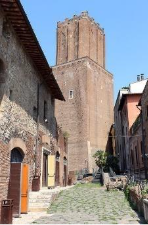
Fortresses abounded in the City during the Middle Ages, almost as much as churches, over 300 in the 12th century. Wealthy and powerful aristocratic families fought among themselves and carved out domains of influence throughout. These they defended with fortifications created independently (Torre delle Milizie) by the Conti) or carved out of the ruins of ancient roman structures. The best-known monuments serving these purposes include the Colosseum and Arches of Titus and Septimius Severus (Frangipani); the Mausoleum of Augustus (Colonna); the Theater of Marcellus (Savelli); the Theater of Pompey (Orsini).
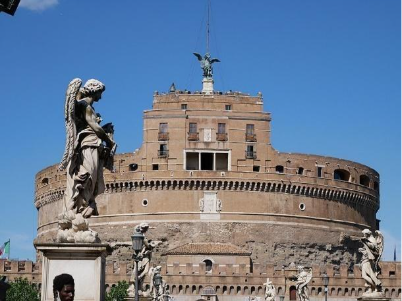
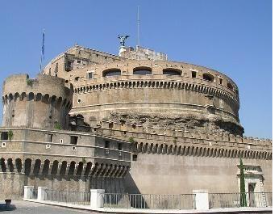
The most prominent castle of them all, now and then, stands out, the great papal fortress, Hadrian’s Mausoleum. It remains one of the City’s most visible and unique monuments.
While many important Roman structures have fallen into ruins, the Mausoleum still survives much intact two millennia later. In the ancient world mausoleums served as large burial monuments usually made of stone, entombing remains of the powerful and wealthy. The term itself derives from the name Mausolus, a 4th century BC ruler from Anatolia who constructed a funeral monument for his wife. Such was its grandeur that the ancients regarded it as one of the Seven Great Wonders of the World. Hadrian constructed the mausoleum for himself and his family (Sabina, his wife, and Aelius Caesar, his adopted son) around 125 A.D. It was not finished at the time of his death in 138 A.D., but his successor Emperor Antoninus Pius placed his ashes in the tomb a year later. The mausoleum became the tomb for many emperors and family members from Hadrian (Aelian family) to Septimius Severus and Caracalla in the early 3rd century. Over the centuries it has performed diverse functions: fortress, prison, barracks, and museum.
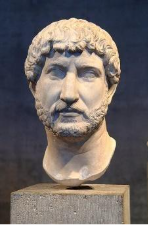
Hadrian built his Mausoleum in the former Gardens of Domitian a half mile away from that of Augustus, almost a stone’s throw away. On his deathbed at Puzzuoli near Naples, he composed an epitaph, a farewell to life, in the form of a poem about his soul, his body’s friend and companion (Animula, vagula, blandula, Hospes comesque corporis …).
Hadrian’s ordered his architect, Demetrianus, to construct the mausoleum on the right bank of the Tiber. The similarity of Hadrian’s Mausoleum to the older tombs of Cecelia Metella on the Via Appia and Augustus’ on the left bank of the Tiber is not accidental, nor its comparative immensity.
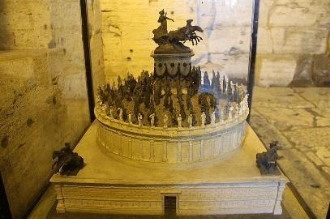
At the summit sat an earthen tumulus adorned with cypress trees, an altar (replaced now with the St. Michael statue), bronze sculptures of Hadrian driving a quadriga, and a decorative, bronze, pinecone displayed now inthe Belvedere Courtyard of the Vatican Museum. Some of these appointments disappeared in the sixth century when employed as weapons against besieging Ostrogoths. Marble inscriptions bearing the names of those interred within its walls stood in place until the 16th century when Pope Gregory XIII expropriated them as spolia for the internal space of St.
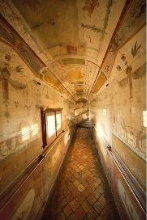
Peter’s. Inside the structure, a spiral ramp leads to a straight passageway leading to the cella, the place of the Imperial tomb.
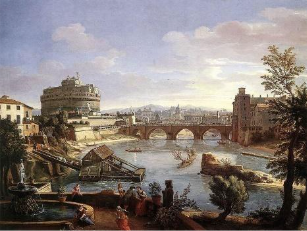
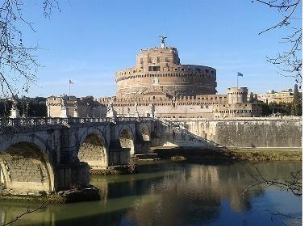
Hadrian also built the triumphal Pons Aelius (Aelian Bridge/Castel Sant’Angelo Bridge) facing straight onto the mausoleum. The bridge, whose three central arches are original, led to a main thoroughfare, the Via Aurelia, out to the City to the west and northward along the Mediterranean coast.
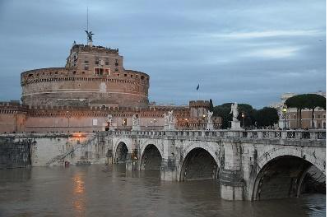
In the mid-3rd century, the emperor Aurelian enclosed the castle and incorporated it into his wall. During the papacy of Gregory I (Great), the plague of 509 ravaged the City. The pope organized a penitential procession through the City seeking God’s intervention to end the epidemic. As the procession passed by the Mausoleum the archangel Michael appeared at its pinnacle sheathing his sword. The plague vanished and its surviving victims were miraculously cured. Gregory ordered an angel statue placed now where St. Michael appeared. In his honor the Mausoleum gradually acquired its current name, Castel Sant’Angelo. The Flemish sculptor, Peter Anton von Verschaffelt, created the present St. Michael statue in 1753.
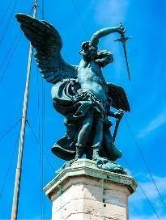
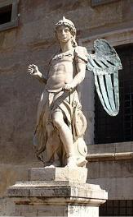
Its predecessor by Raffaello da Montelupo lies on the floor in an open court in the Castle.
In the Middle Ages the mausoleum became a fortified castle (Orsini) and popes, anti-popes and other warring factions fought with each other to gain control of it. In 1084 Robert Guiscard rescued Pope Gregory VII from it during a siege by troops of the German Emperor, Henry IV. From here, Cola di Rienzo fled to Bohemia in 1347 at the end of his first dictatorship.
Many illustrious people were imprisoned here in its cells (Pope John XII, Cesare Borgia, Benvenuto Cellini, Cagliostro, Beatrice Cenci) and some executed (Popes John XI, Benedict VI and John XIV).

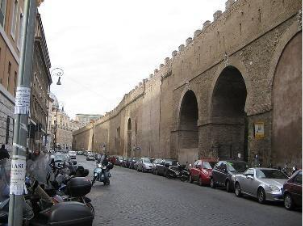
In the 13th century Pope Nicholas III connected the castle at the point of the Leonine Wall to the Papal Palace by a covered fortified corridor, the Passetto visible from the Borgo today. It contains two corridors atop one another: the upper has no roof and a lower, covered one (created in 1492 by Pope Alexander VI), underneath with small circular holes in its walls to provide illumination. Small bunkers buried under the ground of the Passetto near the Castel saved the life of Pope Clement VII during the 1527 Sack of the City by soldiers of Emperor Charles V.
Adjacent to the bastion of St. Luke stands the Chapel of the Crucifix (Clement XII) where condemned criminals attended Mass before their execution. The compound also included an elevator operated by hand. Its shaft is visible still beyond the main entryway near the base of the spiral ramp leading to the upper floors. The thirty foot ramp led to the burial cella housing the ashes of Hadrian and wide enough to allow passage to it by way of horse chariot.
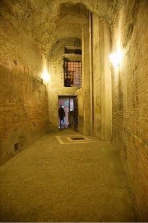
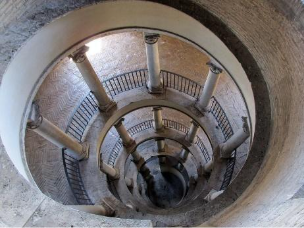
Regarded as a wonder of Roman architecture, it later inspired Donato Bramante’s 16th century design for the spiral staircase now in the Vatican Belvedere Palace.
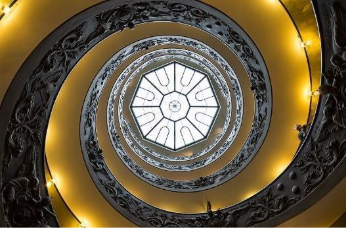
A more modern, 20th century version of it, the double spiral stairs designed by Giuseppe Momo, sits at the entrance of the Vatican Museums.
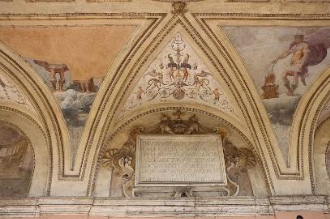
A delegation of Roman nobles who greeted Pope Gregory XI upon his return to the City in 1377 enthusiastically handed him the keys of Castle on a silver platter. At the end of the 15th century Pope Nicholas commissioned the construction of the four bastions at the corners of the structure by which the castle could withstand a three-year siege. Rossellino, Sangallo and Bramante, among the most notable architects of the City, added the arcaded ramparts. These connect to the bastions dedicated to the four Evangelists, each of which marked by a plaque. A covered passageway, the Passetto, located close to the bastion of St. Mark, connects the castle to the Papal Palace.
On the second story lies an open spaced Courtyard of the Angel named after the angel sculpture which once stood there. Michelangelo’s first architectural project in the City sits at one end, the window aedicule of the Chapel of the of Pope Leo X.
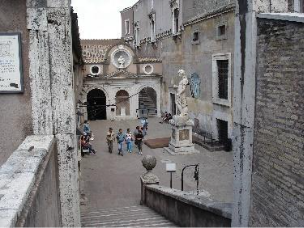
A second open space lies on the second story, the larger Cortile (Courtyard) of Pope Alexander VI. It houses a wellhead and served as the site of theatrical performances staged during the reigns of Popes Leo X and Pius IV. On one side at the lower level remain a line of prison cells (prigioni storiche) which once housed notable prisoners such as Giordano Bruno, Beatrice Cenci and her stepmother, and Benvenuto Cellini whose charcoal drawing of God the Father and Christ, it is said, was etched on the walls of the last cell.
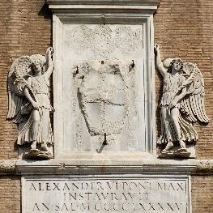
Stairs ascend to the bathroom of Pope Clement VII.
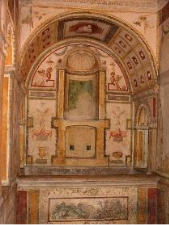
Popes constructed lavish papal apartments on the third story and some claim that Raphael decorated one of its bedrooms. Pope Leo X built the chapel around 1520.
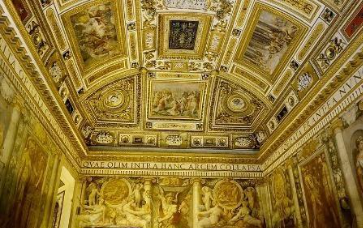
In 1527 Pope Clement VII and his retinue of over 1000 took refuge here in 1527 from the troops of the Holy Roman Emperor Charles V and soon after, Pope Paul III built another sumptuous papal apartment as a contingency measure against future assaults on the Vatican palace.
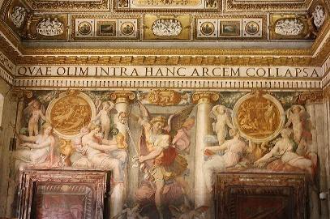
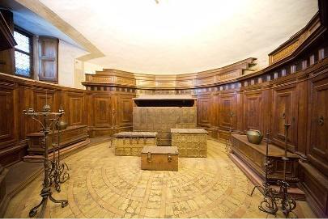
The space also included a separate treasury room where 16th century popes installed large cabinets for preserving archive material and secure chests for safeguarding gold and silver.
Pope Paul III also added the loggia on the north side and decorated it with frescoes. Three decades later Pope Pius IV added the outer defensive. At least five popes have resided here: Alexander VI, Julius II, Leo X, Clement VII, and Paul III.
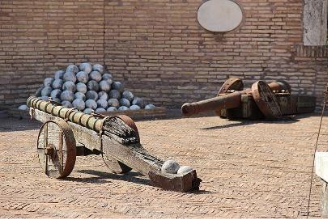
Pope Urban VIII commissioned Bernini in the 17th century to redesign the external defenses. Bernini utilized bronze removed from ceiling of the Pantheon’s portico to fashion cannons for the castle.
From 1849 to 1870 French troops occupied the castle and defaced the St. Michael statues with red, white, and blue paint, the colors of the French tricolor. When in 1870 Rome became the capital of the new Italian state, the Castle housed a barracks and prison. In 1901 work to restore the structure began and in 1933 the Castle was opened to the public as a military history museum.