
During the late Middle Ages the cult of relics made the City the pilgrimage center of the Western world. The papacy greatly enriched its coffers by cultivating and encouraging the fervor of faithful from all over Europe to come into contact with the many and diffuse sacred objects attached to churches and shrines throughout the City. Contemporary visitors, however, are much more drawn to the place by their desire to see works of art, and this need continues to be more than amply satisfied by the papacy in its spectacular holdings of the world’s greatest art, ancient, medieval and modern. The magnificent Vatican Museums form part of the Vatican Palace (papal) and consist of the several the public museums of the Holy See. Together they cover an immense amount of space, five hundred thousand square feet, the equivalent of five miles in a straight line. The museums display works amassed by the papacy for hundreds of years including many of the best-known Greek, Roman and Renaissance works of art as well as Egyptian, Etruscan and Paleo-Christian.

The history of the Palazzo Apostolico (Vatican Palace) begins in 1377 when Pope Gregory XI put an end to the seventy-year-old Babylonian Captivity by returning the papacy permanently to the City from Avignon. Two fires in 1307 and 1361 had virtually destroyed the papal residence at the Lateran Palace, rendering it uninhabitable. Upon their return to the City popes lived for short periods at Santa Maria in Trastevere and at Santa Maria Maggiore. In 1447 Pope Eugene IV replaced an older structure in the Vatican with the core of the current palace. To it Gregory XIII added a loggia in the late 16th century and Sixtus V yet a second wing which constitutes the actual official papal residence centered around a courtyard called the Cortile di Sisto V.

Pope Julius II founded the museums in the early 16th century after he had purchased the newly unearthed sculpture, the Laocoon.

At the recommendation of Giuliano da Sangallo and Michelangelo, the pope acquired the sculpture and immediately put it on public display in the Octagonal Court of the Belvedere Palace along with his other art pieces such as the Apollo Belvedere.

One of the Roman emperors commissioned the Laocoon in the second half of the first century A.D. Unearthed hundreds of years later, the sculpture lacked one of its arms. The Vatican sponsored a competition to recreate and reattach the missing arm. Giovanni Montesoli’s version of the arm won the competition and this the arm attached to Laocoon. In the 20th century the Austrian archaeologist Ludwig Pollack discovered the original missing arm and it matched perfectly the one designed four centuries earlier by Michelangelo.

Julius subsequently commissioned Donato Bramante to link the Belvedere to the summer Palace of Nicholas V with two long corridors and, thereby, created the Cortile del Belvedere. Bramante designed it so that the pope could see it from his study in the apostolic palace, the Sala della Segnatura. Julius and intended the structure to resemble monumental Roman buildings like Nero’s Domus Aurea to signal that the papal City stood as worthy successor of its Imperial forerunner. Its gigantic size, over one hundred yards wide and thee hundred yards long, encompassed arcades, gardens, fountains and an open-air theater and in subsequent years gradually came to accommodate holdings of the Museums and the Vatican Library.

As the art collection expanded, so too the museums holding it, the effort of numerous popes in the next four centuries. In this, the age of the Renaissance, generations of popes and scholars worked mightily to rediscover the glory of antiquity and to revive the City in the light of its accomplishments and hopes for the future. They toiled jointly to regenerate, restore, revivify the City intellectually, aesthetically, religiously and politically. Ample testimony to the success of these humanist efforts today shine forth in the astonishing holdings of the Museums. The first real Renaissance pope, Nicholas V, regarded by some as its most complete papal personification, set about in1447, the first year of his papal reign, to create a ‘new City’. Among his many plans was the rebuilding of the Vatican, including the reconstruction of the Basilica, the rejuvenation of the City through urban planning projects, the commissioning of Florentine artists such as Leon Battisti Alberti and Giotto, and the construction of a public Vatican library. Bibliophile and avid collector of Greek and Roman manuscripts, Nicholas amassed over 1200 ancient texts and hired translators to render Greek classics into Latin. His early death in 1455 brought a quick end to many of these projects but the library plan was later executed his successors.

Pope Sixtus V, around 1586, commissioned Domenico Fontana to build a wing into the Cortile to house the newly founded Vatican Library.

Popes Clement XIII, Clement XIV and Pius VI created the Museum of Pagan Antiquities in spaces they enlarged around the original Belvedere Palace and Pope Pius VI founded in the 18th century the Pinacoteca (painting gallery). Pope Pius VI created another wing in the Belvedere Cortile parallel to the Library (New Wing) and opened a section of the corridor in the Cortile for a sculpture gallery. Pope Gregory XVI created the Egyptian and Etruscan Museums. Pope Pius XI built a new Pinacoteca in 1932 and in 1970 Pope Paul VI constructed a new building which houses materials from other parts of the museum: the Lateran Museum, the Pagan Antiquities Museum and the Pio Christian Museum. In the floor below he added in 1973 a Museum of Modern Religious Art.

This guide covers only those parts of the Museums which the students in the Rome class regularly visited during their spring break excursion through the City. These include, in the order the tour followed in the museum: 1) the Pinacotheca, 2) the Pio-Clementine Museum, 3) the Raphael Rooms, and 4) the Sistine Chapel.
1: The Pinocotheca
Vatican paintings were originally housed in the Borgia Apartment. In 1797 Napoleon seized and brought to France many of its best works, some of which (senty-seven) were returned in 1815 when his regime finally came to an end. In 1932 Pope Pius XI inaugurated this new building, the Pinocotheca, to hold the Vatican’s collection of paintings. The gallery consists of four hundred sixty of some of the world’s finest paintings, mostly Italian, from the Middle Ages to the 17th century. Masterpieces by artists like Giotto, Raphael, Leonardo da Vinci, Titian, Caravaggio and Bernini are here arranged in chronological order throughout its eighteen rooms.

In Room I: The 11th century Last Judgment by Nicolaus and Johannes, the oldest painting in the gallery.

In Room II: The Stefaneschi Altarpiece by Giotto was commissioned around 1315 for the Confessio in the Old St. Peter’s. Giotto, the greatest painter of the 14th century, exerted great influence on later Renaissance painting, important because of his emphasis on human behavior and emotions. It is a Gothic polyptych (painted on both sides): Peter enthroned, the central theme on one side and Christ enthroned, the central theme on the other. One panel depicts St. Peter’s Crucifixion, interesting because of the scene set between two structures, Castel Sant’Angelo on the right and the Borgo on the left.

In Room III: Fra Angelico’s Madonna and Child with Saints Dominic and Catherine is another polyptych. In this 1437 painting three colors dominate– red, blue, and gold – all on Mary, in contrast with the muted colors on the other figures. Mary holds a rose, the symbol of Wisdom with Dominic, the founder of Fra Angelico’s religious order by her side.

In Room IV: Some of the more important works of Melozzo da Forli are found here. The fresco paintings of Angel Musicians, Cherubs, and Heads of the Apostles survive as parts of a larger fresco painted for the church of the Santi Apostoli. In this fresco, Pope Sixtus IV Founding the Vatican Library, the pope confirms the Platonist scholar, Platina, as director of the Vatican Library founded earlier by Pope Nicholas V. The interesting and historically important painting includes four Riario and Della Rovere papal nephews, one of whom (Giuliano) would later become Julius II.

In Room VII: The works of artists like Pietro Perugino, Rafael’s teacher, and other representatives of the Umbrian school fill this room. Rulers of the city of Perugia commissioned Perugino’s the Decemviri Altarpiece for the chapel in the Palazzo dei Priori. It portrays the Virgin on a high throne holding the Christ child. At her side stand St. Lawrence and civic dignitaries of Perugia.

In Room VIII: The largest room in the Gallery is mainly devoted to some of Raphael’s best works. The artist painted the Coronation of the Virgin at the age of twenty. In it the apostles gaze upwards to Mary’s heavenly coronation by Christ.

The Madonna of Foligno he painted around 1511 for Sismondo Conti as a votive offering in gratitude for his escape from death at the Battle of Foligno.

Cardinal Giulio Medici (Pope Clement VII) commissioned the Transfiguration, Raphael’s last painting, intending it for the French Cathedral of Narbonne. Unfinished at the time of the artist’s premature death (37 years of age), it contains the last image he ever painted, the face of Christ. His pupils, Giulio Romano and Francesco Penni completed the unfinished parts on the lower right side of the composition. Mourners placed this painting behind his body laid out at his house in the Borgo Pio. Compared to his other works this painting of the Transfiguration stands out by reason of its vivid colors and dramatic energy and the influence of Michelangelo’s style on its human forms. Napoleon looted this painting, along with the Apollo Belvedere, the Laocoon, and around one hundred other Vatican masterpieces, when his troops occupied the City in 1797.
This masterpiece was housed in the Louvre, but returned to the Vatican in 1815 by the Congress of Vienna after Napoleon’s last defeat. It hung initially in the Borgia Apartments but eventually transferred to the Pinacoteca. In the 16th century, Giorgio Vasari regarded it as Raphael’s most inspired work and in the 18th century Neoclassical period, art critics described it as the greatest painting in the world and the most celebrated in the City.

Raphael designed the Acts of the Apostles Tapestries commissioned by Pope Leo X for the lower walls of the Sistine Chapel.

In Room IX: Leonardo da Vinci’s least known but most remarkable painting and only painting in the City can be found here. It stands out as a monochromatic, unfinished painting of St. Jerome in the Desert in outline and in sepia-colored tones. A lost work for many years, it re-emerged remarkably in parts and at separate times due to amazing detective work by Cardinal Fesch, the nephew of Napoleon Bonaparte. By accident he came upon its first part in a place where workers in a pawnshop used it as a tabletop. He searched more and found the other half in a shoemaker’s shop, a piece of a wooden stool. Leonardo’s visible, preliminary outlines provide real insight into how he prepared paintings before completing the final version. This painting is one of the few Da Vinci works regarded by art historians as incontrovertibly authentic. In this room hangs, as well, a portrait of Donato Bramante, the first architect of the new St. Peter’s.

In Room X: This room houses the works of Venetian artists. Titian, a master portraitist, painted the Portrait of the Doge Nicolo Marcello long after the subject had died. He used as his model an older painting of the Doge by Giovanni Bellini.

Also here hangs Veronese’s The Vision of St. Helena. Veronese, regarded as the master colorist of his age, in this painting, depicts Helena, the mother of Emperor Constantine, having a vision which will guide her to the discovery of the True Cross on which Christ died.

In Room XII: Caravaggio’s controversial, Deposition of Christ graces this space. The Oratorian church, Chiesa Nuova commissioned the painting but rejected it because of its striking naturalism. Caravaggio set the figures against the dark, tomb-like background, the context for the extreme chiaroscuro that made this artist’s work so prized and famous and the hallmark of Baroque realism. He depicts Christ as a heavy corpse showing signs of rigor mortis in his right hand. Three women and under–idealized Virgin Mother stare at his lifeless body.

St. Peter’s Crucifixion by Guido Reni underscores the naturalistic influence of Caravaggio on the artist of his age.

Room XIII: The work of a contemporary and friend of Caravaggio, Orazio Gentileschi stands out in this room. His painting of Judith and Her Handmaid With the Head of Holofernes depicts graphically the Old Testament story in which a heroic woman beheads the warlord who attacks her town. Judith’s red gown symbolizes the ghastliness of the deed she has just committed.

Room XIV: The Pieta by Lucas Cranach the Elder graces this room. Cranach stands out as one of the best-known painters of the German Renaissance and very famous for his portraits. This work represents one of the few non-Italian works at the Vatican. In it Cranach untraditionally depicts Christ, with Mary standing at his side, seated on his sarcophagus gazing mournfully out at the viewer.

Room XVIII: The Plaster Busts used by Bernini to create the bronze sculpture of the Chair of St. Peter in the Gloria of the apse in St. Peter’s are scattered about this room. The busts feature St. John and St. Athanasius and stand four feet tall, the angels eight feet.

2: Pio-Clementine Museum
Even though the ancient Romans had conquered the Greeks and made their states a province of the Empire, the influence of Greek culture on the Romans proved even greater, especially in the realm of sculpture. Originals and copies of Greek statuary filled public places and residences all over the Roman world: gods and goddesses, statesmen, orators, philosophers, athletes, and animals. Today the Vatican Museums and private collectors possess some of the best Greek sculptors and their original works or copies found anywhere in the world. The Vatican greatly expanded its collections in the second half of 18th century because of artifacts unearthed as part of archeological excavations carried out in Rome and regions of the Papal States. Donations from benefactors were a factor as well.
Contemporary enlightened attitudes also encouraged the creation of museums open to the public and organized to preserve and safeguard antique works of art. Popes Clement XIV and Pius VI created the Pio-Clementine Museum, named after them, to house Greek and Roman masterpieces. Papal collections of classical sculpture originated in the early 16th century with the sculpture collection of Pope Julius II. He originally set these treasures in the Cortile delle Statue (Octagonal Courtyard) of the Villa Belvedere. The Villa, designed by the Florentine architect, Antonio Pollaiuolo, and constructed in 1484 by Pope Innocent VIII, served as a summer house in back of and overlooking the Basilica. Pope Julius II moved his growing collection of antique Greek and Roman sculpture into the Cortile (courtyard) of this building. He purchased for it the Laocoon group, very recently discovered in 1506, and soon after, added to the collection the Apollo sculpture. The moniker “Belvedere” Torso derives from a part of this collection.

At the top of the staircase from the Pinacotheca area to the Pio-Clementine Museum stands the Square Vestibule to the Courtyard. It contains the Etruscan-styled sarcophagus of Lucius Cornelius Scipio Barbatus, the victorious Roman general who defeated the Etruscans in the 298 BC Battle of Volterra.

In a separate room off the Courtyard, the Cabinet of the Apoxyomenos displays a 4th century copy of Lysippus’ Sculpture of an Athlete. The exhausted, but victorious, young athlete scrapes oil from his body with a strigil. In the 19th century excavators discovered the statute buried under a private house in Trastevere, earlier a medieval Jewish synagogue.

From the next room the Scala del Bramante (stairway) makes its appearance, commissioned by Pope Julius 2 in 1512 to connect the 15th century Belvedere Palace of Pope Innocent VIII to the city. Riders on horseback could climb its ramp.

This space leads to the Octagonal Courtyard of the Belvedere Villa, the original nucleus of the current Vatican Museums and once an open courtyard and garden full of greenery, where Pope Julius II displayed his sculptures. An inscription over its main door read, ‘Procul este profani’ (‘stay out of here, you who are unworthy’). Pope Pius VI enlarged the museum in 1775 and transformed the courtyard into an octagon with recesses (gabinetti) in its corners housing four sculptures.

In its Gabinetto dell’Apollo stands the Apollo Belvedere, a second century Roman copy of 4th century BC bronze original. Pope Julius placed it here in 1503, the first of the many works of art he established in the villa, followed by the Laocoon in 1506. It depicts the figure of the young god Apollo. Leochares probably sculpted its original bronze version around 325 BC for the Agora of Athens. Throughout the Neoclassical age of the 18th century, critics regarded it as the model of formal perfection, the personification of beauty itself. The influential art historian Johann Winckelmann described it as the greatest sculpture in Western art, the embodiment, he said, of ‘quiet grandeur and noble simplicity’. Because of his endorsement, and that of others, it was the first work of art to achieve world-wide notoriety, a status comparable today to that of Michelangelo’s David or da Vinci’s Mona Lisa. Ranked after it, in terms of popularity as tourist attractions were the Belvedere Torso and the Loacoon.

In the Gabinetto del Laocoonte showcases the famous Laocoon group, a 1st century A.D. Roman copy of a 2nd century BC original Greek work by the sculptors Hagesander, Athanadoros and Polydorus. Pliny regarded it as the finest sculpture of antiquity in his book, Natural History and described it as belonging to the Emperor Titus. Felice De Fredis, a wealthy Roman nobleman in 1506 found it accidentally, buried under his vineyard on the Esquiline Hill near the church of San Pietro in Vinculi. As he probed the ground in search of bedrock for the construction of a new house, he discovered an underground vault, part of the Baths of Titus. It contained seven rooms, all empty except the seventh. In it, twelve feet underground, he found the sculpture of the three figures entwined by a snake. Each had lost a limb: Laocoon, his right arm; one son, a right arm; the second son, part of a lower leg.

Word of the discovery spread, and crowds of Romans flocked to the site to gawk at it while Michelangelo and Giuliano da Sangallo drew sketches of it for the pope. A bidding war for it raged: Cardinal Raffaele Riario offered 2,000 ducats. Pope Julius II outbid all contenders by offering De Fredis 600 ducats annually for the rest of his life and deposited it in the Belvedere Villa.

The pope conceded to De Fredis as well, the privilege of burial in the church of Santa Maria in Aracoeli where his tomb is still visible to this day.

Much admired and studied by Michelangelo, he described it as a ‘unique work of art’. Inspired by its perfect human form, he employed it as a model for many of his later nude subjects, especially those (ignudi) on the walls of the Sistine Chapel. With these figures Michelangelo created a new canon for the nude form which prevailed in Western art for many decades, characterized by highly developed musculature, broad shoulders, and heavy torsos. So much was Laocoon admired by contemporaries that a young humanist, later cardinal, Jacopo Sadoletto, wrote a poem about it describing it as the Loacoon ‘now come back from deep mass of earth and great ruins”. Some, however, expressed shock at the images. The Dutchman, Pope Adrian VI, regarded them as pagan idols and threatened to remove them. His sudden death in 1523 intervened and kept them from harm.

The sculpture represents the Trojan priest Laocoon and his sons killed by snakes sent by Athena, angry that the priest had warned fellow Trojan citizens about the danger of the wooden horse gifted to them by the Greeks. Its style, characterized as late Hellenistic, vividly reflects the violent realism, dynamism, and drama evinced in the contorted bodies of its victims.

The sculpture, when recovered in 1506, had lost several parts, including the right arm of the Laocoon. In 1510 Pope Julius held a contest among artists to see who could create the best design for the missing arm. Most designs, including that of the winner, Jacopo Sansovino, depicted an outstretched arm. Michelangelo’s design, however, depicted a bent arm extending backward in a gesture of pulling the serpent from his body.
Giovanni Montorsoli, a disciple of Michelangelo, won the contest. Officials attached the outstretched arm to the sculpture in 1532 where it remained for many years. In 1906 excavators discovered the original missing limb on Via Labicana in the yard of a Roman workman and merely a few yards from where the sculpture had been unearthed in 1506. As Michelangelo had originally conjectured, the arm bent backwards, confirmed by the presence of a drill hole in it which lined up perfectly with one in the sculpture’s shoulder. This arm, at last, in 1942, returned to its owner.

The Gabinetto dell’ Hermes holds a copy of Praxiteles’ sculpture, Hermes Psychopompos, the messenger of the gods who conducts souls to the underworld.

The Gabinetto del Canova displays three early 19th century statues by the Italian Neoclassical sculptor, Antonio Canova: they include Perseus (inspired by the Apollo Belvedere sculture) with the head of Medusa, and two boxers, Creugas and Damoxenes. These were installed here to replace ancient sculptures taken to Paris by Napoleon and never returned. In the early 19th century, the Perseus statue by Canova stood as a substitute in the niche of Apollo, seized by Napoleon along with that of the Loacoon, transferred to Paris, but eventually returned after his 1815 exile to the island of St. Helena.

Adjacent to the Octagonal Courtyard are the following rooms:
The Animal Room contains statues of Roman animals extensively restored by Francesco Antonio Franzoni for Pope Pius VI at the end of the eighteenth century. Some of its holdings are ancient such as the copy of the 4th century original, Meleager and his Dog by Skopas.

The 2nd century AD statue of Mithras slaying the bull stands here and impressive animal mosaics from Hadrian’s Villa in Tivoli.

The Gallery of Statues, once the open loggia of the Villa but transformed into a sculpture gallery in the second half of the eighteenth century, occupy this large space. It contains Roman statues, some copies of works from the classical Greek period (5th-4th century BC), including the Apollo Sauroctonos ( killer of the lizard) from an original by Praxiteles (around 350 BC), the Ariadne Asleep, a Roman copy of the 2nd century AD from an original of the School of Pergamum of the second century BC.


The Room of Busts house sculpted portraits of Roman emperors.

The Cabinet of the Masks display the much-admired Venus Cnidia, a Roman copy of a 4th century BC Greek original by Praxiteles.

This room also hosts a curious artifact, the sedia stercoraria, an 11th century porphyry papal throne designed, according to legend, to prevent a recurrence of the 9th century Pope John VIII (“Popess” Joan) incident. It provided a crude method for determining the masculinity of the newly elected papal candidate prior to his consecration.

The Room of the Muses is filled with Roman copies of Greek original statues of the Muses and poets. In the center stands the famous Belvedere Torso, an original work from the 1st century BC signed by the Athenian sculptor Apollonius son of Nestor. The chain of historical ownership begins with Cardinal Prospero Colonna around 1433, the artist Andea Bregno around 1500, and Pope Julius around 1503. One legend states that the pope asked, unsuccessfully, Michelangelo to retrofit the sculpture with arms, legs and a face. The figure possibly represents the Greek hero Ajax meditating suicide. Michelangelo very much admired this work, studied it, and transferred its formal qualities into many of his own paintings and sculptures.

The Round Room was constructed with a Pantheon-like dome at the end of the eighteenth century. In the center rests a large round monolithic porphyry basin from the Domus Aurea.

It contains, as well, a 2nd century AD gilt bronze Hercules discovered in the neighborhood of the Theater of Pompey, and a 3rd century mosaic from thermal baths in Umbria.

Colossal statues and busts line up along the walls and include: the 4th century BC statue of Jupiter of Otricoli by Bryaxis; the Braschi Antinous; Emperor Antoninus Pius’ wife, Faustina; a female goddess (Demeter); the head of Hadrian from his Mausoleum (Castel Sant’Angelo).

The collection contains a bust of Antinous (lover of Emperor Hadrian);

a Roman copy, the Barberini Hera (Juno);

the Emperor Galba as Jupiter;

a bust of Serapis;

the Emperor Claudius as Jupiter;

a bust of Emperor Claudius;

a statue of Juno Sospita;

a bust of Plotina, emperor Trajan’s wife;

a bust of Julia Pia (Domna) a relative of Emperor Septimius Septimus;

the statue of the Genius (divine quality) Togatus of Augustus, his head covered as officiant in a sacrificial rite.

The Hall of the Greek Cross hosts a 3rd century AD central mosaic from the town of Tusculum and two colossal red porphyry sarcophagi. That of Sant’ Elena, mother of the emperor, Constantine, stands on the left. Although originally designed for Constantine, it derives from the mausoleum of Helena located on the outskirts of Rome on the Via Casilina. Elena, on pilgrimage to the Holy Land, discovered and brought back to the City many relics of Christ’s Passion.

The sarcophagus of Constantia, daughter of Constantine stands on the right side and comes from the church of Santa Costanza on Via Nomentana. Both sarcophagi contain an interesting mix of natural and Christian decorations.

The Belvedere Courtyard (Cortile del Bevedere) is an open courtyard, designed in 1505 by Donato Bramante. Regarded as a major architectural achievement of the High Renaissance period, it served for many centuries throughout Europe as the model for formal gardens and open spaces.
Originally constructed as a single enclosed space, it connected the Belvedere Villa, the summer house built in 1484 by Pope Innocent VIII, to the Papal Palace with long and narrow, lengthy (1000 feet), parallel wings of three stories.

At the Belvedere end, the courtyard culminated in the semicircular exedra devised by Bramante to create the illusion that the façade of the Villa lay parallel to the façade of the Vatican Palace at the other end. In front of it once stood a large terrace whose broad set of stairs was pitched so slightly that horses could ascend and descend with ease. The courtyard during the reign of Pope Leo X housed the papal menagerie, the place where the pope would amaze the public by parading his prized elephant (Hanno) now buried on the grounds. Bramante died in 1514 and Pirro Ligorio completed the Courtyard by adding a third story to the exedra, making it the largest niche (nicchione) in Europe. The Vatican later added bleachers to create a venue for diverse sorts of outdoor entertainment, even Spanish bullfighting during the Borgia papacy.

Today the section close to St. Peter’s is still called the Cortile del Belvedere, but the upper terrace close to the old Villa is called the Cortile della Pigna. The Pigna, a large bronze pinecone placed near the exedra consists of the great thirteen-foot pinecone from the age of Hadrian in the early 2nd century AD may have been a part of the Temple of Isis area near the Pantheon. It was found in the Middle Ages near the baths of Agrippa and incorporated into the atrium of Old St. Peter’s. At the time the legend surrounding it was that it had once sat atop the Pantheon until the Devil blew a hole into the center of its roof.

Once Bramante had torn down the atrium in in the early 16th century, he
made the cone the centerpiece of his new Belvedere Courtyard. Michelangelo designed its staircase, similar in form to the one he designed for Palazzo Senatorio on the Capitoline Hill. The fountain’s bronze peacocks are copies of those which decorated the Mausoleum of Hadrian. The originals remain inside the Museum.

The visitor route to the Raphael Rooms (Stanze di Raffaelo) and the Sistine Chapel. These follow along the long west corridor of the Belvedere Courtyard divided into four sections: the Gallery of the Candelabra, the Gallery of Tapestries, the Gallery of Maps, and the Gallery of Pope Pius V.
The Gallery of the Candelabra acquires its name from the pairs of Imperial marble candelabra set on both sides of the arches which divide this part of the corridor into six sections. It contains displays of ancient Greek and Roman statues, relief carvings, sarcophagi, candelabra and mosaic pieces.

The Gallery of Tapestries contains a series of 16th century tapestries woven in Brussels. These, designed from cartoons executed by Raphael’s pupils, depict scenes from the life of Christ.

Walls of the Gallery of Maps display many 16th century maps of the regions of Italy and its neighboring islands.

The Gallery of Pope Pius V houses Belgian and French tapestries.

3) The Raphael Rooms (Stanze)
The Raphael Stanze, once the residence of popes and still a part of the Apostolic Palace, are now also part of the Vatican Museum. Decorated by frescoes painted by Raphael, they together with the frescoes painted by Michelangelo on the ceiling of the Sistine Chapel, stand out as the most visited sites in the Museum.

Originally built in the middle of the 15th century by Pope Nicholas V, these four surprisingly small Stanze served multiple purposes: papal audience hall, library, and judicial tribunal. They occupy the space on the third floor directly above the apartment of Julius’ predecessor and antagonist, the Borgia pope, Alexander VI whose rooms he refused to occupy when he ascended to the papacy because, as he said, ‘he couldn’t endure the sight of Borgia kneeling before Christ’.

Julius II commissioned several artists, Luca Signorelli, Perugino, Baldassare Peruzzi and others, to redecorate these four rooms. Among them was a former pupil of Perugino, the young twenty-five old Raphael, a barely known artist from Urbino just beginning his brief but brilliant career. His style focused on the dynamic beauty of the natural world and within a very short time the Pope, thrilled by the extraordinary skill visible in the panels executed by Raphael, dismissed the other painters and turned over the commission to this upcoming artist and his students. Raphael who worked on the project for twelve years until his unexpected death, began in 1508 with trial works in the Stanza della Segnatura and then proceeded in chronological order to the Stanza di Eliodoro, the Stanza dell’Incendio, the Stanza di Constantino. The over- arching theme of the panel in all the rooms deals with the defense by the Church against its diverse enemies, internal and external: thieves (Heliodorus), heretics (Bolsena miracle), foreign invaders (Attila and Huns), papal foes (St. Peter’s liberation) and even the forces of nature (Borgo fire).

The project spanned the years of four popes, some of whom exerted great influence on design: Popes Julius II, Popes Leo X and Clement VII. Pope Julius died in 1513 but only the frescoes of two rooms had been completed. His successor, Pope Leo X continued the project and, when Raphael died in 1520, Leo passed it on to his disciples (Gianfrancesco Penni, Giulio Romano and others).

This itinerary follows not the chronological sequence, but the order in which the rooms present themselves in situ.
The Stanza di Constantino, the largest of the rooms, was completed after the death of Raphael, and painted by his disciples. The theme of the design is Christianity’s triumph over paganism focuses on the role of the emperor Constantine in promoting the development of the institutional Church.

Scenes include:
Constantine rallies his soldiers before battle; his vision of the Cross;
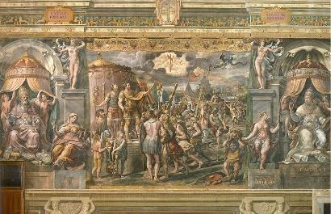
the Milvian Bridge victory over his imperial rival, Maxentius;

the baptism of Constantine in which Pope Sylvester is depicted with the
face of the contemporary Pope, Clement VII;

Constantine’s Donation of imperial land to Pope Sylvester and temporal sovereignty over them.

The Stanza d’Eliodoro, the second room painted by Raphael, takes its name from the Old Testament episode of the Expulsion of the general Heliodorus attempting to steal money from the Temple of Jerusalem.

It alludes to the successful campaign of Julius II against the attempt of French troops to occupy the Papal States. In the center the triumphant Julius II sits on his sedia gestatoria (ceremonial portable throne) surrounded by the newly found Swiss Guard.

The room also includes scenes from the Miracle of Bolsena in which a drop of blood drips from the Host onto the corporal below during a Mass celebrated by a priest entertaining grave doubts regarding the doctrine of Transubstantiation. Included in it as a witness to the event is Pope Julius II with a life-like image.

The Liberation of St. Peter depicts Peter’s miraculous escape from prison
aided by an Angel who frees him from his chains. Implicit reference is made in theme of the painting to Pope Julius II who had been titular cardinal of the basilica of St. Peter in Chains.

Pope Leo I Turning Back Attila the Hun, painted by Raphael’s disciples, depicts Pope Leo mounted on a white horse repulsing from the outskirts of the City Attila and his troops terrorized by a vision of Saints Peter and Paul. Visible on this fresco remain scratches, traces of damage done by German soldiers during the 1527 sack of the City.

The Stanza della Segnatura, the room of the Supreme Tribunal, the Vatican’s highest judicial body and the place where the Pope signed and sealed official documents and, as well, the room of his private library, became the first of the rooms painted by Raphael and executed entirely by his hand. Many art historians regard his works here as his finest, contributing to the well-deserved honor of being numbered among the best of Italy’s great High Renaissance artists along with Da Vinci and Michelangelo. His unique style, fusing elements of decorum, grace, harmony, rich color, clarity of form and ‘sprezzatura’ (effortless composition) already appear in these frescoes despite the artist’s relatively young age. The fresco ingeniously and successfully pays homage to the achievements of Renaissance humanism in learning and in the arts and in an extraordinary fashion, fuses artistically the truths of poetry, philosophy and theology. All the frescoes together stress the idea of the complementarity of truth, wisdom, and beauty as understood by Church authority and by humanist scholarship. The beautifully designed, but highly complex ceiling, intricately combines over 150 divine, historical, mythical, and scriptural figures engaged with one another in lively conversation. Its four walls are thematically differentiated according to the traditional four arts: theology, philosophy, law, and literature. These, in turn, arranged conversationally, face one another, as if to speak.

In the Parnassus, the home of Apollo and the Muses, the god plays the violin surrounded by the nine Muses under his signature laurel and the great poets of the Renaissance age. Seated around him on the left are his agents, the nine Muses, the daughters of Jupiter, ruler of the gods, and Mnemosyne, goddess of memory: Calliope (epic poetry), Melpomene (tragedy), Terpsichore (dancing), Polyhymnia (sacred poetry), Erato (love poetry), and on the right, Clio (history), Thalia (comedy), Euterpe (music), Urania (astronomy).

The greatest Classical, Christian, and Renaissance writers appear here and include on the left, the figures of Homer, Dante, Virgil, Petrarch, and on the right, Ovid, Horace, Pindar.

In a scene below, the emperor Augustus prevents friends of the Roman poet Virgil from burning his copy of the Aeneid.

The view from the window of this room looks toward that part of the Vatican Hill once regarded as sacred to Apollo and the place where auspices were taken by Etruscan priests. The Latin term,”vaticinia,” (prophecy) is the source of the word, “Vatican” Hill. This detail was Raphael’s inspiration for the Apollo and Muses fresco, the Parnassus.

On the wall to the right of this room, the greatest of its panels, the School of Athens, symbolizes the triumph of Philosophy over other modes of human thought and, as well, the idea that among the widely diverse schools of philosophical thought there prevails great harmony.

The background, a portico, represents the Palace of Science. On its sides stand statues of Apollo and Minerva, the divinities of Wisdom. On the steps of the portico appear the greatest philosophers, scholars and scientists of the ages gathered around the two great intellectual giants, Plato and Aristotle , shoulder to shoulder, from whom the other thinkers descend.
Each holds a seminal work: Plato, his Timaeus, and Aristotle, his Ethics. The figure of Plato, intended as a portrait of Leonardo da Vinci, points towards heaven, the symbol of his love of ideas and speculative philosophy. Aristotle, on the other hand, points towards the earth, symbol of his emphasis on the world of experience and the importance of nature as the basis of scientific research. The painting masterfully creates its own Summa of the chief thinkers of classical Greek philosophy and emphasizes the importance of the thinking processes which form the basis of learned and worthwhile discussions and written works produced by human thought.

Philosophers from the school of Aristotle are depicted on the right side of the painting: Euclid, Ptolemy, Strabo and their own disciples. On the left side Plato’s disciples cluster: Parmenides, Zeno, Socrates, Pythagoras, Empedocles, and Anaximander. Among the great thinkers included in this panel on the same side as Plato and representing speculative philosophy are Zeno, Epicurus, Pythagoras, and Pericles, Heraclitus (Michelangelo face).

Raphael later added the Michelangelo figure of Heraclitus after his secret viewing of and great emotional response to the frescoes of the Sistine Chapel.

On the other side, around Aristotle stand students of the natural sciences including Ptolemy, Zoroaster, Apelles (Raphael self-portrait), Archimedes, Euclid (Bramante figure), and Diogenes. Raphael actually signed this fresco, RUSM, the acronym for “Raphael of Urbino by his own hand”.

Opposite the School of Athens appears the well-known Disputa (Disputation on the Eucharist), representing a discussion on the nature of the sacrament of Eucharist. It forms a counterpart to the Triumph of Philosophy: the contrast between the Queen of the sciences (Theology) and its Handmaid (Philosophy). The conversation taking place in this painting focuses on the sacred mysteries of creation, redemption and revelation, a conversation which begins with the image of the Eucharist, moves upward towards the Holy Sirit, to the resurrected Christ and, finally, to God the Father in heaven, blessing all that He has created.

The center depicts Christ with the Virgin and St. John the Baptist.

Above Jesus appears God the Father and below the Holy Spirit.

On the left stand St. Peter and other Old and New Testament figures, and on the right, St. Paul. In the middle of the earthly sphere sits a monstrance with the host on the altar. At both sides emerge the Latin doctors of the church (Augustine, Ambrose, Gregory, and Jerome), together with popes, cardinals, theologians, dignitaries, and Christian faithful.

Portraits of several well-known, contemporary people appear on the faces of some of its subjects, including those of Dante, Savonarola, Fra Angelico and Bramante.

On the wall above the window sit three of the four cardinal virtues
(Fortitude, Temperance and Prudence).

The Stanza dell’Incendio, the dining room of Pope Leo X, painted during his reign, seeks to glorify him and his pontificate by depicting heroic deeds of earlier popes who shared his papal name. Facing the window, the scene of the Fire in the Borgo (Incendio dell Borgo). This occurred in the ninth century, and the fresco shows how the fire was miraculously extinguished when Pope Leo IV made the sign of the Cross over it from his palace in the Vatican. In the foreground of the panel stands Aeneas, his father Anchises and son Ascanius, an historic reference to the flight of these Roman ancestors from the burning city of Troy.

Another scene, the Coronation of Charlemagne by Pope Leo III, the features of Charlemagne clearly resemble those of Pope Leo X.

Other panels include the Oath of Pope Leo III and the Victory of Pope Leo IV over the Saracens at Ostia.

The ceiling of this room contains Perugino’s, Glorification of the Trinity, which Raphael retained to show respect to its author, his mentor.

4. Sistine Chapel
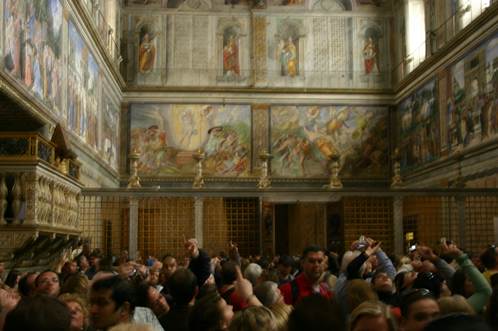
In 1473 Pope Sixtus IV commissioned the Sistine Chapel, part of the Papal (Apostolic) Palace complex in Vatican City, to serve as their official private chapel and a place for liturgical and administrative functions, including papal conclaves where the college of cardinals gathers to elect a new pope.

Baccio Pontelli and Giovanni Dolci designed the chapel, imposing on it the design of the Temple of Solomon as described in First Book of Kings: the length, two times the height and three times the width.

Pope Sixtus IV commissioned a team of the best painters of the Renaissance age to paint on its wall a series of frescoes depicting the lives of Moses and of Christ: Pietro Perugino (foreman), Sandro Botticelli, Pinturicchio, Domenico Ghirlandaio, Luca Signorelli and Cosimo Rosselli and the Umbrian, Pietro Vanucci. Florentine artists had begun to migrate to the City during the reign of Pope Nicholas V but the pace beginning with Sixtus and his papal successors so much so that the City became recognized as the ‘studio of the Renaissance’.

At the insistence of Pope Julius II, Michelangelo reluctantly painted the chapel’s ceiling beginning 1508, a four-year project which forever changed the direction and standards of Western art. After the Sack of Rome in 1527, Michelangelo returned to the Chapel with a very different view of the world and on its wall behind the altar painted another masterpiece, the somber and dark Last Judgement.

When a papal conclave occurs, workers ( Sanpietrini) install a chimney through the roof at the back of the chapel. Cardinals burn ballots in the stove with a mixture of straw and chemicals after each vote. White smoke designates the election of a new pope. If black smoke billows out from the chimney, it signals that more balloting will take place until the chosen candidate receives two thirds of the votes cast. While conclaves have elected popes since the 11th century, Pope Alexander VI in 1492 became the first pope elected in the Sistine chapel. All popes since 1878 (Pope Leo XIII) have been elected in this place.

The exterior of the chapel remains undecorated, a feature common to many Medieval and Renaissance Italian churches. Its third story houses rooms for guards and has a gangway, now roofed over because of water problems, which encircles the building. Entrance to the chapel passes through rooms internal to the palace.

Originally painted brilliant-blue and dotted with gold stars, the vaulted ceiling, rises sixty-eight feet high, segmented by smaller transverse vaults over the windows.

Sixteen arched windows, some now blocked up fill the space with light.

Arranged in a pattern that marks the processional path for ceremonial occasions, the pavement consists of tile in an opus sectile style with polychromatic stone and marble pieces. A transenna (marble screen) with a wooden door topped with ornate candlesticks, divides the chapel into two parts.

The earliest part (Perugino and associates) of the fresco scheme stretches along the side walls divided into three main tiers. The principal tier contains cycles of paintings parallel to one another, The Life of Moses and The Life of Christ.

Lower level of the walls, decorated with frescoed panels, display scenes of Scriptural and Classical prophets (Sybils). Above the windows sit lunettes depicting the Ancestors of Christ, painted by Michelangelo. On the pendentives, he painted twelve men and women, Scriptural prophets and Classical sybils, who foretold the future coming of Jesus as savior of the world.

When Pope Julius decided to embellish the chapel even more and to fresco its ceiling, he commissioned Michelangelo to paint the twelve apostles on the triangular spaces below the vault. The artist demurred and, instead, convinced the pope to allow him to execute an entirely different scheme, a theologically thematic one, nine scenes from the Book of Genesis depicting God’s creation of the world, His special relationship with mankind, and mankind’s ultimate fall from God’s grace.

In 1515 Pope Leo X commissioned Raphael to design for the lower walls ten tapestries highlighting events from the lives of Saints Peter and Paul. Imperial mercenaries destroyed these in 1527 during the Sack of Rome. Replicas now replace them, sometimes taken from storage and employed for ceremonial occasions.

Side walls of the chapel
Renaissance Christians believed that human history developed in three ages: before the Law (creation to Moses); under the Old Law (Moses to Jesus); and under the New Law of grace (Jesus to the end of time). The artists skillfully detailed these eras on the walls of the chapel: the first, the age before the Law, on the ceiling, depicting God’s creation of the universe;

the second, the age under the Law, on the south wall depicting scenes from the life of Moses;

and the third, the age of grace and salvation, on the north wall with scenes from the life of Christ.

Sub-themes of fresco depict the efforts of its papal patrons to promote their own authority by emphasizing the connectedness of Moses and Christ as the eternal lawgivers to St. Peter and his successors who embody in time the continuation of that authority.

The panel (near the entrance) depicts events from the life of Jesus. These include: the Baptism of Christ by Perugino; the Temptations of Christ by Botticelli; Calling of the Apostles by Domenico Ghirlandaio, Michelangelo’s youthful mentor; and Cosimo Roselli’s two works, the Sermon on the Mount and the Last Supper; the Giving of the keys by Perugino.

The southern wall unfolds the story of Moses. Beginning at the rear of the chapel and moving towards the altar, these include: the Death of Moses by Signorelli: the Punishment of the Rebels by Botticelli; the Descent from Mount Sinai by Rosselli: the Crossing of the Red Sea by Ghirlandaio; the Trials of Moses by Botticelli: the Departure of Moses for Egypt by Perugino.

The eastern wall (rear of chapel) contains two scenes: the Resurrection of Christ and the Disputation over the body of Moses. These frescoes replace originals destroyed by the collapse of this wall in 16th century.

Some of the frescoes on the side walls depict portrait faces of the Della Rovere and Riario family members, relatives of Pope Sixtus IV: Botticelli’s Temptation of Christ and the Healing of the Leper, the faces of Giuliano Della Rovere (Julius II) and Giovanni Della Rovere; and Perugino’s, Baptism of Christ, the face of Girolomo Della Rovere.

Ceiling of the chapel
Michelangelo desperately resisted the insistence of Pope Julius II to fresco the ceiling of the Sistine Chapel. The artist maintained steadfastly that he was not a painter, but to no avail. Despite it all and within only four short years, he created the world’s largest fresco and its most revered artistic masterpiece.

Despite the immense size of the space (one hundred thirty-two feet by forty-six feet) and his lack of familiarity with the technique of fresco painting, Michelangelo commenced this project very tentatively. He started at the far end of the chapel near the scene of the Drunkenness of Noah and moved step by step towards the altar with the Creation scenes. The artist painted figures on the first panels smaller than those in the later panels because he had initially underestimated the ceiling’s scale. As the work progressed, however, Michelangelo adjusted his technique. The artist painted most panels on wet plaster (‘buon fresco’), a technique which minimizes subsequent salt leakage on fresco surfaces in damp conditions. Most artists of his day employed the work of several assistants to complete such a gigantic project, but, very remarkably and unusually, Michelangelo alone painted over ninety-five percent of the entire ceiling surface even though, of course, he employed many workers to perform auxiliary manual services: carpenters for the scaffolding, plasterers (stuccatori) to set the surfaces, workmen to carry paint and water, and associates to hold cartoons to the plaster from which they traced outlines created by stylus scratches or charcoal dots. Because laid on his back for hours on end to paint most of the ceiling panels he complained in one of several sonnets he composed that he had become bent over ‘like a Syrian saw’.

The ceiling represents a pictorial expression of the Christian theology of the history of salvation, the great spiritual drama of the human soul and its destiny, the human adventure as it unfolds in the process of life towards death. Magnificent in its presentation, Michelangelo focused all his attention upon this central theme with virtually no reliance on ancillary elements of landscape or illustrative decorations. In the beginning, God created a world good, but later corrupted and disorientated by the sinful disobedience of its first human ancestors, Adam and Eve. Expelled from the Garden of Paradise, humanity slips further from God. In time, God sent His only and eternally begotten Son, Jesus, as the Savior of humanity, His coming foretold often enough by prophets of the ancient world and of the Old Testament. Virgil’s Aeneid, for example, spoke of a child who would come as savior to the world. Christians saw in the Old Testament hope of a future Messiah, allusions to the person of Jesus the Incarnate Word of God.

Much of the symbolism in the ceiling also contains many Renaissance references very familiar to Michelangelo because of his experience as a young man with the Neoplatonic Florentine Academy established and supported by the Medici, Cosimo and Lorenzo il Magnifico, his patron. The artist was a great friend and associate of his many contemporaries who worked to reconcile Christian theology with the philosophy of Renaissance humanism.

The scenes begin near the altar, move towards the back, and are arranged in chronological order.
Light separated from Darkness. The Book of Genesis relates that God’s creative work took six days and that He rested on the seventh day. In this scene of the first day, God created the light and separated it from darkness. The faces of God in His acts of creation reproduce the face of Michelangelo, a self-portrait, a symbol of the artist’s creative role in the production of the ceiling.

God creates the Sun, Moon and Plants. On the third day God created the Earth (dry land), the seas, plants and trees.

God separates Land and Water. On the second day, God divided the waters from the heavens and created the sky.

Michelangelo’s panels do not depict all six days of Creation: only the fourth, when He set the Sun and the Moon and Stars in place to govern night and day and establish the time and the seasons of the year; the fifth, when He creates the birds, fish, creatures of the deep; the sixth, when He brings forth the creatures of the earth, animal and human; and the Creation of Adam. Michelangelo painted four episodes from the first three chapters of Genesis. The first image shows God as He reaches out to touch Adam, one of the best known in the history of painting. In response, Adam stretches out his arms to the creator. The face of God is that of Pope Julius II.

The Creation of Eve. In this central scene, God creates Eve from the side of the sleeping Adam. Adam and Eve eat fruit (fig) from the forbidden tree. Eve receives it from the hand of the Serpent while Adam actively plucks it for himself.

The Fall and Expulsion. God expels Adam and Eve from the Garden of Eden to the world outside where they must fend for themselves and experience death.

The Sacrifice of Noah. The panels tells the story of Noah related in sixth to the ninth chapters of the Book of Genesis. They depict the Sacrifice of Sheep, the Great Flood, and Noah’s Drunkenness.

The Great Flood. This episode details the dramatic unfolding of the flood by which God intends to destroy the work of his creation. God relents and saves Noah, his family, and pairs of all animals. The central scene shows a sinking boat to contrast with the arc of Noah, the instrument which will save all forms of life.

The Drunkenness of Noah. This panel tells the story of the drunkenness of Noah whose nakedness his youngest son Ham mocks. His brothers, however, respectfully cover their father. For his impiety, God curses Ham and his descendants forever. To Shem, his younger brother, God promises that salvation will come to the world through his offspring.

On the five pendentives along each side and the two at each end Michelangelo painted twelve prophets arranged alternately (male/female and Old Testament/ Classical) and identified by an inscription under each. The artist chose for the ceiling the major Prophets of Israel, Isaiah, Jeremiah, Ezekiel, and Daniel, and three of the minor prophets, Joel, Zechariah (whose portrait face of that of Pope Julius II), and Jonah. Sitting above the altar is the image of Jonah and a large fish. Famous for his encounter with the whale and later as a very reluctant prophet, the Jonah figure foreshadows Christ who spent three days in a tomb before his Resurrection.

Jeremiah, the reluctant prophet, sits on the left side of the altar with head bowed in meditation. Pained by his knowledge that he is about to proclaim the destruction of Jerusalem, Michelangelo captures his anguish. The face of Jeremiah contains the portrait either of Pope Julius II or of the artist himself.

Ezekiel appears as an elderly man who, with his open hand, symbolizes readiness to listen to the voice of God. His face is that of Michelangelo.

Michelangelo shows Joel attentive to the voice of God and waiting patiently for the day of his Coming. His face is a of Donato Bramante, Michelangelo’s predecessor as chief architect of St. Peter’s.

The image of Zechariah painted above the entrance to the chapel shows an older man to emphasize his prophetic skills and accomplishments.

Michelangelo’s Isaiah represents a young man deep in thought, the Old Testament prophet of the Virgin Birth and the death of the coming Messiah.

An open book on Daniel’s lap alludes to the prophet’s ability to read dreams and see the future.

The Sibyls, seers (oracles), prophesied at shrines in ancient Greece, Italy and Asia Minor. Michelangelo includes here five who prophesied the birth of Christ: the Persian, the Erythraean, the Delphic, the Cumaean, and the Libyan. Virgil’s Cumaean Sibyl predicted in his Fourth Eclogue that a child would come to usher in a new Golden Age. Christian literature had long paid reverential respected to Sibyls, evidenced, for example in the well-known 13th century hymn by Thomas of Celano, the Dies Irae. In these panels Michelangelo pays homage to them with the highest degree of artistic expression.

Among the prophets and sybils Michelangelo interspersed twenty ‘ignudi’, naked, young men, whose images caused consternation and comment among some contemporary Vatican personnel (Pietro Aretino). Some speculate that they represent angelic figures, part of the order of creation which encompasses the human, angelic and divine. Michelangelo, however, drew the inspiration for these figures from the Belvedere Torso which never ceased to influence artistic expression. For him they represented the most perfect ideal form of classical beauty which, in his art, he attempted to fuse with a Renaissance Christian view of reality. No artist before Michelangelo succeeded as did he in providing such variety in the depiction of human posture and gesture.

Triangular pendentives fill the space between the walls and the arch of the vault in the four corners of the chapel. On each of these spaces Michelangelo painted panels from Biblical stories associated with the salvation of Israel focusing on four of its great Jewish heroes:
Moses, Esther, Judith, and David. Michelangelo connected the Old Testament story of Moses and the Brazen Serpent to idea of the salvation of sinful humanity redeemed by the death of Christ hung upon the cross.

In the panel depicting the Punishment of Haman, Michelangelo relates the story of the foiled attempt to overthrow him, a plot discovered by the king’s wife Esther.

In the David and Goliath episode, the shepherd boy, David, has brought down the gigantic Goliath with his sling and dispatches him with his sword.

The Judith and Holofernes panel points to the episode from the Book of Judith where the heroine beheads the enemy, places his head in a basket, and covers it with a cloth.

The frescoes on the ceiling of the Sistine Chapel had an immediate and profound effect upon other artists. The architect of St. Peter’s, Donato Bramante, held keys to the chapel and allowed Raphael to examine the ceiling frescoes during Michelangelo’s absence. After he had painted a fresco of Isaiah on a column in the Church of Sant’Agostino, he later returned and repainted it in the style of Michelangelo.

Raphael, no friend of his counterpart, but recognizing the greatness of his skill, painted the image of the philosopher Heraclitus with the face of Michelangelo in his own masterpiece, The School of Athens.

Michelangelo, commissioned by Pope Paul III, painted his unparalleled masterpiece, the Last Judgment (1535 to 1541).

Two very important historical events occurred which affected profoundly the mind and spirit of the artist at the time of the painting: the 1527 Sack of Rome and the 1545 Council of Trent. Not irrelevantly did Michelangelo insert his own image into the fresco on the face of the flayed skin held by St. Bartholomew. As he aged, Michelangelo became more and more disillusioned with life, civil and personal, and increasingly concerned with the state of his own soul. In this fresco it becomes evident that he questioned many of his earlier assumptions about the importance of earthly beauty. The fresco represents the confession of his sinfulness, and an expression of hope that with Christ’s mercy, his eternal destiny would be secured.

Many historians regard the calamitous Sack of Rome in 1527 as the death knell of the High Renaissance period in the City. Pillaged and looted for over a month by mutinous German, Spanish and Italian soldiers of the Holy Roman Emperor, Charles V, the City suffered ruinous damage which left lasting scars: physical, psychological, spiritual, political and cultural.
Gone forever was the City’s self-assurance and confidence about its own timelessness, the papal ambition for religious hegemony over Europe, and the humanist assumption about human perfectibility.

Because of the great political and economic disruption wrought by Sack of the City it very much contributed to the successful development of a new artistic movement, Mannerism, evolving out of the style of the Late Renaissance. Mannerism, among whose first representatives in the City were Raphael (Stanze) and Michelangelo (Sistine Chapel). Mannerism introduced a stylish and courtly art form (maniera) characterized by conspicuous elegance, bright colors enhanced by specialized light effects, and extenuated figures. It would flourish until the beginning of the 17th century when a new style, the Baroque, would dominate the City’s sensibilities and landscape.

Michelangelo’s depiction of the Last Judgement represents his own somber version of the Dies Irae, the Latin sequence and lamentation used by the Church funeral rites. He intended that the Last Judgment fresco complete and complement the narrative of the other fresco cycles in the chapel: the former describes the beginning of all things, the latter the end. The fresco contains almost four hundred marvellous figures and covers the entire wall behind the man altar. That surface, specially designed to accommodate the painting, slanted inwards from top to bottom to prevent dust from settling on the fresco.

Its theme focuses on the coming of Christ on the Day of Judgment. Many describe the fresco as a work of ‘terrifying beauty’. At first it seems very somber and dark but, in fact, the painting speaks more about the triumph of Christ than it does about damnation. Most attention focuses on the elect. In this reversal of the tradition Renaissance version of the Last Judgement, naked bodies, usually the symbol of sin, are numbered among the elect, and a youthful, athletic Christ figure with the face of the Apollo Belvedere, effects the final and eternal separation of wheat from chaff, sheep from goats, blessed and damned. Mary, his Blessed Mother, from under his right arm, gazes intently at the scene below.

Among the saints who surround the Christ figure, St. John the Baptist and St. Peter stand out.

Below Jesus, wingless angels carry out their designated tasks: sounding trumpets to wake the dead and keeping the record books of good and evil deeds.

On the lower left the dead rise from their graves, some effortlessly so, others assisted by angels.

In one scene, rosary beads pull a couple into heaven and, below, a rising body struggles to survive in a violent tug of war.

On the right side, demons drag the damned to hell and angels repulse those who struggle to escape.

In the lower right corner appear two figures from Dante’s Inferno: Charon, the ferryman to the underworld who transports his passengers to the shores of hell and, as well, another mythological figure, the ass-eared Minos, who will determine the punishment of the condemned.

Michelangelo wove portrait faces of historical people into this and other frescoes on the ceiling: in this, his own on the face of the skinned Marsyas, Pietro Aretino on the face of St. Bartholomew, Biagio da Cesena on the face of Minos, and in other cycles the faces of Dante, Savonarola, Julius II, Clement VII, Tomasso da Cavalieri, Vittoria Colonna, and Urbino his personal servant.

Observers of the fresco experienced mixed emotions. The fresco displays only human bodies, most nude originally, and manifests virtually no landscape. For Michelangelo no other object better displayed the purpose-filled complexity of the divine order than the human form, made in the very image and likeness of its Creator. Some viewers, however, strongly protested that its nude figures were obscene and immoral. Biaggio da Cesena, Vatican Master of Ceremonies, complained to the Pope and said that the painting was more appropriate for public baths or local taverns. In retaliation, Michelangelo painted his image on the face of Minos, judge of the underworld.
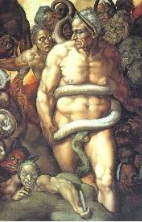
When da Cesena complained even more loudly to Pope Paul and demanded that Michelangelo remove the offensive image, it is alleged that the pontiff replied: ” I might have released you from purgatory, but over hell I have no power.” In contrast with Pope Paul’s view on papal authority over hell, however, was that of a 15th century predecessor, Pope Pius II, who, in 1460, formally enrolled a political enemy, Sigismondo Pandolfo Malatesta, Lord of Rimini, in its domain.

After Michelangelo’s death in 1564, Pope Pius IV ordered the covering of the nudes and the re-working of some figures (Saints Catherine and Biaggio). The task went to a disciple of Michelangelo, Daniele da Volterra, who, thereafter and unhappily, inherited the nickname,
“Il Braghettone” (loin cloth maker). The project was very short lived, however, because the pope died within the year, the scaffolding removed for the upcoming papal conclave and not reassembled during the reign of the succeeding pope, Pius V. In the 1730’s, the effort to drape more nudes commenced in the papacy of Clement XII who commissioned Stefano Pozzi to add loin clothes to many of its figures.

The Sistine Chapel represents one of the greatest artistic achievements in the history of Western art, a sublime work of unrivalled splendor.

No Western artist before Michelangelo had ever been the subject of biography in his own lifetime. This changed, however, when Giorgio Vasari, a contemporary of Michelangelo, his friend, and famous art historian, wrote glowingly of the grandeur of his work.

Vasari said of its importance and impact: “Of the truth, this chapel, as thus painted by his hand, has been the very light of our art, and has done so much for the progress thereof that it has sufficed to illumine the world, which had lain in darkness for so many hundreds of years. Nay, no man who is painter now cares to seek new inventions, attitudes, draperies, originality, and force of expression, or variety in the modes of representation, seeing that all the perfection given to each of these requisites in a work of this character by the highest powers of art are presented to him here, and have been imparted to this work by Michelangelo.”( Giorgio Vasari, The Lives of the Most Excellent Painters, Sculptors, and Architects).

No wonder, then, that of all the many exquisite and interesting artistic treasures on display in the Vatican Museums, this, the Sistine Chapel, remains its most prized, sought after and visited possession.
5. Borgia Apartments
Pope Alexander VI created these apartments on the second story of the papal palace built by his predecessor Pope Nicholas V. Alexander commissioned the Umbrian painter Pinturicchio to decorate its six rooms. The apartments provide a unique view into the spirit of the age and into the lives of Borgia family members including the pope, Lucretia with her golden blond hair, and Cesare in his gilded armor.

When Julius II became pope in 1503 he chose not to occupy the space of his predecessor and created his own apartment on the floor above. Pope Leo XIII restored them in the early 20th century, and Pope Paul VI created there the Museum of Modern Art in 1973. These rooms and fifty others on the same floor and below to showcase over five hundred paintings and sculptures of 19th and 20th century artists from all over the world. In 2021 an art gallery of contemporary art was added to the space.
