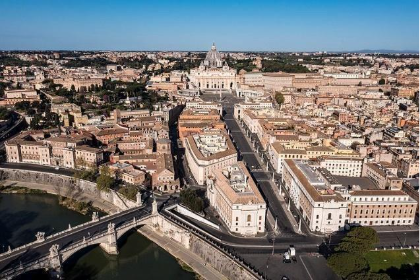
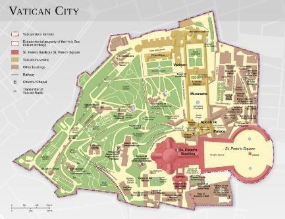
The story of Via del Concilizione can hardly be told without reference to the Vatican City State, an independent political entity consisting of 108 acres of land surrounded by the Leonine Walls. These had been constructed by Pope Leo IV in the 9th century to ward off attacks from Saracen invaders.

The origin of the Papal States dates to 756 AD when Pope Stephen III journeyed across the Alps to seek out the Frankish king, Pepin, and to acquire his military aid to drive out aggressive Lombard tribes from Northern Italy. Pepin succeeded in pacifying the region and donated to the papacy a large tract of land in central Italy to serve as a buffer against foreign invasion of the City. This zone included the regions of Romagna, Emelia, the Marches, Umbria, and Latium and later would become known as the Patrimony of St. Peter. Throughout the Middle Ages and beyond, until the 19th century, popes served both as spiritual head of the Catholic Church and temporal ruler of these Papal States.

This smallest sovereign nation in the world, Vatican City State, came into existence in 1870 after the army of King Emmauel II, having already annexed 17,000 square miles of the Papal States ten years earlier, invaded and occupied the City.
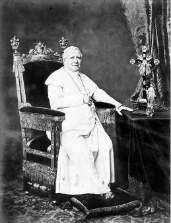
Pope Pius IX refused to recognize the authority of the king over the City. He and all his successors remained in exile behind the walls as ‘prisoners of the Vatican’ for almost sixty years.
In February 1929 the Church (Pope Pius XI) and State (Benito Mussolini) entered into an agreement (Lateran Treaty and Accord). By it the Italian government compensated the Vatican for its expropriated territories, recognized the authority of the Church over marriage in the country, mandated religious education for public schools, recognized the Vatican City State’s full sovereign rights as an independent nation, provided extraterritoriality for St. Peter’s Basilica, Castel Gandolfo, the major basilica of the City, Curial offices and specified properties and institutions outside its walls and the City’s catacombs.

Residents of the City State today number around seven hundred fifty. Inside the walls, the Vatican houses many amenities for residents and employees including a bank, post office, pharmacy, supermarket and coffee bar. As an independent and sovereign state, it also has a train; TV and newspaper offices; fire and police departments along with a jail; hotel (Casa Santa Marta where Pope Francis lived during his papacy); a cemetery; audience hall; convent (where Pope Benedict XVI lived in retirement); and a seminary. Despite these and other amenities, however, it lacks a restaurant, movie theater, barbershop, skateboarding facilities, and high school.

The Borgo area lies today in an area beyond St. Peter’s which in ancient times was bounded by the Tiber at the far end and by two imperial roads, Via Triumphalis to the north and Via Cornelia to the west. In the Middle Ages, especially from the 8th century onwards, associations (scholae) consisting of monasteries and hostels emerged to attend to the pilgrim needs of diverse nationalities flocking to the City. Ina, king of the West Saxons created the first such hostel, the Schola Saxonum, which in the 13th century became Santo Spirito Hospital and still functions ten centuries later.
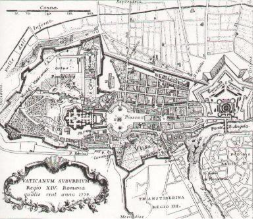
In 852 Pope Leo IV enclosed the entire area within a protective wall (Leonine) to defend the Vatican against attacks hostile forces. Part of it consists of a covered passageway (the Passetto) connecting the Apostolic Palace to Castel Sant’ Angelo. In the 16th century curial officials and wealthy aristocrats populated the area with palaces designed by the best architects of the age: Bramante, Raphael, Bregno, and others.

Via del Conciliazione, a neo-modern and overtly stylized street, came about as a late addition to the area of St. Peter’s, created on the initiative of Benito Mussolini. His highly authoritarian regime ambitiously strove to refashion the City and in 1936 undertook the construction of a very wide and straight road that led directly from the Tiber at the Castel Sant’Angelo junction to St. Peter’s Square. The massive project resulted from the Lateran Pacts of 1929, accords which created a mutually agreeable legal arrangement between the Vatican and Italian government. The street project, although completed in 1950 in time for the Holy Year, necessitated the demolition of a the Spina and a veritable tangle of many streets, houses, palaces (four), church (three), in the Borgo.
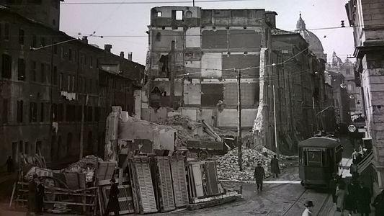
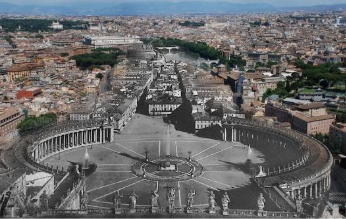
The project, unfortunately, compromised an essential part of Bernini’s conceit in the design of the square. Prior to its construction the square and colonnades were completely invisible visitors to the basilica as they wended their way to it through a maze of crowded, winding, small streets.

Only at the last minute and at the outer edge of the square itself would the magnificent backdrop of the piazza and basilica reveal themselves as if by magic.
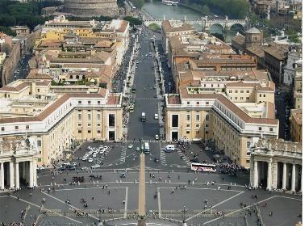
In an effort to counteract this unfortunate defect, the Vatican added propylaea (gateways) to the new palaces on both sides of the street and close to the Vatican. These project outward and toward the center of the street camouflaging the view of the square until the last moment.

Parts of the old Borgo remain in the area of the Leonine Wall on the right
side of St. Peter’s.

Palaces all along the street house many offices of the Roman Curia.
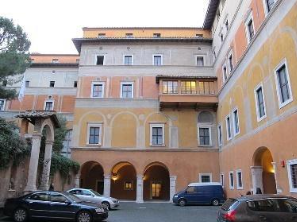
As part of a renovation project to accommodate a new hotel (Four Seasons) in preparation for the Holy Year of 2025, excavators worked at the site of the 15thcentury Palazzo della Rovere, owned by the Knights of the Holy Sepulcher and located near the Tiber end of the road.

They unearthed the remains of a theater built by Emperor Nero in the 1st century. They recovered at the site artifacts both ancient and medieval which will shed new light on the environs of these two important historical periods.