
During the Augustan age Agrippa constructed the Saepta Julia, an extensive colonnaded piazza, in this area of Campo Marzio. In the same general region two other structures already existed built by Pompey, a temple of the Egyptian goddess Isis and Serapis and a shrine to the Roman goddess Minerva.
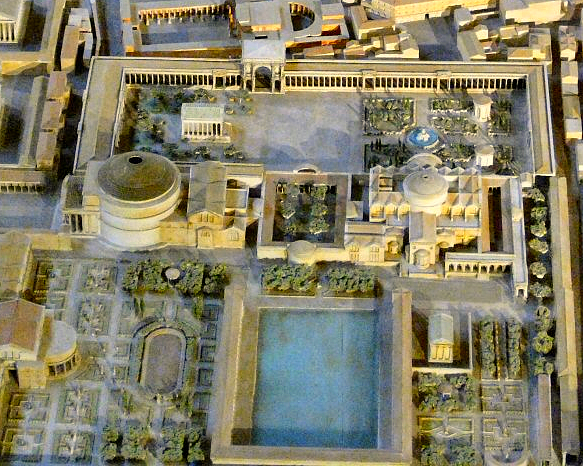
Around 800 AD Christians built a church over the sites of these temples from which, in part, its name, Santa Maria sopra Minerva derives. In 1260 Pope Alexander IV gave the Dominicans a monastery next to church. They moved their administrative headquarters here from Santa Sabina on the Aventine Hill and in 1275 Pope John XXI turned over to them the church as well. In 1280 the Dominicans rebuilt the church and convent under the direction of two of their own, Brothers Sisto and Ristoro, architects earlier of the church of Santa Maria Novella in Florence. Though construction stalled for a short time because of the Babylonian Captivity, the sixty-eight years (1309-1377) when the papacy resided in Avignon, it was finally completed in 1370.

For many centuries Santa Maria served as the parish church of the Florentine community in the City until the 17th century when the local Florentine community constructed the church of San Giovanni dei Fiorentini near the Tiber across from the Vatican. Virtually every period of European art and history appears and shines forth in this unique Dominican church: Egyptian in its obelisk in front, Ancient Roman in its foundations over the Sanctuary of Minerva, Medieval in Fra Angelico’s frescoes and tomb, Gothic in its pointed arches and stained glass, Renaissance in its works by Lippi and Michelangelo, Baroque in sculptures by Bernini, and Modern in its 19th century neo Gothic renovations. Santa Maria, originally constructed in the Gothic style, remains the only one of its kind still extant in the City. Some of its original Gothic features have been diminished because of its many subsequent renovations over the course of centuries: 16th century Renaissance renovations, 17th century Baroque, and in the 19th-century a partial restoration to the earlier Gothic. The 19th century renovation represented an effort to restore the original design but, instead, resulted in creating of mix of Gothic and Italian styles. The church today is better known as a ‘museum church’, because of its spectacular internal ornamentation, than as an historic architectural masterpiece.

In the late 13th century, the Dominicans established their house of theological studies in the convent which later evolved into the current Angelicum, the Pontifical University of St. Thomas Aquinas, now located in another part of the City. The convent of the church also provided the setting for two very turbulent papal elections: Pope Eugene IV in 1431 and Pope Nicholas V in 1447.

As seat of the Dominican Generalate, this huge structure, the size of a city block, became the headquarters of the Inquisition and in 1633 the site of the trial of Galileo.

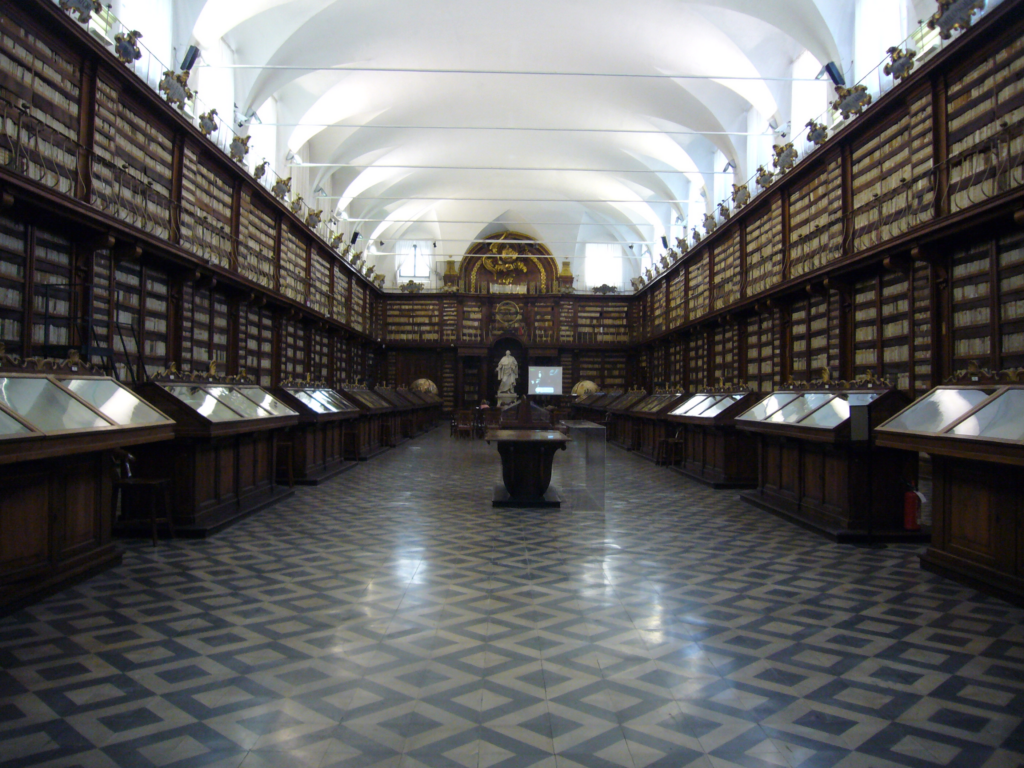
During the French occupation of Rome from 1798 to 1814, Napoleon’s troops stabled their horses desecrated the church by stabling their horses in it. In 1870 the new Italian State expropriated the entire complex of buildings: church, novitiate, convent, cloister, and library. Later the church and a small part of the convent were restored to the Dominican community but not its library of over 360,000 books (Biblioteca Casanatense), owned now by the State (Ministry of Culture) and open to the public.
A 19th century restoration of the church included the addition of stained glass in the windows and the construction of new vaulting over the transept and sanctuary which, unfortunately, rendered less visible the original, Gothic-styled, cross vaulting.

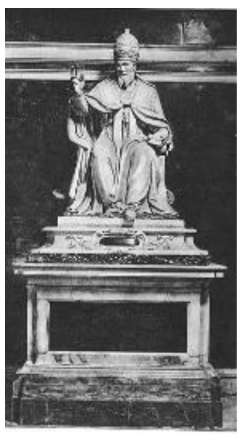
In this same period the Dominicans enshrined under the main altar the relics of Sant Catherine of Siena. Funerary art dating from Middle Ages to the 18th century abounds in this church which, as well, contains the tombs of five popes (Leo X, Clement VII, Paul IV, Urban VII and Benedict XIII) and at least 60 cardinals.
Santa Maria sopra Minerva has a rectangular campanile at the left end of the transept, although invisible from the street. The early Renaissance styled façade displays stained glass rose windows set above its three doors. These and its doors alone remain from its original 15th century design. Faded frescoed lunettes sit over the side doors. The facade consists of one story with three entrances the larger central one topped with a triangular pediment and the coat of arms of the Dominican Pope Saint Pius V.

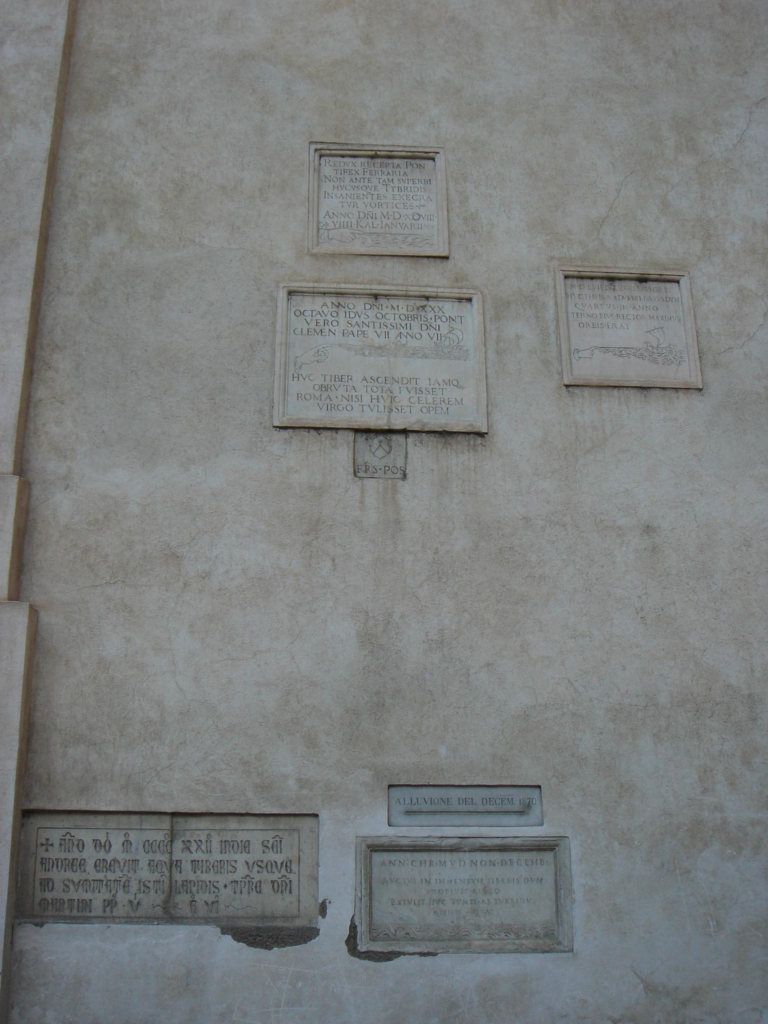
On the right side of the façade hang flood markers, plaques indicating the height of various and regularly occurring Tiber floods over the centuries. The earliest dates from 1422 and the latest 1870. One, dated 1598, speaks of the pope cursing the whirlpools caused by the high waters. Flooding disappeared as a problem after 1870 when the new and secular government came to power and installed embankments along the Tiber.
In front of the church stands an interesting sculpture, Bernini’s Pulcino (little chick), an elephant with an obelisk on its back, erected there in 1667. The obelisk, a fragment from the Temple of Isis, was unearthed in the garden of the monastery and dates to the 6th century BC reign of Pharoah Apries (26th dynasty). Pope Alexander VII commissioned Bernini to create a statue as a symbol of his papal regime to contrast with the sculpture placed by Pope Innocent X in Piazza Navona.
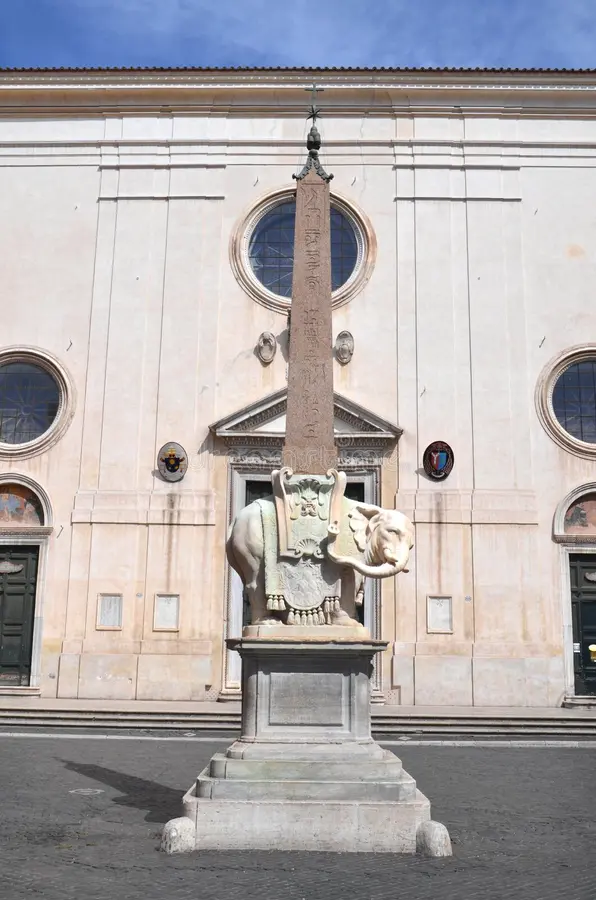
In response, Bernini and his assistants, Ercole Ferrata, in particular, ingeniously created his highly distinctive sculpture, an elephant bearing on its back the burden of an obelisk which itself bears the Chigi family coat of arms. The small obelisk, only six feet tall, arrived in the City along with two others transported by the emperor Domitian from Heliopolis in Egypt. Unearthed fortuitously near the church in 1650, it became easily available for Bernini’s sculpture. The pope himself composed the Latin inscription on its base which makes reference to the elephant as the symbol of robust intelligence needed to support solid wisdom. This monument’s construction took place not without dissension, however. Bernini argued with the Dominican superior, Father Paglia, over its design. Paglia wanted a dog symbol as reference to the Order (domini canis), but Alexander VII insisted on the elephant, the wisdom symbol, to represent sunlight and, thereby, to glorify his own papal reign. In addition, Bernini intended that the elephant have free standing legs, but Paglia opposed this because he believed that structure wouldn’t support the obelisk. Forced to design bas relief legs with a saddle cloth covering the solid space, Bernini, however, had the last word by aiming the backside of the elephant directly at the Dominican House. The elephant lifts his tail and, in addition, smiles serenely and with a grand look of relief. Some believe that Bernini, a recognized master at caricature drawing, incised on the elephant’s face some recognizable features of Pope Alexander: its sly expression and twinkling eyes look toward the obelisk. It is certain, however, that the project did not please Pasquino in the least. Of Pope Alexander, a lover of building construction and a victim of frequent kidney- stone attacks, he remarked that in this project, the pope had suffered a “mal de pietra” (stone attack).

The Santa Maria sopra Minerva plan incorporates the Latin cross style dominated by its nave, side aisles, a transept, an apse enclosing the sanctuary, and behind it a choir.

Pointed arches instead of the rounded Romanesque ones typically found in most Roman churches and stained glass windows from the 19th century renovation restoration abound throughout the structure. These center around a symbolic heaven studded with golden stars and the fresco scheme figures of the Apostles, the Evangelists, Doctors of the Church and Major Prophets. Above the ceiling lie attics where during World War II the Dominicans courageously provided hiding places for Jews, escaped POW’s, and Italian dissidents.

A medieval confraternity founded by a major benefactor of the church, the Dominican Cardinal Juan de Torquemada, uncle of the infamous Grand Inquisitor, Tomasso Torquemada, commissioned its construction. Carlo Maderno designed the Annunciation Chapel on the right side. It houses an altarpiece, the Annunciation, executed in 1500 by Antinozzo Romano, as well memorial tombs of notables like Torquemada and Benedetto Giustiniani, brother of Vincenzo, an early patron and protector of Caravaggio, the innovative Baroque painter.

Buried here as well is the Dominican Pope Urban VII who died of malaria in 1519 after being pope for 12 days, the shortest of all papal reigns.

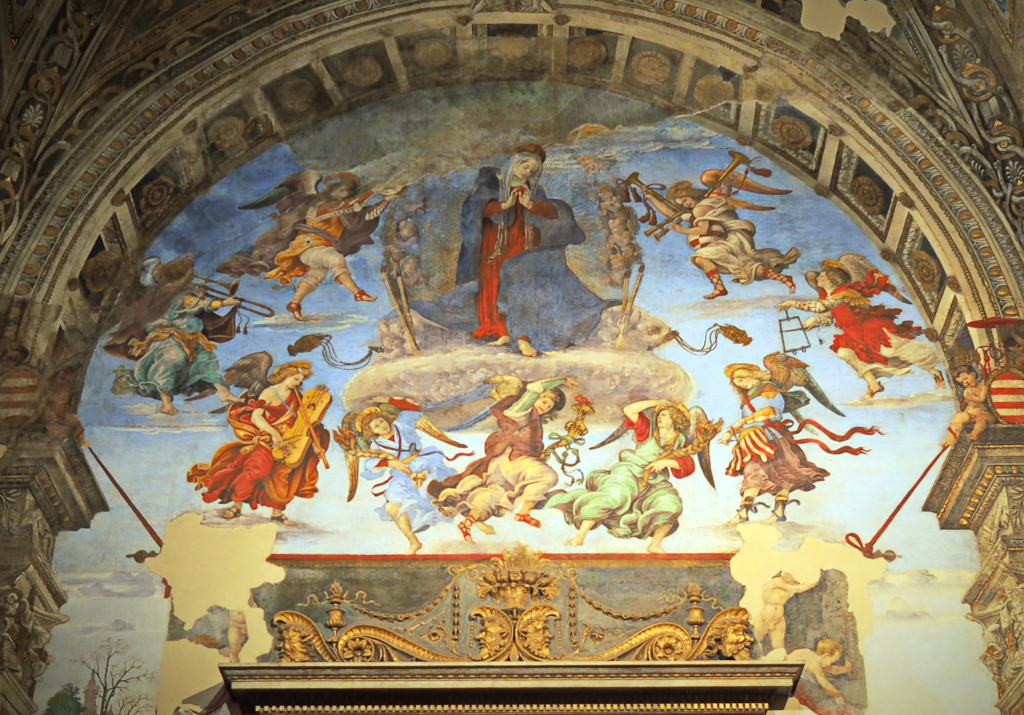
The Carafa Chapel at the end of the right side of the transept stands out as one of the most aesthetically impressive and pleasing parts of the church. Commissioned by Cardinal Olivero Carafa in 1489, he dedicated it to the Assumption of Mary and to the great Dominican theologian, St. Thomas Aquinas.

An elegant triumphal arch designed by Mino da Fiesole, Andrea del Verrocchio and Giuliano da Maiano sets the tone for the magnificent interior space. Filippino Lippi painted the altarpiece in oils, the Assumption of Mary, and frescoed the walls and vault. The altarpiece on the wall behind the altar depicts Aquinas presenting Cardinal Carafa to the Blessed Mother.
In the Triumph of St. Thomas fresco on right hand wall, Lippi’s masterpiece, Aquinas sits in judgment over two ancient heretics, Arius and Sabellius. Four female figures with him represent allegories of Grammar, Rhetoric, Dialectic and Philosophy, subjects of study in mediaeval schools. Thomas himself symbolizes Theology. The younger men in the fresco would later become the Medici popes, Leo X and Clement VII. In the background appears an image of the earlier medieval Papal Palace at the Lateran. In front of it rears up the Marcus Aurelius equestrian statue which Michelangelo very reluctantly moved to the center of the Campidoglio at the behest of Pope Clement.

The tomb of the Carafa Pope Paul IV rests on original marble flooring (pietra dura) of the chapel on the left side.
Next to the Carafa Chapel stands the medieval Gothic tomb of Bishop William Durandus, an influential canonist and papal diplomat. A colorful, 14th century mosaic of the Madonna and Child adorns the unusual tomb.

Two organ lofts located on nearby transept walls came as gifts to the church by Cardinal Scipio Borghese, Cardinal Protector of the Dominican Order. On the right of the apse rests Our Lady of the Rosary Chapel (Capranica) where, on the right wall, rests Andrea Bregno’s sculpted tomb of Cardinal Domenico Capranica, benefactor of the church.

A 19th century statue of John the Baptist stands near the altar on the left side, placed there to match the Michelangelo statue on the opposite side of the sanctuary.

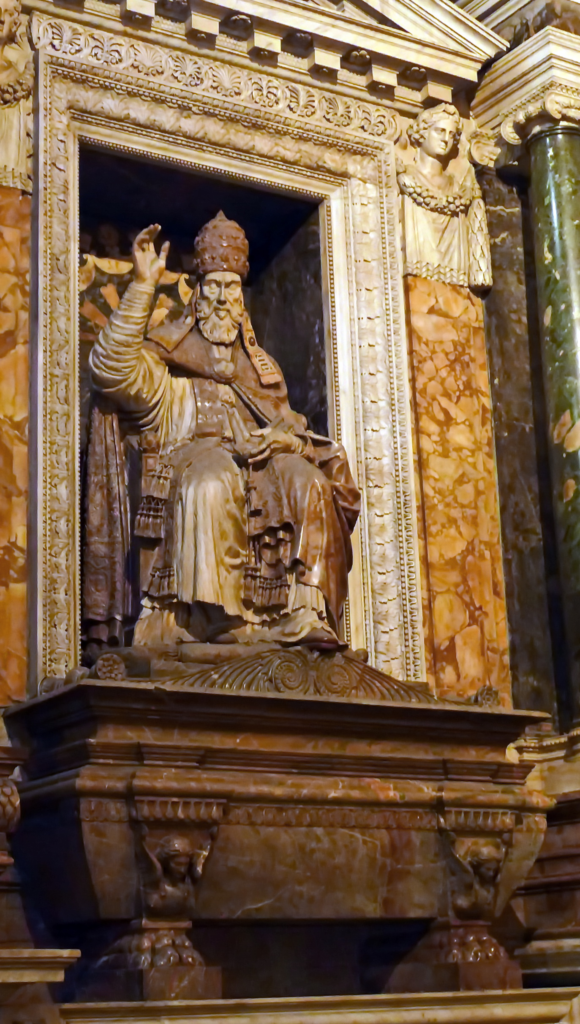
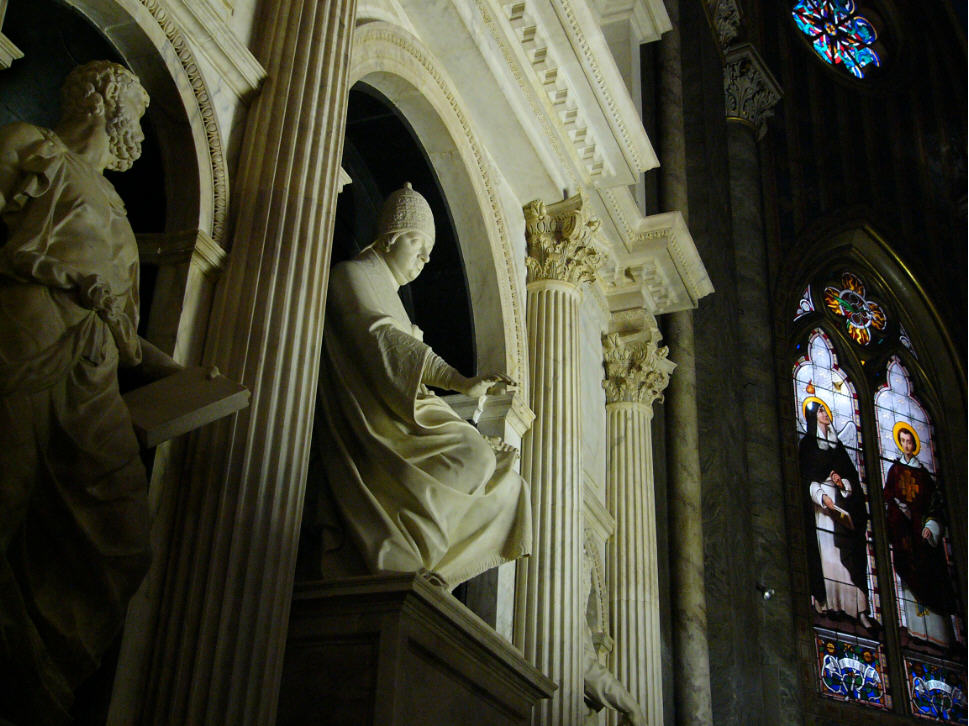
In the mid-16th century Antonio da Sangallo the Younger renovated the original apse of the 13th century church to make way for the choir and the matching funerary monuments of the Medici popes, Leo X on the left and Clement VII on the right, both designed by Baccio Bandinelli and featuring Corinthian columns flanking their niches. In front of choir stalls lies the floor tomb of Cardinal Pietro Bembo, a noted Renaissance humanist and, as well, a good friend of Michelangelo and Raphael.
The shrine of St. Catherine of Siena, Doctor of the Church, patron of Italy and co-patron of Europe lies under the high altar. The metal and glass Gothic casket designed by Isaiah da Pisa contains her marble likeness and most of her relics rest in a silver urn. Her native city, Siena, retains possession of her head.

To the left of the sanctuary stands Michelangelo’s Statue of Christ the Saviour. He began its execution in 1515 but quickly abandoned it because of a flaw in the marble. Contract obligations obligated resumption of the project and the work was turned over to and completed by his pupils, Pietro Urbani and Federico Frizzi sometime after 1521. Most art scholars believe that Michelangelo put the finishing touches on the sculpture. These believe also that the sculpture represents Christ, carrying the instrument of his death when he appeared to St. Peter on the Via Appia as Peter was fleeing the City during Nero’s persecution of the Christian community. A copy of it once existed, but no longer, in the Domine Quo Vadis church on the Via Appia Antiqua. The statue originally stood nude and bronze coverings were only later superimposed over its loin parts.

A pavement tomb of the Dominican painter Fra Angelico lies on the floor to the left of Michelangelo’s sculpture. Pope Nicholas V, his patron in the City, wrote the epitaph on the tomb. Fra Angelico (Giovanni da Fiesole), famous for his frescoes in the Florentine monastery of San Marco. died in the adjacent convent while painting Vatican frescoes. Pope John Paul II beatified him in 1982 and proclaimed him patron saint of artists. In this area of the church proliferate floor tombs of prominent medieval aristocratic families such as the Frangipani and Capodiferro.

The sacristy stands at the far corner of the left side of the transept. The 1431 election of Pope Eugene IV took place here. Cardinal Antonio Barberini commissioned its decorations which account for the Barberini bees visible throughout. The reconstructed room where St. Catherine of Siena died in 1380 lies in the rear. Cardinal Barberini in the 17th century removed it from its original site near the church on Via Santa Chiara #14 and sponsored its construction in the church.

St. Dominic’s Chapel at the left end of the transept is the largest in the church. Black and white colors of the Dominican Order subtly pervade the space. Near the entrance stands the 18th century monumental tomb of the Dominican pope, Benedict XIII whose cause for canonization has been introduced three times, most recently in 2004.

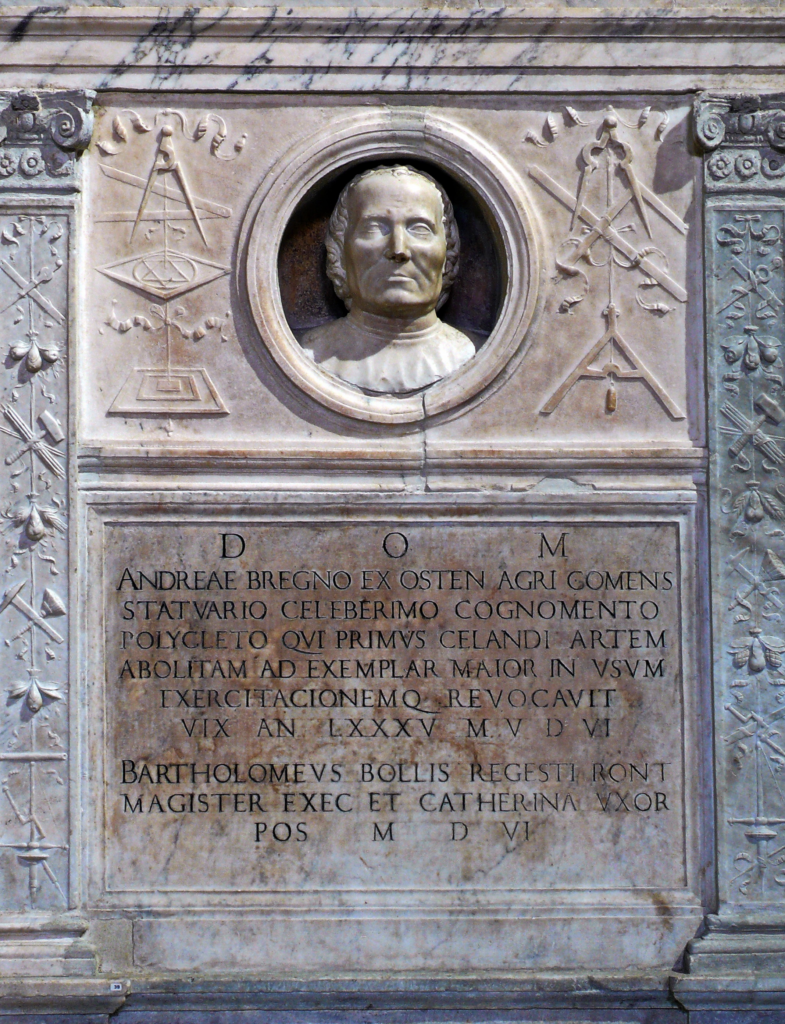
The portrait tomb of the well-known, 15th sculptor, Andrea Bregno, rests on the wall outside this chapel.
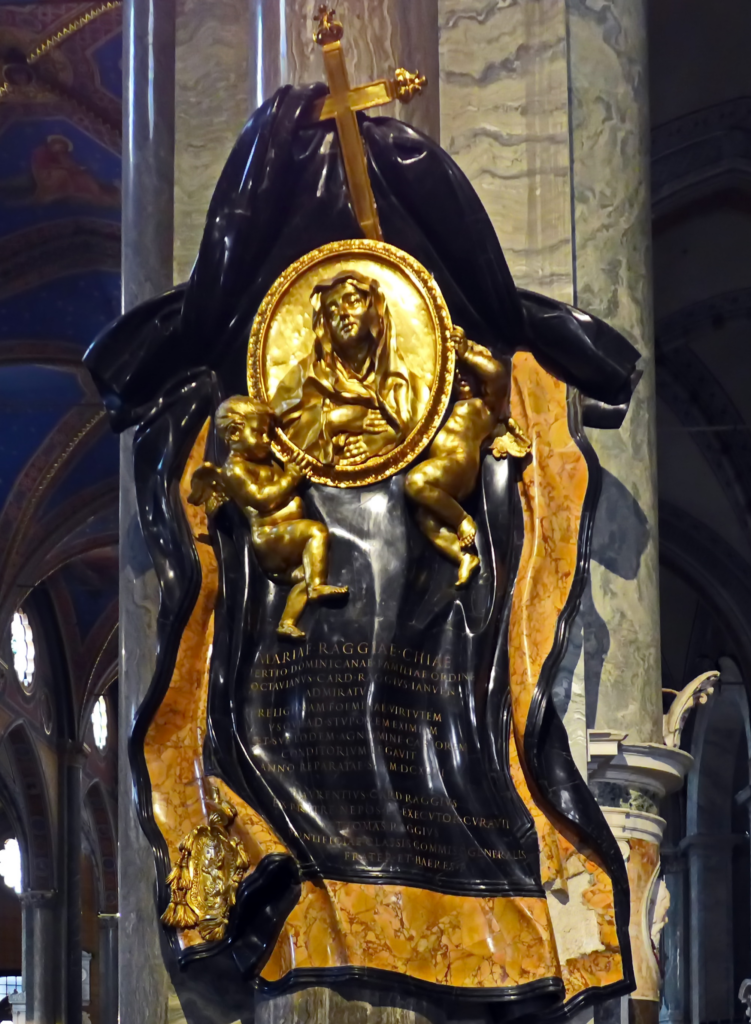
Bernini sculpted two monuments near it, the first, early in his career, the monument to Sister Maria Raggi, a nun and mystic from an aristocratic family. It demonstrates a characteristic feature of his genius, the ability to shape marble into a wide variety of dynamic forms of his choice. The drapery of the nun in this instance moves in such a way as to reveal her image, a figure unconventional for its time because it depicts the subject at the very instant of death. Bernini excelled in applying the principles of Baroque style to funerary art and set new and long-enduring standards for this art form throughout much of the Western world. It combined, typically, a host of predictable elements: dynamic movement, and dramatic background scenes together with idealization of the deceased’s virtues, sorrowing figures, and allegorical symbols.
The other sculpture, a monument to Giovanni Vigevano, stands out as an amazing life-like bust carved by Bernini when Vigevano was still alive.

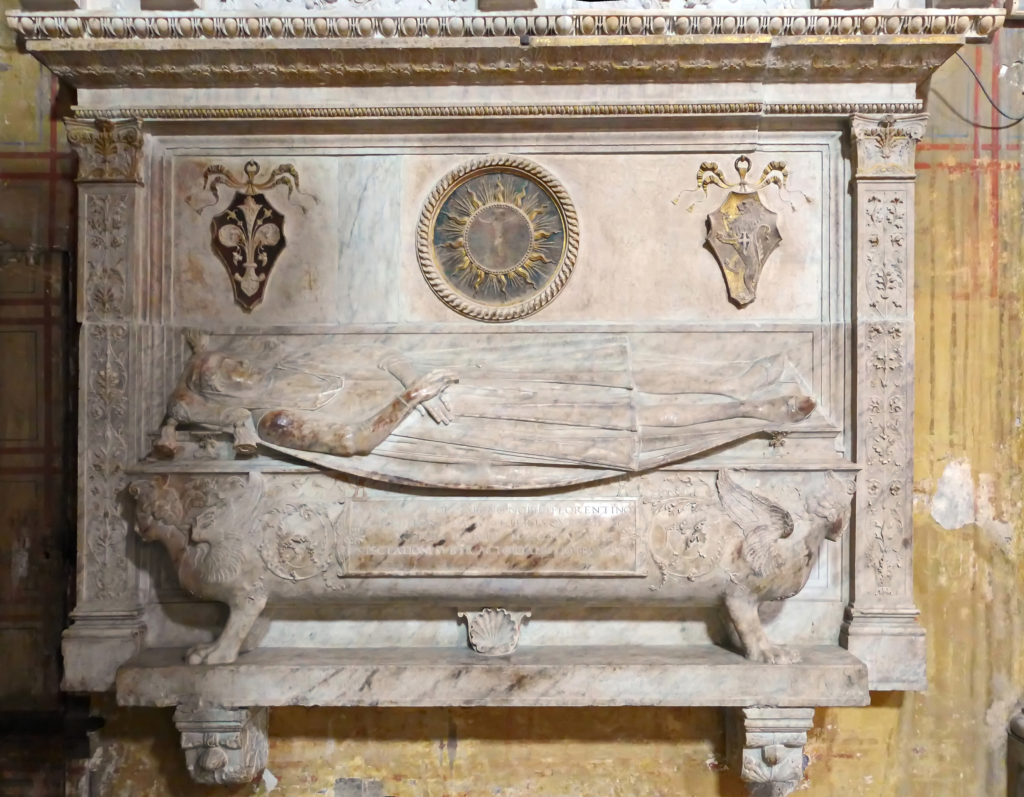
On the left side of the church near the back sits the Chapel of St. John the Baptist and in it the monument of Gregorio Naro recently attributed to Bernini. Just inside the left-hand door of the church rests the 15th century tomb of Francesco Tornabuoni by Mino da Fiesole and above it that of Cardinal Tebaldi sculpted by Andrea Bregno and Giovanni Dalmata.
During World War II in the period known as the Shoah when the Nazi regime targeted the Jewish people for total annihilations, as many as 4000 Roman Jews were hidden in private homes and religious houses and monasteries throughout the City. Nazis occupied the City for nine months during 1943-1944, during which time over 2000 Jews were deported and murdered in the concentration camps of Germany. The Dominicans saved some of them by hiding them in the attics above the ceiling of the church.
