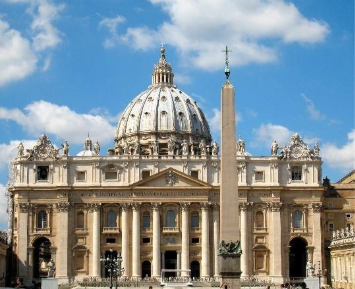
In some sense Rome is the City of St. Peter where his cult finds expression in multiple sites: the Lateran, San Pietro in Montorio, San Pietro in Vinculi, San Sebastiano, but most especially at St. Peter’s Basilica. The world’s most famous church and its largest (200 yards x 150 yards x 150 yards), St. Peter’s is merely a “papal” basilica, one of several, and, to the great surprise of most visitors, superseded in title and dignity by St. John Lateran whose official title is archbasilica. The Lateran remains as the official episcopal see of the Bishop of Rome since its construction by Constantine in the 4th century. St. Peter’s and the Lateran, however, represent but two of the seven churches designated as the Seven Pilgrim Churches of the City. St. Philip originated this designation in 1552 when he urged Romans to join him on a pilgrimage to these sites on the Thursday before Lent. The other five include St. Paul outside the Walls, San Lorenzo fuori le Mura, Santa Croce in Gerusalemme, San Sebastiano and Saint Mary Major.
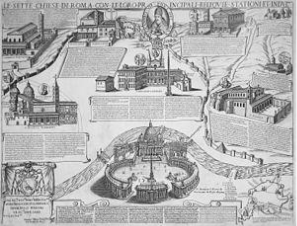
Art historians regard this basilica as the ‘architectural equivalent of an epic poem’ because its completion included 5 major changes in plans, spanned the reigns of twenty popes, engaged at least twelve architects, and required over one hundred fifty years to build. Even more, it is said, the church represents the fusion of the very best elements of Western architectural history and tradition: the Etruscan arch, vault, and dome; the Greek ideal of harmony, proportion, and unity; the Roman fusion of cement and brick; the Byzantine appreciation of the sensory. Effortlessly, does it combine a magnificent Renaissance dome (Michelangelo) with a Baroque monumental facade and expansive piazza (Bernini). Origins of the basilica extend back to the Roman persecution of Christians in the 1st century.
State officials crucified the Apostle Peter on the Vatican Hill at the Circus of Nero in 67 AD.

Almost from the beginning of its history Romans thought of the Vatican Hill as sacred space. The City’s second king, Numa Pompilius, created its first public religious institutions there and consulted its representatives whose pronouncements he conveyed to the populace on the other side of the Tiber.

The Vatican Hill became incorporated into the City boundaries around 850
AD during the reign of Pope Leo IV when he created the ‘Leonine Wall’ to protect St. Peter’s and surrounding area from hostile forces after the
Muslim Sack of 846.
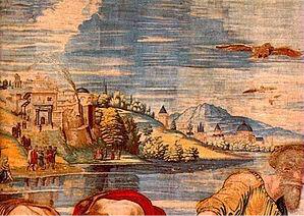
After the Great Fire of 64 AD, Nero hunted down and murdered members of the Christian community, especially its leaders whom he scapegoated for the conflagration. Caught up in the persecution, Peter died, hung upside down, in Nero’s Circus located at the base of the Vatican Hill. An obelisk sat at its center (spina) and this remained in its original position until 1586 when moved by Domenico Fontana to its present location in St.
Peter’s Square.

Christians buried Peter, murdered in the Circus, in a nearby cemetery close to the Via Cornelia.

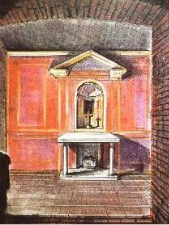
With the passage of time a cult shrine, the Trophy of Gaius, erected over the grave of Peter by Pope Anacletus around 160 AD, became a devotional place where Christians came to pray and honor the martyred Apostle. A simple, small open-air aedicule, it consisted of a niche against a wall built over the grave, topped by a travertine slab and supported by two columns. Most of Peter’s successors, except Pope Clement I, martyred in the Crimea, were buried in this cemetery until the third century.
The Emperor Constantine befriended the Christian church after the 311 AD Milvian bridge defeat of Maxentius, his rival for the imperial throne. In gratitude to the Christian God for this victory and, as well, to promote appropriate worship, Constantine ordered, during the reign of Pope Miltiades, the construction of ten churches in the City as votive offerings, all but one located outside of its walls. Upon two in particular, the Lateran (the bishop’s church, cathedra) and Santa Croce in Gerusalemme (his mother Helena’s church, he lavished munificent endowments, five hundred pounds of gold and over twelve hundred of silver. The others were votive churches, devotional shrines built over the tombs of martyrs. Two of these especially stood out, in the minds and hearts of the City’s Christians: St. Peter’s and St. Paul fuori le Mura. In this respect, St. Peter’s is the first church of its kind in the City, a ‘basilica ad corpus’, a
church built directly over the tomb of a martyr.
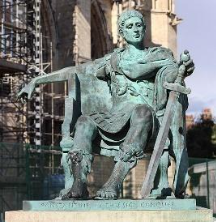
With this gesture Constantine, unwittingly, initiated a new epoch in Roman history. The long, one thousand year, story of the ancient, pagan City, which would disappear in 476 AD, harkens back in its foundational myth to two brothers, Romulus and Remus. A new, different, long-lived Christian city and empire would gradually emerge from it, catalyzed by Constantine’s architectural initiative, and tied foundationally to the stories of two apostles, Saints Peter and Paul. Some scholars question the historicity of the factual presence in the City either Peter or Paul and cite the lack of any direct historical evidence to substantiate it. Many others, however, believe that there are too many secondary sources, literary and monumental, which, along with established tradition, provide enough very plausible reasons to hold that both saints resided and died there. In addition to the burial sites of these two leading apostles, many churches in the City preserve the relics of the other original followers called by Christ: Saints Jude and Simon in St. Peter’s, St. Mathias in Santa Maria Maggiore, St. Batholomew in his church on the Tiber Island, Saints Philip and James (Less) in the Church of Santi Apostoli, and St. Andrew in the Church of San Andrea al Quirinale.

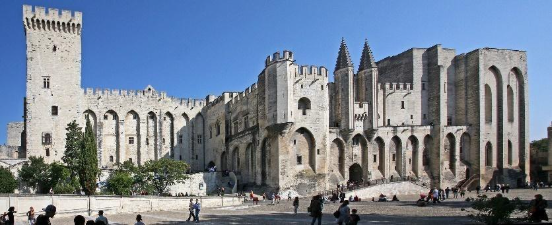
When the two parts of the Roman Empire, West and East, were reunited in 324, Constantine transferred its capital to the ancient Greek city of Byzantium, rebuilt to serve the administrative and military needs of the state, and renamed Constantinople in his honor. Throughout most of the first one thousand years of the Church’s history after Constantine, popes mostly took up residence at the Lateran Palace and then at St. Peter’s after the 14th century. They frequently resided for short periods of time outside the City in family fortresses in places such as Anagni, Orvieto, and Viterbo. The most notorious of these residences was the Papal Palace at Avignon where in the 14th century popes spent seventy-two consecutive years until the end of the Great Schism in 1417.
The construction of the church over Peter’s Trophy in 315 AD proved to be an extraordinarily difficult engineering project because of the location of the necropolis on the steep slope of the Vatican hill. In addition to that, Roman law and custom prohibited the demolition of any burial ground. Only a very strong imperial will (Constantine) and access to great financial resources (State) could overcome these almost insurmountable difficulties. The emperor personally marked out the boundaries for the church complex, carrying twelve baskets of earth as a symbol of the twelve apostles.

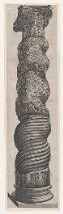
Consecrated in 326 by Pope Silverius, long before its completion in 346 AD, the basilica had five doors: on the far left, the Door of Judgement for funerals; the Ravenatti door for men; the middle door, Silver Door over which was the Latin inscription, Limen Apostoli (‘threshold of the Apostle’), for special functions; the Roman door for women; the Guides’ door for pilgrims and visitors. From archeological evidence, it appears that its first foundations were laid for a square structure, probably later changed for topographical reasons requiring a more longitudinal structure. The addition of a transept separating nave and apse (the first of its kind in the City) resulted from the placement of the main altar over the Apostle’s tomb in a basilica-styled structure. The basilica consisted of a central nave, side aisles on each side, a transept extending on each side beyond the nave, a triumphal arch and a semi-circular apse, the tomb under a rectangular, marble box visible from the nave and accessible to the faithful. An opening in the pavement allowed the lowering of objects such as strips of cloth providing pilgrims the opportunity to acquire relics of the Saint. Over the shrine rose a marble canopy supported by six twisted columns (‘Solomonic’), allegedly from the Temple of Jerusalem.
Throughout the Middle Ages the Basilica was enlarged, renovated, and restored many times over. More than one hundred chapels were added to the internal structure. Pope Symmachus was the first pope, in 498 AD, to take up residence in a palace he constructed near the atrium (quadriporticus). Here in this palace Charlemagne resided in 800 AD on the eve of his coronation by Pope Leo III as emperor of the newly established Christian Roman Empire.

Thirty-five steps led to a terrace in front of the atrium, named ‘the Paradise’ which contained palm and olive trees.
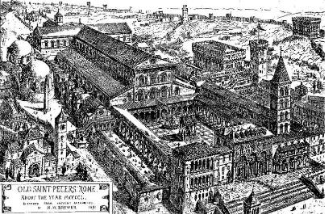
In the center stood an ancient pine cone (legend said from the Pantheon) now in the Vatican Museums. It was covered by a canopy on which rested two peacocks taken from the Mausoleum of Hadrian (Castel Sant’Angelo).

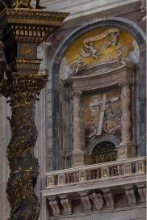
In 594 Pope St. Gregory set a new altar over the original Constantinian shrine. He created around it a new baldacchino supported by twelve Solomonic columns, six from the previous monument plus six others many of which Bernini in the 17th century set into small balconies on the piers supporting the dome. Two staircases leading to the shrine were also added.
Throughout most of its history, the Vatican Hill was not fortified because of its location far outside the ancient city walls. In 846 Saracen pirates (11,000) from North Africa landed in 76 ships at the mouth of the Tiber, made their way to the City, and plundered the undefended basilicas of St. Peter and St. Paul. Incentivized by this catastrophic event, Pope Leo IV built walls (Leonine) around the church and Borgo creating, thereby, the ‘Leonine City’. Not long afterwards, around 880 AD, Pope John VIII fortified the area around San Paolo fuori le Mure to safeguard that settlement then called the Ioannipolis.

In the late 13th century Pope Nicholas III rebuilt the Papal Palace and the first Vatican conclave took place here in 1303 electing Pope Benedict XI. Within six years succeeding popes moved to Avignon and resided there for most of the 14th century. The palace, basilica, and the entire city suffered very serious neglect and deterioration during the papal absence. When the popes finally returned to the City in 1377 (Babylonian Captivity), the Great Schism soon followed and rocked the papacy until 1417 when Pope Martin V (1417-1431) was elected and universally recognized as the legitimate pope.
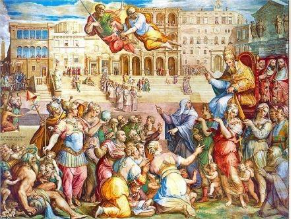
Because of its sad state of deterioration Pope Nicholas V (1447-1455) moved the papal residence from the Lateran to the Vatican which, since 804, had been enclosed by the Leonine Wall (Pope Leo IV). Nicholas V enlarged the Vatican palace complex, adorned its chapel with frescoes by the Florentine Fra Angelico, and linked the complex with a wall to Castel Sant’ Angelo. Thereafter, it became the permanent residence of the papacy and successive popes vied with one another to make the compound more magnificent and grandiose. Innocent VIII (1484-1492) constructed a summer residence (Belvedere) on an elevated part of the property, Alexander VI created the Borgia Apartment, Julius II (1503-1513) constructed a new papal apartment and linked the Belvedere to the palace with two parallel wings (Cortile del Belvedere), Leo X (1513-1521) added the Loggia of Raphael, Paul III (1534-1549) created the Paoline Chapel and Scala Regia, and Sixtus V (1585-1590) transformed this some of this space to create the Sistine Chapel.

By the mid-15th century, however, architects such Leon Battista Alberti, the first architect of the Renaissance papacy, a gifted painter, sculptor, archeologist and writer, became aware that nave walls were leaning outwards, a serious threat to the entire structure.
Pope Nicholas V invited the Florentine architect Bernardino Rossellino to the draw up a design for the construction of a new church and palace.
Nicholas and his papal successors, inspired by the achievements of the ancient City, thought of themselves as heirs to its imperial glory.
Encouraged by humanist scholars, artists and curial officials like Alberti, Rossellino, Poggio Bracciolini, Donato Bramante, Andrea Bregno and Michelangelo, they enthusiastically embraced the architectural models of the classical past.
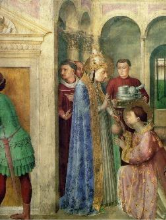
Nicholas V succeeded in creating the palace around 1450, but not the church. The 13th century palace stands now a part of the Cortile del Pappagallo, next to the more modern, Cortile del Damaso, and remains the oldest part of the Apostolic Palace. Fifty years later, Pope Julius II became the first pope to undertake the actual construction of a new basilica. Julius, a della Rovere family member whose uncle ruled as Pope Sixtus IV (Sistine Chapel), stands out as one of the papacy’s most energetic, bold, and decisive representatives. Justifiably did he deserve his many nicknames: ‘Il Terribile’ and the ‘warrior pope’. Even though some of his contemporaries believed that the only thing priestly in him ‘was the robe and the name’, he succeeded in his relatively brief, ten-year, papacy to re-establish the City not only as the hub of European politics but, as well, the urban epicenter of the arts. Because of his many successful, urban renewal projects, he transformed the City into a metropolis well-regulated, clean, beautiful, and modernized. Another of his nicknames was ‘Il Ruinante’, applied to him by those who opposed the demolition of the basilica. If not for that reason, however, the nickname would have been amply justified because Julius was the first pope to actively demolish ancient monuments to utilize their spolia for the construction of new buildings. Before his papacy only ancient remnants fallen to the ground were employed for architectural purposes. Raphael was so amazed at this turn of events that maintained a list of demolitions he witnessed with his own eyes: the Temple of Ceres, Forum of Nerva, and Baths of Diocletian.

Donato Bramante designed the new church in the form of a Greek cross (symbol of martyrdom) with four equally long arms over which he intended to raise a huge central dome. Bramante’s vision resulted in a structure which integrates features of the Basilica of Maximus with its huge naves and the Pantheon with its spectacular dome. Bramante initiated partial demolition of the basilica in 1506 and thereby earned for himself among irate Romans the derogatory moniker, “Mastro Ruinante” (‘master wrecker’). Workers laid the cornerstone and part of the foundations for the new structure in 1506 along with the piers of the central dome.

Pope Julius died in 1513, and his successor, Pope Leo X, chose new chief architects, Giuliano da Sangallo and Raphael. To increase the amount of space for processions in the basilica they decided to add more length to the nave, leading Raphael to change the design plan from a Greek to a Latin cross. When he died suddenly in 1520, his successor laid aside his scheme.

Michelangelo eventually succeeded him as chief architect and superintendent of the project in 1546. For the next fourteen years construction of the church consumed him. The drum of the dome, the vaulting of the choir and transepts, and the huge pilasters on its external walls provide evidence of his tangible input. He returned to the more simplified form of Bramante-based Greek cross and set permanent and irreversible foundations for the main part of the basilica beyond the nave, putting in place four free-standing piers around the Petrine shrine. When he died in 1564, work on the nave of the ancient basilica halted for forty years but, nonetheless, its direction set forever in the piers he had laid in the ground below.
Other architects followed: Vignola, Giacomo della Porta, Domenico Fontana, Carlo Maderno, Gian Lorenzo Bernini. Della Porta completed the dome in 1589. Carlo Maderno finally returned to the nave in 1607. It and the facade were completed in 1614. Oddly enough, the inscription on the façade states erroneously that its construction was completed in 1612.

Pope Paul V ordered the redesign of the plan to a Latin Cross in part because of the recommendation of the Council of Trent that a Latin cross design was the most appropriate one for Western churches.

The façade of Old St. Peter’s reached to the point where the Chapel of the Pieta lies today. Carlo Maderno extended the nave forward, with its three chapels on each side, including that of the Pieta. The extra length of the nave results in the partial concealment of Michelangelo’s dome, an object of criticism then and now. To the façade Maderno added a pair of campaniles (bell towers) on both sides. The foundations of these were not adequate and work was halted, but only after they had reached the level of the roofline. This results in a disproportionately wide façade, the object of yet more criticism to this day.

Pope Urban VIII consecrated the Basilica in 1626, but work on the interior decoration continued for the next fifty years. The pope commissioned Gian Lorenzo Bernini, his favorite architect, to create a baldacchino over the high altar. So great was the pope’s esteem for the artist that he made him a papal cavaliere (knight) at the age of 23 and gave him unrestricted access to his private quarters. He told Bernini that while ‘the cavaliere had the great good fortune to see Cardinal Barberini pope, the pope had the much greater good fortune to have the Cavaliere alive in his pontificate’. Six years into his papacy Pope Urban made Bernini chief architect of the entire project in 1629. He who served six popes in his long artistic career, directed for forty years the interior decoration of the basilica, the creation of the shrine for the Cathedra Petri and papal tombs in the back of the church, the construction of the colonnades in the piazza, as well as the baldacchino itself. His efforts, both internally and externally, resulted in the City’s most magnificent and ingenious expression of Baroque style combined with orthodox theology. Of him rightly did the Barberini pope remark: “You were made for Rome, and Rome for you”.
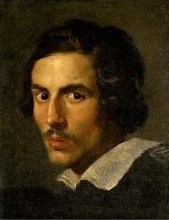
Modern access to the Basilica came in 1937 with the construction of the Via del Conciliazione which cut through the ancient neighborhood of the Borgo Vecchio with its narrow and winding streets and cramped quarters. Demolition of this Medieval area obliterated the characteristic Baroque surprise for visitors to the basilica who got their first real sight of the piazza and basilica at the last moment on the edge of the neighborhood houses and shops just as they crossed over to the square opening before their eyes. Palatial propylaea near the square were added to address that issue of perspective. In 2023 it was announced that the space between the Via and Castel Sant’Angelo would be renovated to better accommodate pilgrims visiting the City for the 2025 Holy Year.

Workers discovered an ancient necropolis under the basilica in 1939. During the tears of World War II, excavations unearthed the tomb of Peter and eventually the bones of the Apostle.
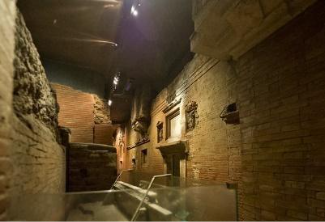
St. Peter’s is, indeed, the world’s largest church: modelled on ancient Roman bath complexes, it covers almost six acres. The arches between its pillars rise six stories high and the external main dome four hundred fifty feet. It can hold over 55,000 worshippers within its walls and throughout the structure sit over forty-five altars. The marvelous harmony of its parts greatly camouflages its great complexity and enormity. The space of its foyer alone, for example, is larger than many of the world’s grandest churches.

Travertine marble covers the basilica’s exterior providing it with a creamy white sheen.
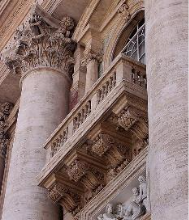
Michelangelo designed the drum of the double shelled dome, the City’s largest, which externally dominates and controls the whole structure. This characteristic feature reflects a long European tradition of dome construction. The origins of cupolas extend back to 6th century Etruscans and Greeks. Romans adopted the feature and took advantage of the newly discovered material, cement, which enabled them to create much larger structures. The Pantheon, for example, built by Hadrian around 120 AD, featured the world’s largest dome measuring over 131 feet at its base.
While the art of cupola building disappeared in the West during the Middle Ages, Filippo Brunelleschi revived it in the 15th century when he constructed in Florence his masterpiece, the remarkable Duomo.
Impressed by this magnificent structure, the young Michelangelo upon his
departure for Rome determined that he would create for the City ‘your sister – not as majestic, but larger’. He fulfilled his promise by creating a dome whose diameter (one hundred thirty-six feet) does not measure as wide as those of the Pantheon or Florentine Duomo, but rises from its floor (four hundred fifty feet), higher than any other dome in the world.
Michelangelo worked uninterruptedly on the dome from 1547 until 1564, the year of his death. His successor, Giacomo della Porta, completed the project in 1590, and slightly modified Michelangelo’s design by creating a more pointed, upward-thrusting structure than the Maestro had intended.
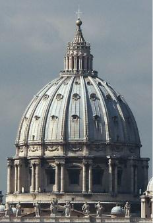
Each of the dome’s sixteen sections has a large rectangular window separated by pairs of Corinthian columns. The columns and plinths disguise buttresses inserted to stop the drum from buckling under the weight of the dome. The dome itself is egg-shaped, in contrast with the hemispherical shape intended by Michelangelo. It contains sixteen lead covered stone ribs meeting at the base of the lantern over which sits a cupola, cross, and ball finial. Inside the shell, multiple internal staircases each with three hundred two steps leading to the lantern itself.
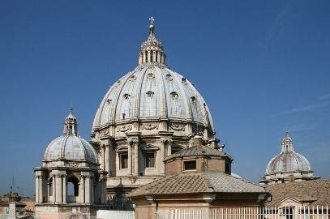
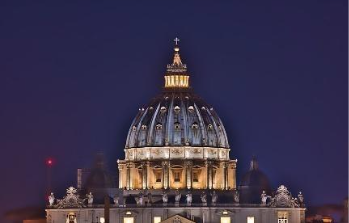
Lantern lights and torches (5191 total) in the past occasionally illuminated the cupola. The lights were illuminated by over 2000 persons, mostly sampietrini (St. Peter’s construction workers). The sampietrini history extends back to the construction of the basilica itself. They are a group of masons, technicians and construction workers (Confraternita) attached to the Fabrica di San Pietro responsible for the maintenance of the entire structure. Until the 20th century, they lit the torches of the dome for special religious celebrations. One of them, in 1938, slipped, fell, and died during that process causing Pope Pius XII to replace the torches with electric lights.
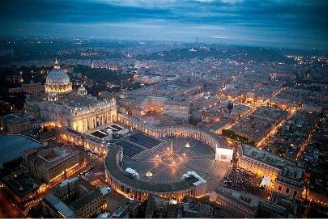
Gian Lorenzo Bernini, St. Peter’s last architect, designed the magnificent piazza in front of the basilica, one and a half times the size of the Colosseum and one of his most successful architectural endeavors.
No one more than Bernini better represented the spirit of the Counter-Reformation, shaped the spiritual aspirations of the age, and artistically expressed the orthodoxy of the 17th Roman Church.

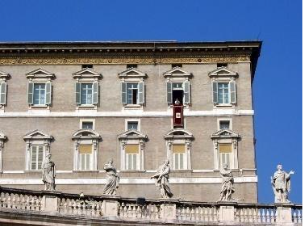
Pope Alexander VII asked Bernini to create an appropriate forecourt designed to hold as many faithful as possible so that they could see the Pope give his blessing both from the balcony on the façade of the church or from a window of the Papal Palace.
Papal blessings are imparted to the crowd in the Piazza who gather there every Sunday at the noontime for the recitation of the Angelus. The pope appears at the window of the top floor of the Apostolic Palace to lead the prayer, greet the faithful, and bestow his blessing.
Underneath it spreads out the broad colonnade, the most magnificent structure created in the City since the Age of the Roman Empire. Inspired by Michelangelo’s plan for the Campidoglio (Capitoline Hill), a construction designed very theatrically for political purposes, Bernini for ecclesial purposes enclosed the space with his renowned and awe-inspiring, open, colossal, colonnades. He designed it to isolate the space from the rest of the City to serve as the final step in the pilgrim journey to the heart of Christendom. He had intended originally to place an arch in the open space between the two arms in order to hide the piazza from the view of visitors until they made their way through the columns and encountered suddenly and dramatically the vision of this immense sacred space. This plan he eventually scuttled in favor of a Baroque conceit which emphasizes optics and perspective.
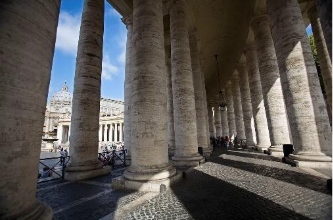
In some respects, the style of these colonnades contrasts with the usual flamboyant and theatrical features typical of Baroque architecture. The classical simplicity and sobriety of the external forms differ sharply from the rich magnificence of the basilica’s interior, but the grandiose harmony and elegant harmony of the whole clearly establishes Bernini as an architectural genius of the highest order. Above all does it demonstrate his mastery of perspective. The colonnades of Bernini give the appearance that the Church in the background is less wide than it is and, as well, diminishes the severity of the Maderno façade, two design flaws raised frequently enough by contemporary architects and art historians.

Bernini began the project in1657 and brought it t a happy conclusion, ten years later, in 1667. A major challenge in constructing the colonnade was to create an enormous space which would not diminish the focus on and centrality of the basilica itself. Bernini’s ingenious response was to create two separate zones, an oval shaped colonnaded space leading to a trapezoidal space in front of the basilica. This design serves as a kind of optical illusion: the façade not only seems closer and taller than it actually is, but also, less wide. A major earlier criticism against the Maderno façade had been the excessive width of the façade and its blocking of the view of Michelangelo’s dome. Bernini’s colonnade helped to
resolve the first of these issues.

The colonnades contain four rows of Doric Tuscan columns (two hundred eighty-four) and pilasters (eighty eight) creating three walkways.
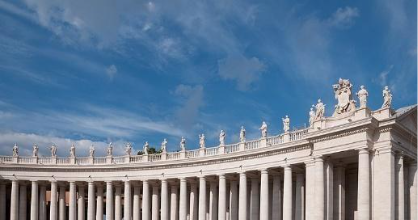
The middle row is wider than the other two to allow for carriage traffic. The curved shafts of the columns frame the elliptical area of the open space and the trapezoidal entrance to the basilica itself.
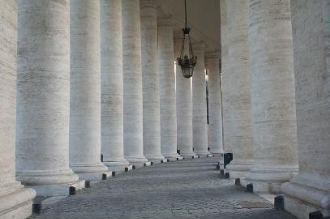
A double axis divides the colonnade: its lines run from the church to the obelisk and from the obelisk to the two fountains. The piazza provides an unobstructed view of the two focal points of papal blessings just as Pope Alexander VII had requested. The creation of the short and low colonnade counteracted the problem of Maderno’s wide façade by creating the illusion of its greater height. Bernini’s mastery of perspective techniques succeeded in making the church seem much less large than it is. This he achieved by narrowing the spaces between the columns as they moved away from the church.
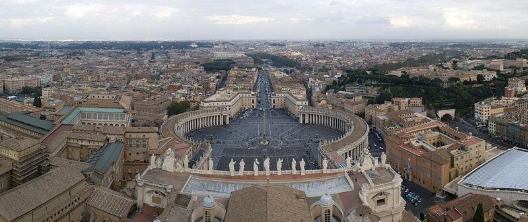
Bernini’s intention was that the colonnaded ellipse would symbolically encircle and embrace the visitor, Catholic and non-Catholic alike, with the motherly arms of the Church. Evidence of this is visible in a drawing he sketched as he conceptualized the construction of the piazza.
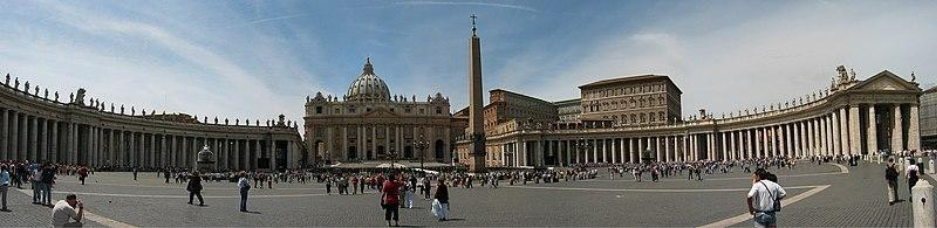
Ninety-six statues sculpted by Bernini’s pupils look towards the center of the square. The outer ends of the colonnades are in the form of Greek temple façades with two more statues are at the outer corners of the pediments.

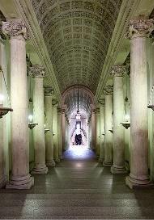
The colonnade on the right side serves as the main entrance to the papal palace at the Portone di Bronzo and its staircase, the Scala Regia. Bernini designed it to showcase his genius in exploiting the tromp d’oeil technique. The stairway leads to the papal apartments, and it features wide and shallow steps to accommodate the papal chair bearers used before the installation of a nearby elevator. En route to the papal residence one passes by the Sistine Chapel and the Pauline Chapel. The first Scala Regia was constructed in the 16th century by Sangallo the Younger but was completely renovated by Bernini in 1663. This architectural masterpiece was inspired by Borromini’s earlier success at Palazzo Spada in applying trompe-l’oeil perspective to the structure to create the illusion of a space much wider and longer than it really is.

Bernini’s technical challenge was to create a magnificent and regal entranceway within a very limited and restricted space.

The side walls were not parallel and converged at the top of the stairs. His goal was to create the appearance of parallel walls. Inspired by Borromini’s perspective corridor in Palazzo Spada, Bernini used a barrel vaults system for the ceiling. He diminished gradually the size of its columns as they moved upward from the entrance and pulled them close to the walls to give from below the illusion of uniform size and the appearance of greater length. Hidden windows soften the darkness of the corridor and provide a sense of grandeur and solemnity to the whole by leaving the upper stairs darkened in shadow.
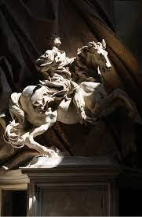
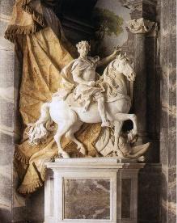
Bernini carved an equestrian statue of the emperor Constantine and placed it at the base of the stairs. It symbolizes his victory over his rival Maximian at the Battle of the Milvian Bridge and ultimately the defeat of paganism by the Christian religion which the emperor supported as attested to by the construction of this and other churches (St. John Lateran) in the City.
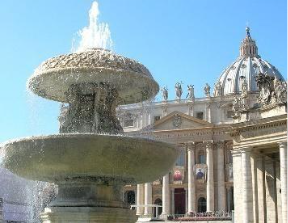
Two identical fountains stand in the center of the piazza, Carlo Maderno’s on the right installed in 1613 (later rebuilt and moved), and Bernini’s on the left designed installed in 1677.
Between the fountains and the obelisk, there are two porphyry discs set into the pavement which mark the foci of the ellipse. The three back rows disappear from the sight of the viewer if one stands on one of the discs.
Meridian lines were added in the shape of wind symbols marking lines from a point on the side of the base to a point where the sun crosses at noon on December and June 22 (solstices). Five other discs mark the passage of the sun following coupled zodiac signs: Leo-Gemelli, Virgo-Taurus, Balance-Aries, Scorpio-Pisces, and Sagitarius-Aquarius.

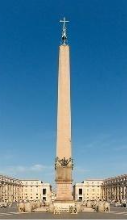
The huge eighty-four foot obelisk, 2nd largest in the City, a single piece of red granite from Heliopolis in Egypt (Pharoah Menephtah, 1420 BC) arrived here at the order of the emperor Caligula for the spina of his new circus on the Vatican Hill (Ager Vaticanus). It remained until the 16th century, the only obelisk in the City which had never fallen. Marks left from Caligula’s bronze inscription remain on its base. The obelisk remained for centuries to mark the site of the Apostle’s martyrdom and a small Chapel of the Crucifixion Visible stood nearby. The cross on the globe at the top, set there by Domenico Fontana 1586, contains a relic of the True Cross, acquired by Saint Helena, Constantine’ mother in the early 4th century. The Latin inscription on the base of the obelisk (ecce crucem Domini) serves to loudly affirm and visibly proclaim to the City and the world the power of the cross of Christ: behold the cross of Christ.

When Felice Peretti was elected pope in 1585, he took the name Sixtus
V. During his short five-year term, he engaged in unprecedented and successful urban renewal programs involving building projects, the restoration of aqueducts and obelisks, the construction of new fountains and roads, and the radical modification of older thoroughfares connecting the major pilgrim shrines throughout the City. The most amazing and spectacular of these, however, was the relocation of the Vatican Circus obelisk from its ancient location on the left side of St. Peter’s to the center of the colonnade.
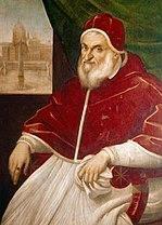
Ordered by Pope Sixtus V to move it to the front of the basilica, Fontana assumed the responsibility for this immensely difficult, complex and challenging engineering feat. The task required many months (April to September) and almost a thousand workers to re-erect the obelisk.

The re-installation in September of 1586 was one of the City’s most dramatic events. Pope Sixtus ordered complete silence during the operation involving fifty-two separate maneuvers to hoist it in place. When a sailor in the crowd, Brescia di Bordighera, noticed that the cables were heating up under the strain, he broke the silence and cried that water should be applied to the ropes. Brescia’s suggestion saved the day and his rescue was amply rewarded by the pope. The pope granted his request that the branches used in the basilica on Palm Sunday should be supplied in perpetuity from his farm.

Fontana intentionally placed the obelisk off center and a little right of the axis of the basilica so that that it would later line up perfectly with a new road intended later for the square and which would run through the Borgo area in front.
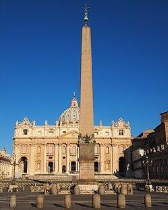
He later removed the ancient metal ball and replaced it with a cross-shaped reliquary containing a piece of the True Cross. At its base, a Latin inscription refers to the Christ who conquers, reigns, commands, and protects his people from all evil. The obelisk serves as the centerpiece of the piazza brandishing the coat of arms of Pope Sixtus V who regarded it as a crowning achievement of his papacy, a visible symbol of the triumph of the Catholic Church over Protestantism.
Michelangelo designed the impressive stairway from the piazza to the Basilica.

The façade of the basilica was designed by Carlo Maderno. Its surface projects outward in the center and recesses inwards at the two ends creating, thus, a flowing dynamic to the structure. Two colors dominate, reddish below the loggia applied by Maderno, and greenish above applied later, around 1700. The two bays at each were not part of the original design but are the remnants of earlier failed attempts (Maderno first then Bernini) to add two bell towers (campanili) to the structure.

Its commemorative inscription is partially obscured by the columns below hiding the reference “princeps apost” and displaying only the “Paulus Borghesius Romanus” part. Not unnoticed by Pasquino, this generated its quip: “a brick for Peter and all the rest for Paul (Borghese pope) and so it’s not a temple to Peter but to Paul”.
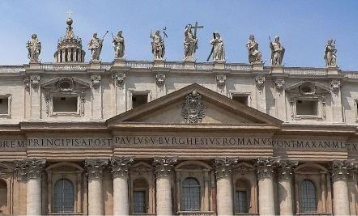
The front of the basilica is a trapezoidal space accessible by stairs on three sides. It has eight columns 3 of which are from Old St. Peter’s (one each at the side of the three main entrances).
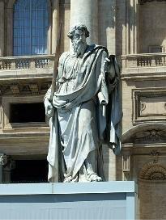
At the base of the stairways are the colossal statues of Saints Peter (left side) and Paul (right side), sculpted originally in 1838 for St. Paul’s Basilica, but later moved here by Pope Pius IX.
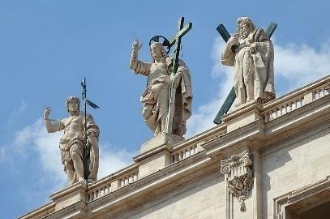
The front of the basilica has a large vestibule above which is an attic with eight windows and pilasters and balustrade. Over these are set thirteen statues: Christ, eleven apostles and St John the Baptist. Saints Peter and Paul are not included in the set because each of these stands as guardians in front of and at the base of the basilica.
Giuseppe Valadier’s two clocks were added in 1799 (the one on the right with Italian time, the other on the left with European mean time).

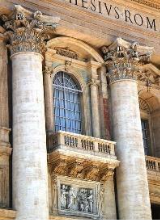
Below the entablature are three similar windows, the middle one of which is the Benediction Loggia. From here the announcement is made by the dean of the College of Cardinals that a pope has been elected: ‘Annuncio vobis magnum Gaudium, habemus papam’. Shortly thereafter, the new pope appears on the balcony and extends his Urbi et Orbi blessing to the City and to all the world. He appears here as well on special occasions and great feasts, Christmas and Easter, for the same blessing. In the modern era three popes declined to impart the blessing to the City, a protest against the 1870 seizure of the City by the new Italian state: (Popes Leo XIII in 1878, Pius x in 1903, and Benedict XV in 1914. Instead, the blessing was imparted from the interior of the Basilica.

The bases of the unfinished bell towers are identical. The Arch of the Bells, on the left contains six bells and is one of several entrances into the Vatican City State.

The current Apostolic (Papal) Palace was constructed in the 15th century while its origins go back much further in time to the 5th. This huge and extensive building not only houses the pope’s private residence, office, library, curial offices, and reception rooms, but also, the Sistine Chapel and the Vatican Museums and Library. Pope Symmacus (+514) constructed the first papal palace here. Once it was fortified it served as a secondary residence to the Lateran Palace on the southern side of the City.
Charlemagne resided in the palace during several times in his many visits to the City. Medieval popes, Pope Eugene III in the 12th century and Pope Innocent III in the 13th, provided significant renovations to the older structure.
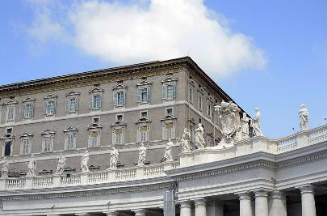
When in 1377 the popes finally returned to the City after an almost 70 year interlude at Avignon in Southern France (‘Babylonian Captivity’) the Lateran Palace had fallen into virtual disrepair because of two significant fires and general neglect. They moved into this palace next to the basilica and remained there until in 1477 when Pope Nicholas V replaced it with a brand new structure. Pope John XXIII in 1410 connected the palace to Castel Sant’ Angelo with a covered passageway to secure its papal residents a secure place in times of military threat. Over the 150 years many additions were made to the palace by several popes, not the least of which were those of Popes Nicholas V (+1455), Sixtus IV (+1484), and Alexander VI (+1503). These include the Sistine Chapel and the Borgia Tower (Tor di Borgia).
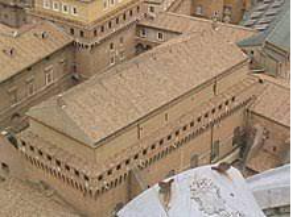
The Borgia Tower was created as part of the defense system for the papal palace, supports part of the Borgia apartments above it, and abuts a section of Bernini’s colonnade.

All the various buildings which comprise the entire structure are connected to one another and feature three large central courtyards.
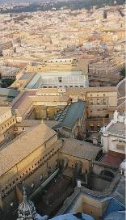
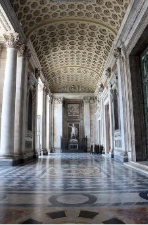
The first story of the façade of the basilica consists of the narthex (vestibule) with its vaulted ceiling and lunettes containing 38 statues of popes and 32 stucco relief panels which detail scenes from the life of the Apostle Peter. Its pavement was designed by Bernini.
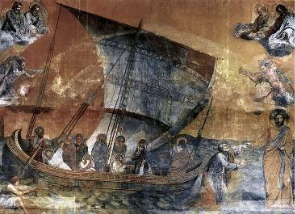
Giotto’s early 14th century fresco of the Navicella, sits over the main entrance of the portico, one of the very few remnants of the Old St. Peter’s. It represents a ship sea tossed and full disciples threatened by stormy winds personified as demons. Above it are depicted Old Testament patriarchs consoling those on board. Nearby and on the right stands Christ, foundation of the Church rescuing Peter it’s Rock from the waves. On the left emerges the image of an undisturbed fisherman, symbol of Christian hope in the face of all difficulties and obstacles.
Equestrian statues appear at both ends of the portico. On the right and at the base of the Scala Regia stands Bernini’s Constantine sculpture, partly modeled on the Marcus Aurelius statue on the Campidoglio. The drapery behind it dramatically reinforces the reference to the apparition witnessed by the emperor and is a counterpart to the rearing of the horse.

Across from it at the opposite end of the portico a complementary equestrian statue, that of Charlemagne by Agostino Cornacchini was installed in the 18th century. It symbolizes the restoration of the Roman Empire in Christian form with the coronation of the Frankish King Charles by Pope Leo III on Christmas day 800 AD.
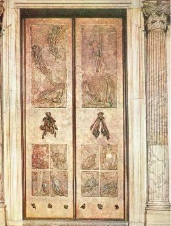
The portico contains five bronze doors, four modern and the middle created in the 15th century. Florentine artists, Antonio Filarete and Simone, the brother of Donatello, designed the 15th century central bronze door for Pope Eugene IV from a remnant of the Constantinian basilica. It contains scenes from the lives of Saints Peter and Paul. Filarete wrote his signature with a comic scene involving the master and his assistants on the inner side of the door.
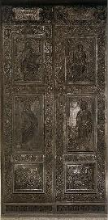
Other doors from left to right include Giacomo Manzu’s 1964, Door of Death (intended for funerals); Luciano Minguzzi’s 1977, Door of Good and Evil; Venanzio Crocetti’s 1968, Door of the Sacraments; Vico Consorti’s 1950, Holy Door.

Commissioned by Pope John XXIII in 1961, Manzu’s Door of Death, located on the far-left side of the porch, depicts various images of death, including those of Jesus and his mother Mary at the top. Some critics claim that many of its panels, those of executions, are too gruesome and lack spiritual depth. The side of the door internal to the basilica contains a panel depicting Vatican Council II and an image of Pope John in conversation with the African Cardinal Rugambwa, scenes parallel to panels in the Filarete central door.
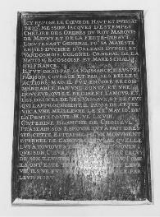
To the left of the central door and on the wall between Manzu’s, Door of Death, and Minguzzi’s, Door of Good and Evil, remains one of the very few medieval monuments in the new basilica which survived the destruction of the old basilica. It is the 8th century epitaph for the tomb of Pope Hadrian I (+795). Originally located in this pope’s burial chapel in the Constantinian church near the main altar, Pope Paul V placed it here in 1619 because of its historical significance. The epitaph expresses poetically an encomium (laudatory poem) written probably by Alcuin of York, the court scholar of Charlemagne. It honors and extols the life and accomplishments of the deceased pope. Not only does it represent a literary masterpiece produced by the Carolingian Renaissance but, as well, reflects symbolically the ecclesial-political developments of the age which within five years would culminate in Pope Leo III’s coronation of Charlemagne as emperor of the newly created Christian Roman Empire in the Latin West. An unusual and significant feature of the epitaph is that is written on black marble stone in imitation of one of the Roman Forum’s most ancient and prized treasures, the Lapis Niger (Black Stone), which Romans believed marked the grave of Romulus, the City’s founder. Alcuin’s poem written in impeccable classical Latin grammar, not only reflects the close personal relation between the pope and Charlemagne but, also, the high quality of the verse itself, copies of which made their way in manuscript form to many libraries throughout Europe, especially in Germany and France.
The interior design of the basilica consciously symbolizes the triumph of the Catholic Church over Protestantism (Counter-Reformation) and showcases papal power in secular and ecclesial realms.
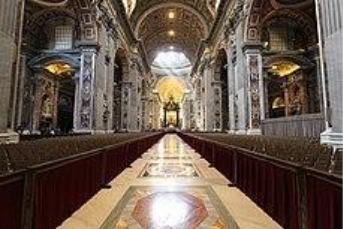
An enormous nave dominates the main space of the basilica together with two side aisles with three external chapels each. The perfectly symmetrical space is enhanced by a large square transept supported by huge piers and an apse. Michelangelo’s design, a Greek cross plan, was modified to a Latin cross plan by Maderno because the pope desired a larger interior worship space and an external benediction loggia in the front. This change requires the extension of the entrance forward and an increase of the length of the structure by one third the original plan. The enormous size of its interior accounts for the large number of its appointments: forty-six altars, twenty-seven chapels, two hundred thirty-three windows.

The nave contains three bays and side aisles separated by arcades supported by enormous rectangular piers. Bernini bedecked its surfaces like jewelry with inlaid marble of brilliantly shining purple, red, and yellow colors. Throughout the whole internal space, gleaming gilt, lustrous bronze, and precious marble fuse harmoniously to create an operatic dimension set against a sublime backdrop suggestive not only of beauty and splendor, but, as well, faith and reverence, expressive of reason and order.
The two narrower naves on either side heighten and underscore the sumptuousness and depth of this central space.
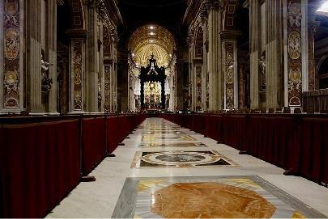
Carlo Maderno’s barrel–vaulted ceiling exhibits in the geometric pattern of its its design the influence of his nephew, Francesco Borromini.

Between each pair of pier pilasters appear niches containing statues of the founders of religious orders. On the counter-facade hang three dedicatory tablets over the three entrance doors of the central nave. Above and over sit three windows which overlook rooms behind the attic of the façade.

Near the main entrance, close to the Epitaph of Hadrian I in the portico, and on the floor of the nave, lies a porphyry disc (rota porphiretica) rescued from the old basilica. Charlemagne knelt on this spot when crowned Roman Emperor in 800 AD by Pope Leo III. The disc, cut from the shaft of a large ancient column, served the same purpose for twenty-one other Holy Roman emperors in succeeding centuries.

Giacomo della Porta, Carlo Maderno and Bernini designed the polychrome marble floor. The beautiful marble of the extensive floor has its origins in the marble cladding stripped from the pyramid of Romulus in the 16th century. The pyramid, (Meta Romuli), an ancient tomb, once thought to be, erroneously, the burial place of Romulus, stood near Castel Sant’Angelo (Hadrian’s mausoleum).
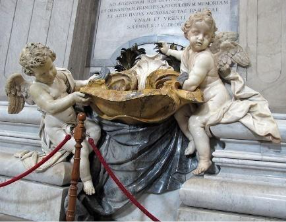
Beyond the disc on both sides of the church sit enormous, 18th century. holy water fonts designed by Agostino Cornachinni in the form of sea shells, supported by cherubs, six feet tall.
On the nave floor appear many bronze lines with inscriptions. Each specifies the length of important churches of the world and indicates the length of each measured against the length of this basilica. New York’s St. Patrick Cathedral is the one closest to the main altar.
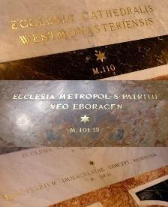
Directly under the dome sits the high altar carved from a single block of white Greek marble from the Forum of Nerva and installed in 1564 by Pope Clement VIII.
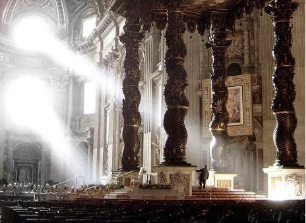
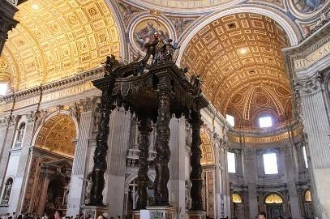
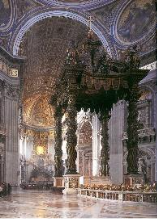
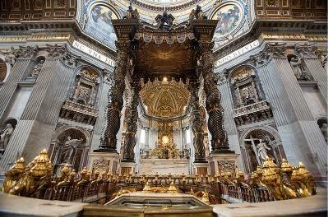
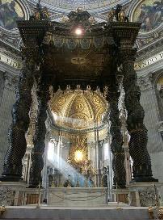
Bernini’s bronze baldacchino, represents historically the first, truly great Baroque monument and, at the same time, a very visible manifestation of Bernini’s unparalleled executive ability. Not only does it dominate the Petrine complex by marking the tomb of the Apostle, but, as well, serves a very practical purpose: it mediates the immensity of the surrounding space and the spectator and. Also, it becomes a powerful and visible multi-valent symbol of Peter as the foundation stone of the Church, the resurgent strength of Counter-Reformation Catholicism, and a monument to the grandeur of the Barberini papacy. Pope Urban VIII commissioned the twenty-five-year-old Bernini to create the monumental work. In a very real way Bernini’s baldacchino does for the interior of the Basilica what Michelangelo’s dome does for the exterior, and at the same time, its opulence poses a sharp but harmonious contrast to the colorful and ordered discipline of the other parts of the structure. The baldacchino rises ninety-six feet high, the height of Palazzo Farnese. It weighs almost 100 tons, is the largest bronze monument in the world and took nine years to complete. Beyond the luxuriousness of its gilding and magnificent proportions, its ingeniousness is best visible in the strigulated lines of its columns together with its whirling, wind-blown drapes. It represents the height of Baroque attainment comparable to the heights of earlier Gothic cathedral design.

The ball at its top can hold fifteen people. Long has it been believed that the bronze for the baldacchino was pillaged from the Pantheon portico. The design of its columns was inspired by the twelve columns supporting the baldacchino in Old St. Peter’s.

Six of the columns actually come from the old basilica. Constantine had taken them from Jerusalem. The other six were obtained in the 8th century by Pope Gregory III. Some of these twelve Bernini placed in the upper niches of the piers supporting the dome. Two are in the Blessed Sacrament Chapel and one is in the Chapel of the Pieta. Into the new columns he designed, Bernini inserted bits of foliage, puti and the Barberini coat of arms. The columns support a roof designed in the manner of the traditional papal canopy within which is intertwined both Barberini bees and sun bursts which symbolize the Holy Spirit.

The columns rest on polychrome marble plinths.
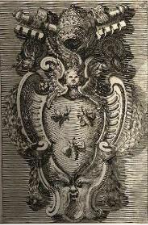
Francesco Borromini designed the unusual coat-of-arms of Pope Urban on two sides of each plinth. Seven of them include a woman’s face depicting the pope’s niece (Anna Colonna, wife of the pope’s nephew) in various stages of her pregnancy and labor).

The eighth represents the cherubic face of a newly minted Barberini. Bernini’s relationship with Pope Urban VIII was especially warm and close. Long before Barberini became pope, the prodigious genius of Bernini had come to the attention of previous popes. Pope Paul V had predicted that the adolescent artist would become the Michelangelo of his generation, and when Barberini ascended to the papacy, almost immediately he summoned Bernini and said to him that ‘however much happy you are to see me pope, I consider myself even more fortunate to have you working during my reign’.
The Dove of the Holy Spirit takes center place in the baldacchino’s ceiling. The complex represents a wonderful integration of rich elements: Old Testament wisdom tradition, ancient Christian faith, and the triumphal Baroque church of the Barberini.
Pope St. Gregory the Great enclosed the Petrine shrine with an altar at the beginning of the 7th century. The current altar was installed and set over the structures below it in the 16th century by Pope Clement VIII and consists of a solid block of white marble removed from the Nerva Forum. The Confessio, embellished with polychrome marble decoration by Carlo Maderno, is the open crypt in front of the high altar. The polychrome marble balustrade includes two staircases leading down to the Niche of the Pallia shrine. Giacomo della Porta created it in the process of digging a pit to provide direct access to the original altar underneath. The tomb of St. Peter lies six feet (circa) directly below the niche.
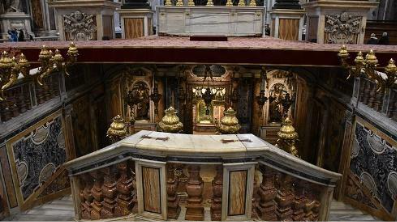
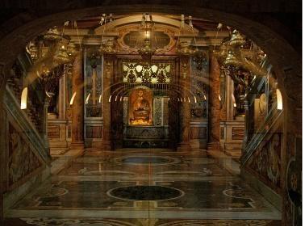
The Confessio contains an aedicule with four alabaster Ionic columns flanked by two niches with gilded statues of Saints Peter and Paul. In the center is a recess with elaborately decorated doors over which are a gilded bas-relief busts of Christ and the two apostles. The recess, the Niche of the Pallia, contains a 9th century mosaic of Christ. In the niche, whose doors were designed by Benvenuto Cellini, are kept the pallia, stoles reserved for archbishops, and conferred on them by the pope in a special ceremony. These symbolize the continuity of episcopal office beginning with the Apostles and extending successively to the bishops of our own time (apostolic succession). In the Grotto below the crypt to which there is public access, glass doors provide visitors a view of the Confessio and Niche.
The Tribune, the apse bay of the basilica, is similar in form to both arms of the transept, although the floor is elevated and includes steps made of porphyry slabs rescued from the old basilica.

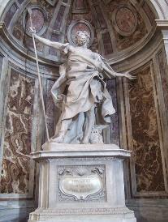
Four large piers surround the altar and support the dome. The sides of the piers facing the altar are decorated by Bernini and hold niches housing huge sculptures of those saints whose relics the church possesses: the skull of St. Andrew the Apostle (recently donated to the Greek Orthodox Church), the veil of St. Veronica, the spear of St. Longinus, and St.
Helena’s remnant of the True Cross (given to the basilica by Pope Urban
VIII). These three relics are kept inside the pier of St. Veronica.
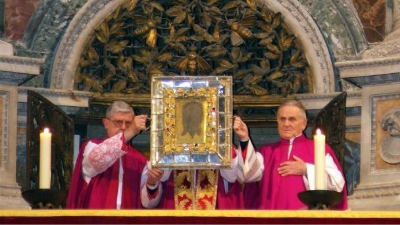
The relic (Veronica) of the St. Veronica statue consists of a linen cloth with the image of the face of Christ. During the Middle Ages it was the most popular relic in the City. It was once preserved in the private chapel of the popes and exposed for public veneration on festival occasions of the liturgical year (Easter, Ascension, Christmas, and on Sundays of the Holy Years). In the 1848 Revolution, the City was proclaimed as the capital of the Roman Republic. It is said that the canons of the Basilica visited and prayed before the relic whose face turned pale in their presence presumably in protest of the newly established government.
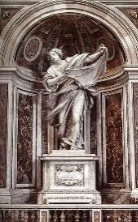
Throughout the 19th century the relics of all four sculptures were exhibited above the statue of St. Veronica during Holy Week. These are housed normally in a reliquary located in the base of the Veronica pier. In more recent times the relic of St. Veronica is annually exposed for public veneration in a colorful ceremony on the fifth Sunday of Lent.
Bernini personally carved the Longinus statue (the only one of the three) from three separate blocks of marble (Michelangelo always used one) and is three-time life size. The face of Longinus is modelled on that of Laocoon in the Vatican Museum. His arms open in imitation of Christ’s on the cross. To effect different textures in the skin and fabric, Bernini used a chisel to stroke grooves into the marble surface. A triangle frames the whole, from the spear to the outstretched arms.
Near the Longinus pier sits a bronze Statue of St. Peter created probably in the 13th century by Arnolfo di Cambio. Its forward foot has been worn away over many centuries by the kisses and touches of pilgrims and visitors from the world over. For many years, throughout the Middle Ages and beyond, legend held that the sculpture originated with 5th century Pope Leo the Great who created it from metal melted down from the Capitoline statue of the god, Jupiter Maximus Optimus. Modern chemical, however, indicates that the bronze corresponds to metal derived from the workshop of Arnolfo.

On his feast day, June 29, the statue is enrobed with cope and miter. Above it hangs a circular mosaic portrait of Pope Pius IX, installed when his thirty-two-year reign exceeded the traditional twenty-five year one of St Peter.

Michelangelo designed the dome completed by Giacomo della Porta and Domenico Fontana in the late 16th century. It took less than two years to complete its construction. Eight hundred worked daily for twenty months on this massive project. The drum design is similar to what Michelangelo had intended (ovoid), but slightly altered later by Della Porta (hemispherical).
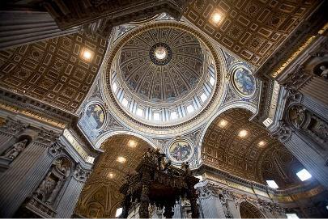
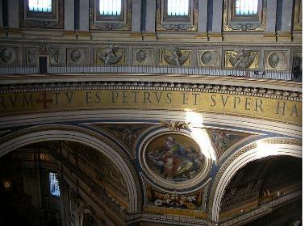
Its mosaics were designed by Cavaliere d’Arpino. The Evangelists’ mosaics appear on the pendentives and on the frieze of the entablature is an inscription of Christ’s words to Peter from the gospel of Matthew 16: ‘Tu es Petrus, et super hanc petram aedificabo ecclesiam meam, et tibi dabo claves Regni Caelorum’.
The two transepts (tribunes) correspond to the arms of Michelangelo’s,
Greek cross design.

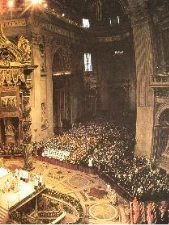
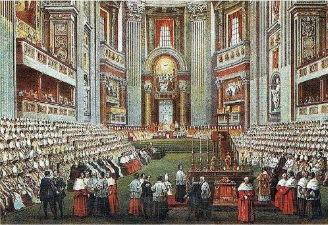
The right transept housed sessions of the First Vatican Council (1869-1870) attended by seven hundred Council Fathers who proclaimed the doctrine of papal infallibility. While in session, the area was blocked off from the rest of the church by a temporary wooden wall and painted to resemble a marble backdrop.
Luigi Vanvitelli in the 18th century decorated with white gilded stucco the vault designed by Michelangelo in the 16th. Eight niches display statues of founders of religious communities.

The south transept, the left arm of the Greek cross, decorated by Vanvitelli, contains three altars. At the main altar, priests celebrate Masses daily and on Sundays. The altar on the right contains relics of Pope St.
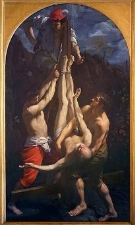
Boniface IV who received the Pantheon as a gift from the Eastern Emperor Phocas in 609 and dedicated it to St. Mary and Martyrs. The altar of the St. Peter’s Crucifion stands at the left with a mosaic copy of Guido Reni’s painting of the crucifixion of the saint above it. Many believe that it is the place in the church closest to the site of St. Peter’s death. Throughout the church appear mosaic copies of paintings of Renaissance masterpieces like those of Reni here and Raphael (Transfiguration). These are the works of a school that continues till now to create mosaic works. The style of these moves well beyond the traditional Byzantine, hieratic, style of the past and harmonizes with splendor of the Baroque Age.
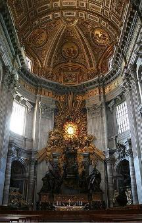
In all the spaces of the church, the apse best represents the magnificence of monumental Baroque architecture. Its immense size, the height of its ceiling, and its ornate appointments and decorations cannot help but inspire awe. The focal point of it all remains its central piece, the Chair of St. Peter, the massive, bronze, Bernini-designed, monument housing the chair of the Apostle. Above it, gloriously shines the colorful alabaster, stained window of the Holy Spirit.
Descriptions of the 27 side aisle chapels and altars proceed counterclockwise from the right of the entrance.
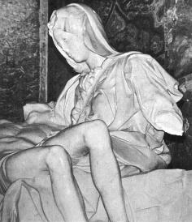
The Chapel of the Pietà was originally named the Chapel of the Crucifix until the installation of Michelangelo’s Pieta in1749. Commissioned in 1498 as a funerary monument of Cardinal Jean Bilheres-Lagraules, former abbot of St. Denis in France, Michelangelo created it, amazingly at the age of twenty-two years. The sculpture depicts the moment after the body of Jesus was taken from the cross and placed in his mother’s lap. Mary’s strength seems as great as her grief. That the artist depicts her innovatively and audaciously as a very young woman, emphasizes his belief that Mary is a special creation of God. King Francis I of France tried unsuccessfully to acquire from Michelangelo this sculpture as well as his Christ the Redeemer now located in the church of Santa Maria sopra Minerva. The finished version of the sculpture represents Michelangelo’s second effort to carve the stone. He abandoned his first attempt when he found flaws in the marble. Remnants of the sketched-out version were later discovered in the courtyard of Palazzo Capranica.

In his long career, Michelangelo signed none of his artistic creations except the Pieta. He did this after completing the work because he had heard the rumor that some attributed it to a lesser artist.
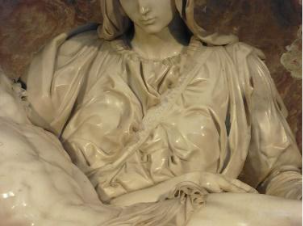
Francesco Borromini designed the base of the sculpture.

The Pieta, one of the most famous works of art in the world, now requires protection by bullet-proof glass after a hammer attack on it in 1971. On May 21,1972, Lazlo Toth, an Hungarian émigré to Australia, jumped the communion rail which separated the sculpture from the viewing public and struck it with fifteen blows of a hammer. He broke the nose of Mary and damaged her left arm and an eyelid in the attack. Toth was arrested, found to be insane and released from prison in 1975. In the subsequent restoration process it was discovered in her left palm traces of the letter, ‘M’ a reference perhaps, to Michelangelo himself, or to Mary.
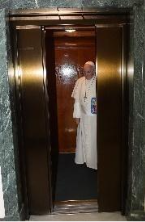
Next to the Pieta Chapel nestles a small oval shaped chapel designed by Bernini, called the Chapel of the Relics or Chapel of St. Nicholas of the the Crucifix because of its 13th century crucifix designed by Pietro Cavallini. It has an elevator used by the pope when he enters the church from the papal apartments above. Over the entrance to the Chapel of the Relics is a memorial to Pope Leo XII.
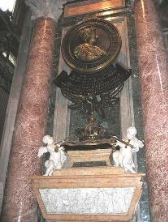
Opposite the Chapel of Relics rests a cenotaph to Queen Christina (1626-1689) of Sweden, buried in the crypt of the basilica. Designed by Carlo Fontana it depicts her 1655 conversion to Catholicism. The daughter of King Gustavus Adolphus, she reigned as queen from 1644-1654, abdicated the throne, converted to Catholicism, moved to and lived in the City until her death 35 years later.
Pope St. John Paul’ shrine lies in the Chapel of St. Sebastian where his body rests under the altar. Memorials to Popes Pius XI and Pope Pius XII are located on the side walls of the chapel.

The archway to the next bay has two monuments: one to Pope Innocent XII and the other to Countess Matilda of Tuscany who died in 1115. Matilda was the great supporter of Pope Gregory during the Investiture Controversy of the 11th century. Hers was the castle in Canossa where Emperor Henry IV of Germany waited in the snow for three days in 1077 to request pardon from Pope Gregory VII. Countess Matilda died in 1115 and was buried in a monastery near Mantua but Pope Urban VIII reinterred her body here in 1635. Matilda was the very first woman buried in St. Peter’s, after whom four others would follow in subsequent years: Queen Christina of Sweden; Maria Clementina Sobieska, wife of James Stuart, the Pretender King of England; Queen Charlotte of Cyprus; and Agnesina Colonna Caetani wife of Onorato Caetani, an infantry general at the Battle of Lepanto in 1571.

The Blessed Sacrament Chapel, commissioned by Popes Urban VIII and Clement X, is not open to tourists, but is so to those who come to pray.
Characteristically decorated in sumptuous, Baroque style, it stands out as Bernini’s last artistic project. He presided over a team of collaborators to produce a work combining sculpture, architecture, and painting. Francesco Borromini designed its elaborate iron gates. Bramante’s Tempietto on the Janiculum Hill serves as the model for Bernini’s complex, lapis lazuli, and gilt bronze Tabernacle (Tempietto). Kneeling angels and imposing candles surround it, surmounted with smaller figures of Christ and the apostles. Bernini himself probably executed the angel on the left.
Pietro da Cortona painted the altarpiece depicting the Holy Trinity, the only true painting remaining in the basilica, the others replaced with mosaic replicas.

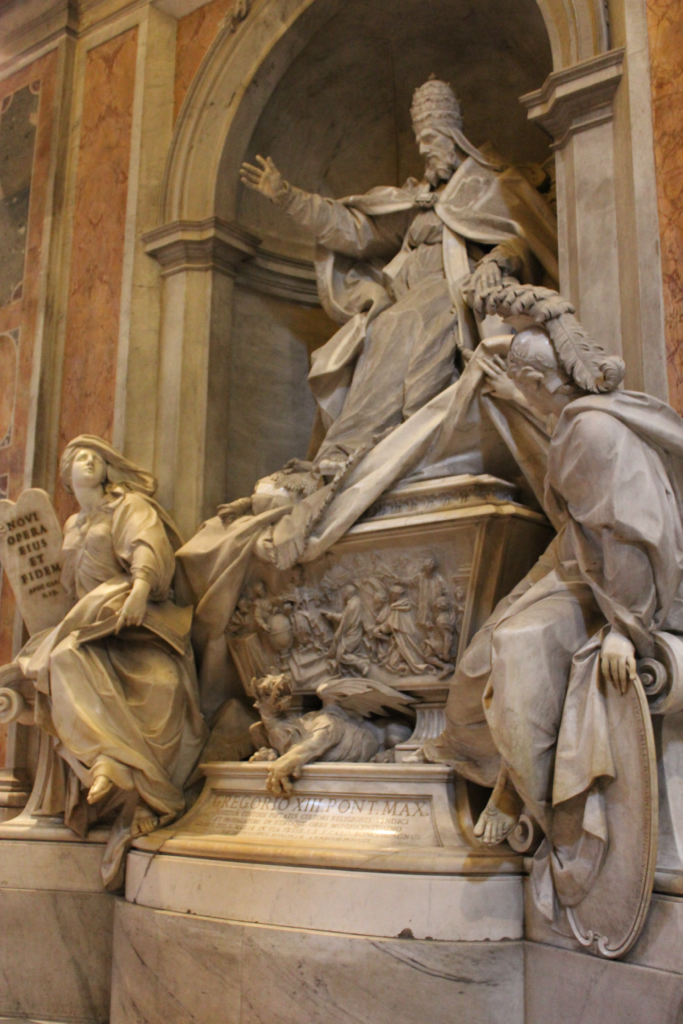
To the left of the altar a door leads to stairs to the papal palace, once used by pope (before the introduction of the elevator) when he officiated at liturgies in the basilica. The archway beyond the chapel contains two papal monuments. The tomb of Pope Gregory XIII, the 16th century reformer of the Gregorian calendar is modern, created by Camillo Rusconi 150 years after death of the pope. The other monument is dedicated to Pope Gregory XIV.
The Altar of St Jerome extends from the back side of the Longinus pier. The altarpiece is a mosaic copy of Domenichino’s painting, The Last Communion of St Jerome, the original of which hangs now in the Vatican Museum Pinacoteca. The body of St. Pope John XXIII, canonized in 2013, rests under the altar.

The Gregorian Chapel, named after Pope Gregory XIII, lies on the right side of the basilica. Its architects were Michelangelo, Vignola, and Giacomo della Porta. It contains an 11th century altarpiece, a painting of Our Lady of Good Help, a remnant of the Old St. Peter’s. The relics of St. Gregory Nazianzen (+395), an early Doctor of the Church, rest under the altar. Gregory XIII transferred them from the convent of the church of Santa Maria in Campo. St. Gregory Nazienzen, an ardent defender of the 325 AD Nicene Creed, became the patriarch of Constantinople. Over the side entrance to the Chapel of the Blessed Sacrament, lies the sarcophagus of Pope Gregory XVI.
The Altar of St Basil stands on the side of the Longinus pier.
Beneath the altar is a glass case holding the body of the Byzantine rite bishop, St. Josaphat. At this altar the Eucharist is celebrated according to the Byzantine Catholic rite. Opposite this altar is a memorial to Pope Benedict XIV.
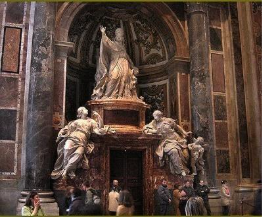
The two arms of the transept share identical designs, each with a single bay and a semi-circular apse. The apse of the transept on the left contains three similarly designed side chapels: the Chapel of St Wenceslaus; Saints Processus and Martinian Chapel; the Chapel of St Erasmus.

The Altar of the Navicella appears along the Helena pier. The altarpiece
shows St. Peter walking on the water. Opposite that altar is the monument to Pope Clement XIII executed by the young Antonio Canova. Many regard it his greatest work and established his fame as the premier sculptor of his age (19th century). On the day of its unveiling in 1795, Canova disguised himself and wandered through the crowd to get a sense of their response to his masterpiece. The kneeling pope is guarded by the figures of religion and death. At the base of the tomb rest two lions, symbols of his forceful temperament.

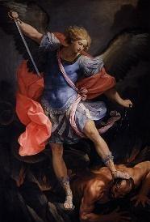
At the far-right corner of the church stands the Chapel of St. Michael. Above the altar rests a mosaic copy of Guido Reni’s famous painting of St. Michael the Archangel wielding a sword.
The chapel includes a side altar, the Altar of St. Petronilla (legendary spiritual daughter of St. Peter) as her body is lowered into her tomb. Pope Stephen in the 8th century donated to King Pepin her relics lying now under the altar. Thereafter, France was given the appellation the ‘eldest daughter of the Church’. The mosaic altarpiece represents a copy of a painting by Guercino whose original is in the Capitoline Museums.

The Helena pier on the left holds the Altar of the Resurrection of Tabitha whose mosaic altarpiece depicts St. Peter restoring life to the little girl, Tabitha. Across the aisle sits a monument to Pope Clement X.

In front of the monument on the pavement marks the burial place of Pope Sixtus IV and his nephew, Julius II. Both popes, the first responsible for the construction of the Sistine Chapel and the other for the construction of the new St. Peter’s, had been buried together in the bronze monument of Pope Sixtus where the Blessed Sacrament Chapel is now located. During its reconstruction in the 16th century, the original 15th century tomb of Sixtus IV, designed by the Florentine goldsmith Antonio Polluaiolo, was removed. Eventually, and very ironically, the remains of both popes now rest under the floor of this inconspicuous spot.

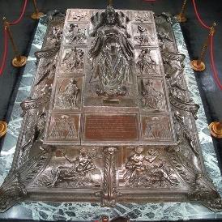
Polluiallo’s empty monument, one of the most beautiful of all papal tombs, is located now in the Treasury Museum of the basilica.
Commissioned by his nephew, Cardinal Giulio della Rovere (future Pope Julius II) it appears as a giant bronze casket atop of which is a lifelike depiction of the recumbent Pope. Surrounding panels depict allegorical female figures representing the Seven Liberal Arts (grammar, rhetoric, logic, arithmetic, geometry, astronomy and music) together with Philosophy (‘handmaid of theology’), and Theology (‘queen of the sciences’).
Incorporated into the whole is the oak tree image (Italian “rovere”), from the family coat of arms and central symbol of papal crests of Sixtus IV and Julius II.
Julius had intended to have his own Michelangelo monument occupy a significant space in the basilica, but the project stalled and was uncompleted at the time of his death and later abandoned by his papal successors. The Moses sculpture by Michelangelo remains from the original project located in the della Rovere family Church of San Pietro in Vincoli.

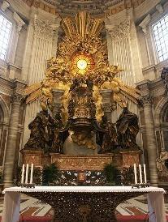
The Tribune serves as Bernini’s theatrical shrine for the relic known as the Chair of Peter (Cathedra Petri), a visible expression of the Baroque spirit and the artistic virtuosity of the architect. It ingeniously combines, as one historian says, “sculpture, architecture, painting and clever lighting all at once”.
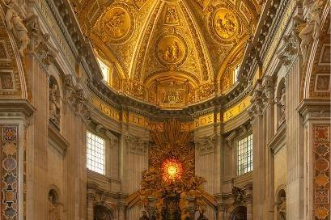
It reflects the artistic expression of the “Church Triumphant” in the age of the Counter-Reform and, as a grand Petrine reliquary, serves as well as goal for the pilgrim visiting the Basilica. The wooden chair (sedia lignea) had been erroneously venerated as belonging to St. Peter. Bernini designed for it a very elaborate bronze casing.

The huge size of the Cathedra serves very successfully as a counterpart for the spectator measured against the baldacchino and as one approaches the high altar the reliquary is perfectly and vividly framed through its columns. More than that, however, the Cathedra, has great symbolic and artistic implications. In the Bernini scheme it represents the crowning point of the basilica itself, the termination of the journey from the earthly and profane to the heavenly and sacred, from the external world of the City to the internal world of the Spirit soaring high on an alabaster screen above the Petrine shrine. It’s a journey outlined by the genius of this great Baroque artist: it begins at his colonnades (Peter’s open arms and key), makes its way to the altar and his baldacchino (Peter’s burial [place) and leads to his Cathedra in the apse (Peter’s Chair).
Below and on its sides are paired sculptures in bronze of the four Doctors of the Church, Western and Eastern who support the throne: Saints Augustine and Ambrose and Saints John Chrysostom and Athanasius. All have been sculpted in an imaginative and highly dynamic fashion: the features of each are unique, but in all four instances, the extremities are attenuated, the facial expressions pronounced, the drapery agitated, all part in motion. Art historians describe it as a theatrical set, a beautiful integration of sacred and architectural ingenuity.
The Tribune has papal memorials on each side. The tomb of
Pope Urban VIII by Bernini is on the right. The face on the sculpture of Charity is that of Costanza Bonarelli, a good friend of Bernini before he was married. This tomb, one of Bernini’s greatest triumphs, combines his masterful artistic skills: symbolism (power, life/death, religion and virtue), drama, and movement. The bees which cover the monument come from the same hive as those on the baldacchino. This monument became the model for many later Baroque monuments such as Alessandro Algardi’s tomb of Pope Leo XI.
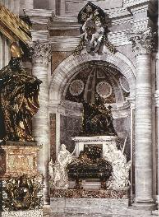
On the left is the monument to Pope Paul III, executed by Guglielmo della Porta with the help of Michelangelo and regarded by many as the finest in the basilica. It was first erected in the old basilica in 1574 and transferred to the new twelve years later in 1574. First placed near the Veronica statue, it was moved in 1629 to its current site. An effigy of the pope rests on top of the marble sarcophagus. Shown in a reclining position, it is a style derived from ancient Etruscan funerary art. Originally the monument was designed with four marble sculptures but two of these were moved to Palazzo Farnese. The allegorical figures of the cardinal virtues, Justice and Prudence are set below the sarcophagus. The face of Justice on the left is modelled on his sister Julia, sister of the pope and once mistress of Pope Alexander VI. That of Prudence on the right is modelled on the face of the pope’s mother. The Justice figure was originally naked but later covered by Bernini and clad with a covering painted to make it look like marble.
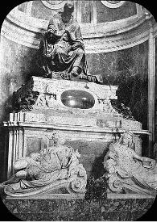
In the upper levels of the spaces in front of the tribune are eight statues of various religious communities. Under them are two marble slabs containing the names of the cardinals and bishops who were present there in the basilica when on December 8, 1852, the Dogma of the Immaculate Conception was promulgated by Pope Pius in his Apostolic Constitution, “Ineffabilis Deus”.

Inserted into the Veronica pier on the left side is the Altar of the Cure of the Cripple. Opposite is a Baroque memorial to Pope Alexander VIII.
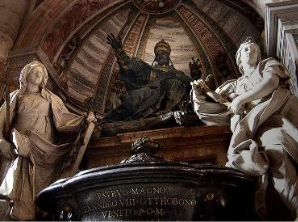
To the left of it sits the Altar of Pope St. Leo I, the first Pope called “great” because he confronted Atilla the Hun in 451 and prevented the sacking of the City. The massive relief above the altar by Alessando Algardi depicts the encounter. The relics of the pope, the first buried in the Old St. Peter’s, lie under the altar, placed there 1606.

The Chapel of Our Lady of the Column, dedicated to a Madonna icon painted on a column, sits in the far-left corner of the transept. The column comes from Old St. Peter’s, popular and a highly venerated object, and, thus, preserved and installed here in the new church. The altar rests on a 4th century Christian sarcophagus with relief carvings of Christ and apostles. It contains relics of three popes named Leo (II, III, IV). Nearby remains a floor monument containing the remains of Pope Leo XII (1829).
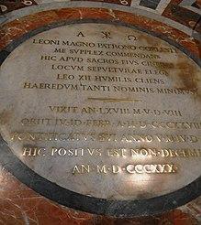
To the left of the chapel stands the monument to Pope Alexander VII who died in 1667. This stands out as Bernini’s last work in the basilica and one of the best-known papal memorials in the basilica. Bernini’s career flourished under the patronage of this pope as it had during the reigns of his predecessors, especially Popes Urban VIII and Innocent X. Bernini served them all as their personal architect, sculptor, painter, city planner, hydraulic engineer, pyrotechnician, and designer of stage props and dramatic special effects for public festivals. The pope’s successful efforts in renewing and beautifying the City earned for it to in his age the moniker, “Roma Alessandrina’.
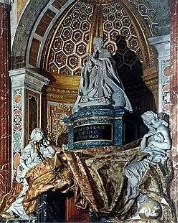
Bernini designed Alexander’s tomb as a personal meditation on death, the
pope’s and his own. The door of the monument symbolizes the passageway from life to the beyond. Bernini had the door extended to allow the marble shroud to cover the papal tomb. Although this tomb has a triangular pattern like that of Pope Urban VIII, it very much varies in tenor from the other. Triumphalism has disappeared in the figure of a haggard, humble pope kneeling in prayer against the backdrop of the skeleton below. In his hand he holds an hourglass, the timeless reminder that death awaits us all, whoever we are and whatever our status in life. Allegorical figures of the virtues Truth, Justice, Prudence, and Charity decorate the sculpture. Truth and Charity originally stood unclothed, until Pope Clement XI ordered the application of stucco modesty drapery. The Truth figure on the right side represents Queen Christina of Sweden: her foot rests atop a globe which represents Scandinavia.

The Altar of the Sacred Heart rests along the base of the Veronica pier. Three chapels in the left arm of the transept match those on the opposite end: the Chapel of St. Thomas with its the relics of Pope St. Boniface IV; St. Joseph Chapel with relics of the apostles, Saints Simon and Jude; Crucifixion of St. Peter Chapel with its mosaic copy of Guido Reni’s, Crucifixion of St. Peter with the relics of Pope St. Leo IX.

The Altar of the Lie stands at the Andrew pier. Its name derives from the altarpiece which depicts the account from the Acts of the Apostles recounting the deaths of Ananias and Sapphira. They lied to St. Peter about keeping for themselves part of the proceeds from the sale of their property and both were struck dead for their sin.

Opposite this is a memorial to Pope Pius VIII above the door to the sacristy.
,
Near the Pope Pius VIII memorial lies the floor tomb of the great and prolific 16th century Renaissance musician, Giovanni Pierluigi da Palestrina. He composed over five hundred masses, offertories, motets, and madrigals, and is especially well-known by church musicians for his polyphonic compositions.

The Clementine Chapel (Cappella Clementina) lies to the left of the Pius VIII memorial, named after Pope Clement VIII who renovated for the Jubilee Year of 1600. The altar contains relics of the first medieval pope, St. Gregory I the Great.
His remains rest in the sarcophagus visible through a grille under the altar in the chapel.

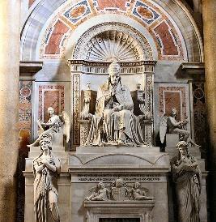
To the left of the Clementine Chapel is the tomb of Pope Pius VII (+1829) designed by the Danish sculptor Bertel Thorvaldsen, the only Protestant artist to work in the church. The tomb was commissioned by his loyal chancellor, Cardinal Consalvi. In his long (twenty three years) and remarkable papacy he crowned Napoleon as emperor of France, endured seven years of French imprisonment, restored the Papal States at the 1814 Congress of Vienna, and resurrected the Society of Jesus after its 1773 suppression by Pope Clement XIV. In 1808 Pius created the four new dioceses of Boston, New York, Philadelphia, and Bardstown and before his death had added to that list the dioceses of Charleston, Richmond, and Cincinnati.
The Altar of the Transfiguration across the aisle lies against the Andrew pier. The altarpiece is a mosaic copy of Raphael’s famous Transfiguration of Christ. When Raphael died suddenly in 1520 at the age of thirty-seven, he had not completed the work. His pupils completed it for him. The face of Christ in this work was the last image he ever painted. The original painting, once stolen by Napoleon Bonaparte and brought to France, now hangs in the Pinacoteca of the Vatican Museums.
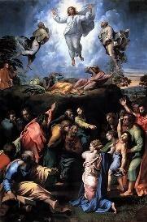
In 2011 the body of Pope Innocent XI, transferred from the Chapel of St. Sebastian on the right aisle of the basilica to this place, rests now in a glass casket under the altar beneath Raphael’s painting.

Opposite this altar are two papal monuments to Popes, one to Leo XI by Alessandro Algardi and the other to Blessed Pope Innocent XI.
Leo served as pope for only 23 days before his death. Some thought that his tomb was inappropriately large for so short a reign. Ornamented with flowers the tomb inscription reads: “sic floruit” (he flourished so [like a flower]). The bas relief on the sarcophagus depicts King Henry IV’s abjuration of his Protestant faith in favor of Catholicism in order to acquire the French throne, very much worth, as he said, a Mass.

The Cappella del Coro, usually not open to the public, sits at the end of the left nave. Here the members of the Canon Clergy of the Basilica recite the Divine Office and celebrate other liturgies.

Two papal monuments sit in the bay of the next aisle, those of Pope St. Pius X and of Pope Innocent VIII. The monument to Pope Pius X represents the last funeral monument depicting a pope wearing a papal tiara. In subsequent image the pope wears a bishop’s mitre.
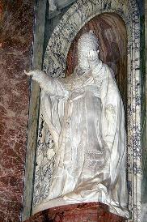
The extraordinarily beautiful, 15th century monument of Innocent VIII created by Antonio del Pollaiuolo remains one of the very few artifacts preserved from the Old St. Peter’s. The effigy of the pope depicts him twice, reclining on his sarcophagus, and seated on this cathedra above it. He holds in his hand the lance of Longinus, the original, gifted to his papacy by Bajazet II, Turkish sultan of the Ottoman Empire. It reposes now in a reliquary inside the piers of St. Veronica near the high altar and would be exposed for veneration together with the ‘Veronica’ on the feasts of Easter, Ascension, and Christmas. America was discovered in the last year of his papacy. No model pope, many criminals were exonerated of crimes upon payment of bribes, believing, as he said that God did not wish the death of sinners, but rather that they live and pay.
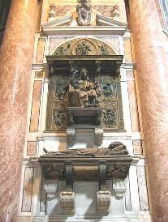
The Chapel of the Presentation, the second chapel on the left aisle, is named after the subject in the mosaic above the altar containing the relics of St. Pope Pius X. At the left of the altar stands a memorial to
Pope Benedict XV.

At the next archway there are two well-known royal monuments. On the pier to the right, the memorial to House of Stuart, the British royal family deposed during the Glorious Revolution in 1688. The Stuarts were exiled after the deposition of King James II of England. His son, the “Old Pretender” king, called James III by those who supported his claim to kingship, lived in Papal cities in Italy for the rest of his life, dying in Rome in 1766. The monument designed by Antonio Canova in a neo-classical style displays above the epitaph the relief portraits of the three Stuarts buried in the church: James III (Old Pretender) and his two sons Charles (Bonnie Prince Charlie/ Young Pretender) and Henry (Cardinal and Duke of York).
Some claim that the English King George III paid for all or part of it.

Across the aisle from it is the memorial to the wife of James III, Maria Clementina Sobieski, daughter of the King of Poland, John II.

The Baptistry, the first chapel on the left side aisle of the basilica, following ancient custom, sets the font near the entrance of the church to symbolize that the sacrament represents entry into the Church. The font, designed by Carlo Fontaa, made from the cover of an ancient porphyry sarcophagus, is said to be that of the Roman Emperor Hadrian and then of the Holy Roman Emperor Otto II. The 1308 fire at the Lateran destroyed the lower part of the sarcophagus. The three mosaics here depict various baptisms: that of Christ by John, those of Saints Processus and Martinian by Paul, and that of the Centurion Cornelius by Peter.
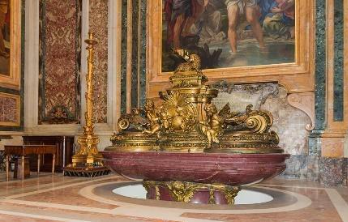
A complex of several rooms makes up the sacristy on the left of the nave. It includes a marble plaque listing the names of the many popes buried in the Basilica. Over one hundred popes are buried outside of St. Peter’s, many in churches dispersed throughout the City.

The Treasury has become a museum housing ecclesiastical art, vestments, and liturgical vessels.
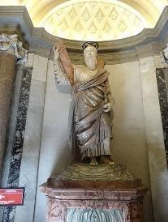
One of its most interesting and beautiful artifacts is the Paleo-Christian marble sarcophagus of the Christian convert, senator, and Prefect of the City, Junius Basso (+359). Originally set in the Grottoes it was transferred to the Treasury Museum in recent times.

It has great historical significance as the oldest sarcophagus decorated with Christian images from the Old and New Testaments on its bas-relief carvings covering three sides. The figure of the deceased Junius Basso does not appear in the carved figures. Instead, its ten panels in the front are filled with biblical figures, Old Testament (Adam and Eve, Cain and Abel, Moses, Abraham, Isaac, Job, Daniel) and New Testament (Peter, Paul, and scenes from the life of Christ). The figures of Christ, often young and beardless, reflect an artistic style much more classical, imperial, and pagan than what would later become a traditional, stylized and Christian one. The Old Testament scenes are understood to be precursors to the Christ events of the New Testament.

Directly under the floor of the basilica lie the papal Grottoes, the ‘subterranean church’, the crypt of the modern church created in the 16th century with della Porta’s construction of the Confession under the high altar and below the area of the nave, a space which approximately corresponds to the level of the main floor of the Constantinian basilica.

Nine of the first ten popes (Saints Linus, Cletus, Evaristus, Sixtus, Telephorus, Hyginus, Pius, Eleutherius, and Victor) were buried in the necropolis of the Vatican Hill near the burial place of St. Peter. The relics of Pope Clement who had died Crimea’ Black Sea, were returned to the City by St. Cyril in the 9th century, and rest now in the basilica dedicated to him (San Clemente) near the Lateran. Leo I became the first pope interred at St. Peter’s in 461 AD. From the 5th to the 16th centuries, Old St. Peters served as the burial place of many popes (one hundred forty-seven), but the construction of the new basilica during the reign of Pope Julius II resulted a significant loss of these (eughty-seven). Virtually all the popes of the 20th and 21st centuries lie in tombs upstairs in the basilica or below in the Grottoes. Some tombs from Old St. Peter’s survive within this lower space, not only the tombs of popes but also royalty, medieval and modern. Fragments of inscriptions and mosaics, sarcophagi, sculptures, statues, statues together with chapel shrines donated by diverse Catholic European nations remain visible throughout the space. The tombs of royalty include those of Emperor Otto II (+983), Queen Charlotte of Cyprus (+1487), members of the 17th century Stuart dynasty (James III (Pretender), CharIes Edward (Bonnie Prince Charlie), Cardinal Henry, Duke of York.
The tomb of Pope Boniface VIII (+1303) occupies one of several spaces in the Crypt. This monument, designed by Arnolfo di Cambio, the most famous Florentine sculptor and architect of the High Middle Ages, contained the body of the last hierocratic pope of Latin Christendom.
Boniface established the first Holy Year Jubilee in 1300. Dante in his Divine Comedy placed this most controversial pope in the lowest circle of Hell. His critics said that “he came in like a fox, ruled like a lion and died like a dog.”

Other interesting papal tombs sit along walls in the same area include: the tomb of Pope Adrian IV, Nicholas Breakespeare, England’s only pope (+1159), has a red, granite, pagan sarcophagus decorated in bas relief with the heads of mythological Medusa but without any inscription;

another sarcophagus tomb, that of Pope Urban VI (+1387) whose reign was responsible for the Great Schism that divided Christian Europe into three papal factions until the 1417 Council of Constance;

the tomb of Pope Nicholas V (+1455), founder of the Vatican Library
and great patron of the insurgent Renaissance culture in City.

In the Chapel of the Patron Saints of Europe remains one of the Grottoes most unusual tombs, that of Agnese Caetani Colonna(+1578). She is one of the several women buried in the basilica and the only non-royal woman among them. Her ancestry, however, ties her to the most aristocratic, wealthy, and influential families of the 16th century.
In all, there are only six women buried at St. Peter’s: three are entombed in the upper church: (St. Petronilla, 1st century AD) who acording to legend was the daughter of St. Peter; Countess Matilda of Canossa (+1115); and Maria Clementina Sobieska, wife of King James III (Pretender) Stuart. The other three are entombed in the Grottoes below: Queen Charlotte of Cyprus (+1487); Agnes Caetani Colonna (+1578); and Queen Christina of Sweden (+1689). The Vatican expanded several times the Grotto space and added chapels. In 1939 workers lowered the floor of the grottoes to prepare space for the tomb of Pope Pius XI. In the process they uncovered the ancient necropolis on the left side of the church which led to further excavations to search for the tomb of the Apostle Peter.

In the late 20th and early 21st centuries the Vatican added new national chapels and renovated and enlarged older ones as well.
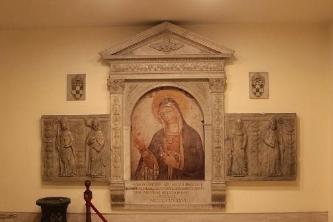
An opening with glass doors between the Grotto area and the Confessio created in 1975 allows visitors a close view of the Niche of the Pallia.
The Niche lies directly below the main altar of the basilica and directly above the tomb of St. Peter buried just a few feet under it. Its door was designed by Benvenuto Cellini, a renowned Renaissance goldsmith and sculptor.
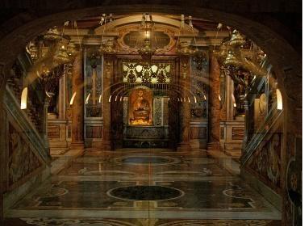
The Grottoes contain twelve chapels and the tombs of seventeen popes, one emperor (Otto II), one king and two queens.

Visitors can climb to the roof which provides bathrooms, gift shop and
coffee bar (bistro).

Access to the base of the inner dome which affords a grand view of space around the altar below is by a set of stairs at the roof level.
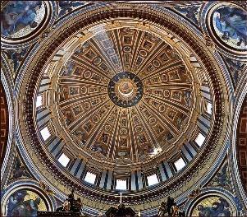
The very strenuous climb from the inner base of the dome to the base of the lantern can be done on foot – but to be avoided by those with heart or breathing problems.
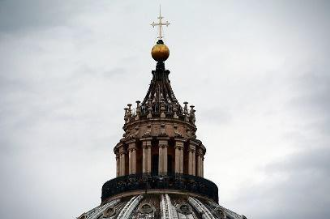
A breathtaking view of the Vatican and panoramic view of the City
rewards those who make it to its balcony.
