
A new era of European tourism began in the middle of the 17th century after the end of the long, drawn-out, Thirty Years War. Italy and Rome, especially, benefitted from the phenomenon, the ‘Grand Tour’, which brought many, cultured, northern Europeans to the peninsula on an extended, months-long, excursion which frequently concluded with a lengthy stay in the City. Allured by ancient, Classical monuments, and Renaissance palaces, parks, and villas, these cultural (aesthetic and intellectual) pilgrims created a new clientele for Roman shopkeepers and entrepreneurs. The area of what would become known as the Spanish Steps catered to the various tourist needs of the French, Spanish and English visitors: accommodations, markets, specialty shops and social spaces.

The Piazza, the City’s grandest and one of its best loved, lies at the bottom of the Spanish Steps. Romans called the area Piazza Francia because of its proximity to the church of Trinita dei Monti. Constructed at the expense of the Kings of France, it assumed its most recent designation (Piazza di Spagna) from the nearby offices of the Embassy of Spain to the Holy See. The piazza results from the 16th century town planning project of Pope Sixtus V, Rome’s first modern city planner. This “builder” pope created new streets and restored the aqueduct of Alexander Severus (Aqua Felice, named after himself) to carry water to this part of the City.

From the 17th century, the piazza grew into a very important tourist center. Travelers arrived here from all over Europe to enjoy the benefits of its hospitality. Illustrious writers, artists and poets such as Rubens, Tennyson, Poussin, Litzt, Wagner, Byron, Keats, Shelley frequented the piazza and became its best advocates. In the 18th century, Europeans spoke of it as “er ghetto de l’Inglese” (English Ghetto), of which Babington’s Tea Room, continues to operate, a living relic of this English connection. The Spanish Steps (Scalinata della Trinita dei Monti), the most imposing urban project of the 18th century and the only truly great rococo monument in the City, consist of an imposing set of one hundred thirty-five steps, the most famous in the world. They ascend the steep slope between the Piazza di Spagna at the base and Piazza Trinità dei Monti, dominating the space above.

Two interesting monuments, Pietro Benini’s, Fontana della Barcaccia, and the Sallustian Obelisk in front of Trinita dei Monti serve as bookend pieces for this unique staircase.

For centuries the hill between the two areas remained wild and undeveloped. In 1660, however, a recently deceased French diplomat left part of his estate for the construction of stairs between the hill, under the patronage of the French monarchy and the piazza under the Spanish. The project stalled for several decades but recommenced at the beginning of the 18th century, the result of a bequest made for it by the French Ambassador, Etienne Gouffier. Francesco de Sanctis won the competition for its design. He created a plan based on the concept of terraced garden stairs with landings in an elliptical shape inspired by precedents established in earlier projects by Bramante and Michelangelo and the steps of the church of Saints Domenico and Sisto at Largo Angelicum. Pope Benedict XIII inaugurated the Steps during the Jubilee Year of 1725. Its twelve ramps, divided into three sections (Trinity reference to the Church above) and one hundred thity-five travertine steps which lead to colorful terraces, make it the widest and longest staircase in Europe. A magnificent operatic-like setting showcases one of the most picturesque churches in the City. Nothing about this pure Baroque structure has changed since its construction over three hundred years ago.

The Sallustian Oblelisk stands at the top of the staircase, named after the Roman historian Sallust who once owned the property, part of his private gardens. The 45-foot, Roman obelisk, mimics an Egyptian counterpart created during the reigns of the pharaohs Seti I and Ramses II. Its hieroglyphic inscriptions also copy those on the Flaminian obelisk in Piazza del Popolo. This obelisk once belonged to the aristocratic Ludovisi family who donated it to Pope Clement XII in 1789. He had it erected here above the Spanish Steps and in front of the church, Trinita de’ Monti, to align with the obelisk on the Quirinal Hill. It is one of the three obelisks visible from Piazza Quattro Fontane near Borromini’s church of San Carlo (Carlino).

If approached from Via dei Condotti, the stairs seem to grow and expand before the eyes of the viewer and dominate the vision field creating a breath-taking panoramic view of the Piazza connected to the imposing and majestic Church of Santa Trinita dei Monti above.

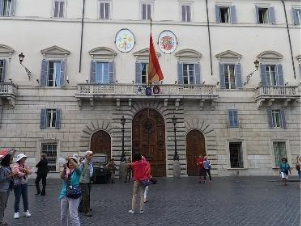
The steps, though commissioned and paid for by the French, over time became known as “The Spanish Steps”. Italians, however, continue to refer to them as la Scalinata , derived their original Italian name, “La Scalinata di Trinita dei Monti.” The Spanish Embassy, located now in the Monaldeschi Palace, pre-existed Piazza di Spagna and its famous steps by several centuries.
Since the mid-20th century, the City annually adorns the stairs with azaleas in the spring to welcome the arrival of warm weather and the tourists it brings to the City.

In the middle of the square, once the site of ancient Naumachie (mock naval battle) and at the foot of the Steps is the famous Fontana del Barcaccia, (ugly boat) sculpted in 1627 by Pietro Bernini and his son, Gian Lorenzo. The impressive concept of his design, however, bespeaks his practical and creative genius. The water pressure in the zone (Aqua Vergine) was exceedingly low and incapable of producing powerful jets of water. In response, he simply designed sit under the road as if the boat was semi-submerged, taking in water instead of spurting it out. The sculpture contains many allegorical references: the ship as a vessel of salvation which does not sink despite enemy attacks; the central spout as source of enlightenment; the Barberini bees as symbol of wisdom and industry and the sun as source of inspiration.

At the corner on the right of the Steps sits the Keats–Shelley Memorial House where the young English Romantic poet John Keats lived and died of tuberculosis in 1821. It has now become a museum dedicated to him and his friend Percy Byssche Shelley. As he lay dying, Keats often heard and was comforted by the sound of water gurgling from the fountain below. It is said that this was the inspiration for the line he requested for his epitaph: “Here lies one whose name was writ in water.”

The museum holds an extensive collection of English romantic works, memorabilia, manuscripts, and letters relating to Keats and Shelley and other important English-speaking literary figures of the age such as Lord Byron, Wordsworth, the Brownings and others. The house was purchased and restored to its present state in the early 20th century. To protect its contents from the Nazis during World War II much of its contents were stored for safe keeping at the Abbey of Monte Cassino.

At the left corner a block away from the Steps, remains the still-elegant
Babington’s Tea Room.

Isabel Cargill and Anna Maria Babington, two English ladies who lived in the City established it in1893. It enjoyed immediate success because Rome an important stop on the route of the Grand Tour for wealthy and aristocratic English gentlemen and ladies. The Tea Room served as a meeting point where they socialized and enjoyed cups of fresh and hot brewed tea. Despite Mussolini’s anti-British policy, Babington’s remained open during World War II and flourishes to this day under the direction of Cargil descendants. One of the tea room’s lovely and charming decorations is the pastel portrait of Isabel Cargill by her husband, a portrait artist, Giuseppe da Pozzo.

The 17th century Palazzo di Propaganda Fide (Palace of the Propagation of the Faith) is a palace owned by the Holy See and located at the southern edge of Piazza di Spagna. It houses the offices of the Congregation for the Evangelization of Peoples. Bernini was its first architect, but Pope Innocent X replaced him by Francesco Borromini whose architectural style he favored.

Two sides of the palace were designed by the City’s most illustrious and competitive architects: the Piazza di Spagna side by Bernini and the Via della Mercede by Borromini. Borromini’s façade with its concave and convex curves both on front surface and in the windows is one of the best examples of Italian Baroque architecture.

After the death of Pope Urban in 1644 Bernini lost his commission to renovate the palace. Pope Innocent X replaced him with his nemesis Francesco Borromini who redesigned the oval shaped chapel Bernini had begun and replaced it with his own remarkably beautiful rectangular structure, the Oratorio Re Magi (Magi Kings). The extraordinary fluidity and dynamism of its inner surfaces fills the space accentuated dramatically by light which pours in from windows on all sides and typifies the internal features of virtually all Borrromini churches and chapels.

On Via della Mercede #12 and curiously enough, diagonally across the street from the Borromini façade, sits the palace where Bernini lived and raised his family and in which he died, aged 81, in 1680.

His well known, but uncompleted sculpture, Truth Unveiled by Time, a naked young woman, though executed in 1652, remained in the house until he died. Bernini intended it as a metaphor for the gradual unveiling of truth often long hidden under erroneous misinformation. This, he believed, caused some of his contemporary critics to blame him for the failure of bell towers he had designed for St. Peter’s. Bernini willed the sculpture to his family. They preserved it for almost 200 years until it was purchased by the Italian state in the 19th century and added to the large collection of Bernini art works in the Borghese Gallery.

Nearby in Piazza Mignanelli stands a striking column dedicated to the Immaculate Conception, inaugurated on December 8, 1856, two years after the proclamation of the eponymous dogma.

Annually on that day the Pope comes to the piazza to pay homage to the Virgin Mary and to adorn her sculpture at the top of the column with a floral wreath. This column is the last papal monument erected in the City.

Via dei Condotti serves as the fashionable Fifth Avenue of Rome with its glamorous retail shops and boutiques selling jewelry, fashion items and luxury goods of all kinds. It is named after conduits buried under the street which carried water to the Baths of Agrippa in the 1st century. Once it was the main road to the Pincian Hill.

The Antico Caffè Greco on Via dei Condotti #86 remains the oldest bar in Rome, opened in 1760 and one of its most luxurious. For centuries it has been a gathering place for local and international celebrities, writers, artists, politicians, intellectuals, royalty and the well-to-do. Its clientele has included luminaries like Goethe, Keats, Byron, Schopenhauer, Stendahl, Elizabeth Browning, Brahms, Ibsen, Joyce, Welles, Liszt, Twain, Nietzsche, Hemingway and many others. The house across street from the Café Greco was a well-known lodging place for English travelers such as Tennyson, Thackeray, and Joseph Severn, the friend of John Keats.

Located on it as well (68# Via dei Condotti) is the headquarters of Sovereign Military Order of Malta founded 1113 as Knights of St. John of Jerusalem (later the Knights Hospitalers, and later still, the Knights of Malta). It is recognized now as a sovereign state, third in the City, along with the Italian Republic and the Vatican City State, and has, for example, its own license plate (SMOM).
