
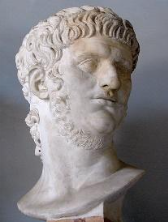
Just beyond the Porta del Popolo, the main entrance to the City for visitors travelling there from the North, is one of the City’s most historically popular churches, that of Santa Maria del Popolo. Since it is the first church travelers see when they enter the city it was from its inception designed to impress. Because it reflects the contributions of many of Rome’s finest artists (Pinturicchio, Bramante, Raphael, Caravaggio, Bernini, and many others) Santa Maria del Popolo has always been one of Rome’s great tourist attractions. Nero, the first emperor to persecute early Christians, according to local legend, was buried here below the Pincian Hill in a family tomb. Over the years a walnut tree grew out of the ground over Nero’s burial spot. The people of the neighborhood were troubled nightly by eerie noises of swarms of black crows perched on its branches. They believed that these were incentivized by the ghost of the emperor. Around 1099 Pope Paschal had a dream in which the Blessed Mother ordered that the tree be cut down, the tomb removed, the emperor’s ashes thrown into the Tiber, and a chapel dedicated to her be built over the site. The name “del popolo” (of the people) is attached to her name on the church because some of the costs of its construction were assumed by people living in the neighborhood.
In the 13th century the chapel was enlarged and consecrated as a church by Pope Gregory IX. He gave it the highly venerated icon of Our Lady which sits above the high altar and which legend and tradition claim to have been painted by the evangelist, St. Luke.

Later in the same century the church was handed over to a group of Augustinian friars from Tuscany who constructed the monastery where Martin Luther, an Augustinian member of their order, may have resided here during his visit to Rome in 1517.

The church and monastery were rebuilt in the late 15th century making it one of the first Renaissance (Florentine) churches in the city.

Pope Sixtus IV commissioned the architect Baccio Pontelli to redesign it in its current form. This same pope undertook the rebuilding of the City which had deteriorated significantly during the seventy-year Avignon Exile. Many historians regard him as ‘founder the new Rome’. Sixtus encouraged wealthy patrons to build new churches (San Agostino by Cardinal d’Estoutville; San Pietro in Montorio by the Spanish crown; and San Luigi degli Francesi by the French) and assumed the responsibility for restoring important City infrastructures such as its sewer system, aqueducts, and the Aurelian Wall. For the Jubilee Year of 1475 he replaced the Aurelian Bridge over the Tiber with a new one, his own, Ponte Sisto. The coat of arms of the pope appeared throughout the City because of the numerous projects to which he put his hand. In this he set the precedent for many of his successors whose specific crests are immediately recognizable to knowledgeable locals, visitors and pilgrims (Medici five balls; Barberini bees; Borghese dragon; Chigi mountains and stars). For the Jubilee (Holy) Year of 1475 Sixtus replaced the ancient Aurelian bridge destroyed in the 8th century with a new one, his own, Ponte Sisto.

The church was built by Sixtus to house his own family (della Rovere) chapel, one of the earliest and a precedent setter for later popes. Members of a significant number of cardinals and members of papal families besides the della Rovere are buried here: Borgia, Chigi, Odeschalchi, Sforza, Pallavicini and others.

In the 17th century Baroque age, Pope Alexander VII commissioned Bernini to restore the façade and interior of the church. Restorations of the 20th century removed some of the more ornate Baroque features to restore aspects of the church’s 15th century architecture.

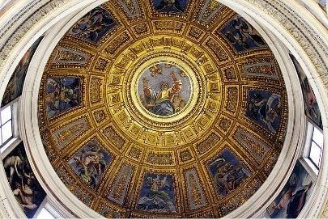
A central dome, the City’s first, rests on an octagonal drum with an arched window on each surface. It symbolizes the resurrection of Christ eight days after his entry into Jerusalem. A 15th-century bell tower characteristic of the Northern Italian Romanesque style is located toward the end of transept and is a part of the convent attached to the right side of the church. A ball and cross top the conical spire. Its rectanguar tower showcases arched windows on all sides. The oversized circular clock on the southern side was added later.

Its 15th century travertine façade of two stories represents one of the best examples of early Renaissance style with its vertical and horizontal orders reminiscent of the classical motif found on the flat façade of the Pantheon. A rose window dominates the upper facade. Bernini and others made minor additions in the 17th century such as the segmented pediments on the sides of the upper story. Three balanced and evenly spaced entrances feature wooden doors decorated with 20th century bronze reliefs.

The monumental central door is larger than the two on either side and houses scenes of the Passion of Christ.

Over the main door in the pediment is the coat-of-arms of Pope Sixtus IV and a relief of the Madonna and Child in its triangular pediment. The inscriptions on the two sides of the main entrance quote passages from bulls of Pope Sixtus IV granting indulgences to the church. The one on the left, ironically, misspells the name of the pope.

There are two external nave chapels each with its own dome.
The large, southern, highly visible Cybo chapel resembles in many respects the form of the main church except its size. The Chigi chapel dome on the north side of the church is not as readily visible.

The church incorporates a basilica styled plan.

It has a nave, aisles, and transept, in addition to a central dome.

Bernini’s decoration of the counter-façade was part of the 17th century reconstruction. Its rose window (sans stained glass) is supported by two stucco angels sculpted by Bernini’s assistants.

The monumental central door framed with marble stands out and above a dedicatory inscription. It commemorates the renovation of the church by Fabio Chigi when he was Cardinal Priest of the basilica and its consecration when he was the newly elected Pope Alexander VII. On the wall of the counter facade at the left of the entrance is the elegant 18th century monument and wall tomb of Princess Maria Eleonora with interesting and contrasting images: on top, a winged skull image, the symbol of the passing of time, and below, the winged dragon, part of the Boncompagni family coat of arms.

Also, on the wall to the left of the main entrance, is the unique and one of the most fascinating funerary monuments in the City. It was created for Giovanni Battista Gisleni, a Roman Baroque architect who designed his own monument two years before his death in 1672.

Filled with various symbols of life and death, these include the image of a caterpillar spinning its cocoon and then its metamorphosis into a moth.
Below his portrait appear the words “Neque hic vivus” (neither living here) and under the skeleton “Neque illic mortuus” (nor dead there) testimony to his belief in resurrection. Unlike most Baroque tombs the skeleton here is not the personification of death, but a symbol of life, the movement of the deceased towards the fulness of resurrected life.

There is no lantern in the dome but it is illuminated by a window on each side of its octagonal drum.
Nave and aisles have four bays with external chapels and its ceilings are cross vaulted. Arcades of the nave are from the 15th century, but parts have been decorated with pairs of white stucco angels and saints added by Bernini in the 17th century.

The nave terminates with a triumphal arch decorated with a stucco group designed by Bernini with the coat of arms of Alexander VII flanked by two angel-like victory symbols holding palm branches. Bramante extended the apse during the reign of Pope Julius II and he designed its triumphal arch to which in the 17th century were added Bernini’s gilded stucco angels.
Pinturicchio decorated the vault frescoes and Andrea Sansovino’s tombs of
Cardinals from the Sforza and della Rovere families are in the apse as well.

A 1627 altar in the sanctuary is the work of Bernini.

A 12th century painting of the Blessed Mother (Madonna del Popolo) sits above the altar. It was brought here by Pope Gregory IX from the Lateran baptistery and according to ancient legend attributed to St. Luke.

The choir behind the altar was designed by Bramante when he extended the apse.

Its stained glass windows designed by Guillaume de Marcillat are the City’s oldest and depict scenes from the childhood of Christ and the life of the Blessed Mother. The theatrical organ lofts supported by angels and putti were designed by Bernini and display elements of the Chigi and Della Rovere family crests.

On the side walls behind the altar are Andrea Sansovino’s funerary monuments of cardinals Sforza and della Rovere. These are some of Rome’s most important Renaissance sculptures whose styles depart significantly from traditional medieval ones by resurrecting older Classical and Etruscan forms and themes. Influenced by recent archeological discoveries of Etruscan tomb sculptures, the figures of the cardinals recline instead of the medieval custom of lying-in-state. This innovation was influenced by forms discovered on Etruscan tomb sculptures. The vault was painted by Pinturicchio in the early 16th century with images of the Coronation of Mary, Latin Doctors of the Church, Evangelists and Sibyls.

Chapel descriptions begin at the right aisle near the entrance and move counterclockwise in the direction of the transept.
- The mortuary chapel of the della Rovere family.

Pinturicchio’s Nativity sits over the altar.

- The spacious domed 15th century Cybo Chapel, originally decorated with frescoes by Pinturicchio, but lost when the chapel was redesigned by the Cybo family in the 17th century. The chapel is famous for its use of polychromatic marble patterns throughout, but especially in its columns.

- Frescoes of the third chapel are by the school of Pinturicchio
who supervised the painting in person.

The altarpiece is Pinturicchio’s, Our Lady and Saints.

- The Costa Chapel is the fourth chapel on the right aisle. It contains the tomb of its early 16th century founder, the 102-year-old, Portuguese Cardinal Jorge da Costa who died in 1508.

- Gian Lorenzo Bernini designed the Chapel of the Visitation and the one at the opposite end of the transept. The altarpiece depicts the Visitation.

- On the right side of the sacristy is an altar and tabernacle created by
Andrea Bregno for the Borgia pope, Alexander VI.

- The Cicada (Borgia )Chapel is one of two on the right side of the transept. In the one furthest from the altar once was interred Vannozza dei Cattanei, the mistress of Pope Alexander VI, together with one of her several children, Juan Borgia, Duke of Gandia. The tomb was removed in 1594 from the chapel which was renamed St. Lucy by orders of the pope, Clement VIII. Their marble funeral memorial plaque, defaced by Borgia enemies, now hangs on the wall of the porch of the church of San Marco near Piazza Venezia.

- Next to the sanctuary The Feoli Chapel displays an altarpiece depicting the Augustinian St. Thomas of Villanova well known for his almsgiving to the poor.

- The Cerasi Chapel stands to the left of the sanctuary, the most popular spot in the church because of the two Caravaggio paintings it contains. Tiberio Cerasi, the treasurer general to the apostolic chamber, commissioned Carlo Maderno, the chief architect of St. Peter’s, to create the chapel in 1600 as a family mortuary and dedicated it to the Assumption. Over the altar rests the painting of the Assumption by Annibale Caracci in which Peter and Paul venerate the Blessed Mother assumed into heaven.

Caravaggio masterpieces, Paul on the left and Peter on the right, face each other on the side walls of the chapel.

In the history of European painting Caravaggio stands out as one of most radical and innovative artists of the 17th century. His remarkably innovative style (Caravaggisti), characterized by extraordinary religious drama mixed unabashedly with raw human expression, influenced virtually all painters for over one hundred years (Rembrandt, Velazquez, and de La Tour).
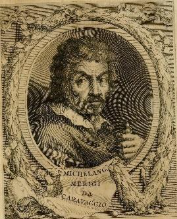
Cerasi commissioned Caravaggio for the two paintings in the same juxtaposition as those of Michelangelo’s in the Vatican Pauline Chapel, the Conversion of Saint Paul and the Crucifixion of Saint Peter. He resisted the artist’s intention to do the paintings on wooden cypress panels. He also insisted that Caravaggio paint them on canvas and in the end rejected the first version of the Conversion. Its rejected rendition remains in a private art collection located in the Palazzo Odescalchi- Baldi in Piazza dei Santi Apostoli.

In his second more revolutionary version of the Conversion, Caravaggio transformed a merely physical journey into a purely spiritualized and internalized one.

St. Peter’s Crucifixion depicts realistically the utter brutality of the action, Peter crucified upside down, creating an X shape made of human flesh, a symbolic, cross-like form. The faces of the executioners turn toward the darkness while the body of Peter radiates light. His anguished eyes stare at the nail they drive into the wood beam of the cross.

- The Theodoli Chapel is at the top left corner of the transept next to the Cerasi Chapel and is dedicated to St. Catherine of Siena.

- The Chapel of the Holy Family is at the left end of the transept and it contains a Bernini-designed altar.

- The Cybo-Soderini Chapel is the fourth chapel off the left aisle. Its center piece is its 15th century crucifix and the 17th century frescoes depict the legend of the True Cross.
- The Mellini Chapel, a mortuary chapel, is the third on the left and is dedicated to St. Nicholas of Tolentino. The 17th century monument to Cardinal Giovanni Garcia Mellini is by Alessandro Algardi who also sculpted the busts of Urbano Mellini and the effigy of Mario Mellini.
- The restored Chigi Chapel is the second from the back on the left aisle. The domed chapel dedicated to Our of Loretto was designed by Raphael and commissioned by the wealthy Sienese Chigi family, the bankers, Agostino and brother, Sigismondo. Both rest in tombs on either side of the chapel. The project in 1520 ceased for over one hundred years because of the sudden death of Raphael. Not until the 17th century was the project completed by Bernini.

The tombs of the Chigi brothers display red pyramids designed by
Raphael. Bernini later the portrait medallions.

The strikingly beautiful gold and blue cupola mosaics designed by Raphael represent the heavenly spheres.

Statues of four important Old Testament prophets stand in the corners of the chapel. The Jonah and Elijah sculptures were designed by Raphael, whereas those of Daniel and Habakkuk, were carved by Bernini himself.

Daniel and the lion, inspired by the Laocoon sculpture in the Vatican, sits diagonally across from the Habakkuk figure, its thematic counterpart. Bernini drew a parallel between the Jonah and Daniel figures both of whom, by God’s grace, escape death from the fury of wild beasts.

The statue of Jonah and the whale, designed by Raphael stands on the left side of the altar.

Historians report that the head of Jonah resembles that of Antinous, a much-admired statue once housed in the Farnese palace and that Raphael supervised personally and attentively the chiseling of the statue by his assistant, Lorenzetto. The statue represents the prophet spewed from the belly of the whale, a pre-figuring of Christ’s resurrection, the theme central to Raphael’s design of this magnificent funeral chapel. Originally intended to stand at the entrance of the chapel, Bernini placed it in its present setting during the restoration of the chapel in the 17th century.

The statue of Elijah by Lorenzetto stands on the right side of the chapel’s entrance. Whereas Raphael intended the Jonah figure to symbolize the burial and resurrection of Christ, that of Elijah refers to his ascension. Elijah looks towards the dome of the chapel at the figure of God depicted there.

Bernini created the magnificent, bronze hanging lamp surrounded by three putti. At its top is set a Marian crown.
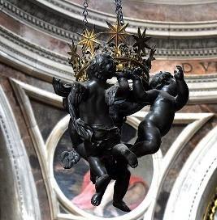
He also designed the mosaic tiled floor. The inscription reads Mors aD CaeLos whose capital letters spell out in Latin the date MDCL(1650) when the tomb was completed.

Outside of and to the left of the Chigi chapel is one of the church’s most remarkable funeral memorials, the monument of Princess Maria Flaminia Odescalchi Chigi, the last of the great Baroque monuments executed in the City (1771). Emblems associated with the Odescalchi and Chigi families were incorporated throughout its design: the portrait framed with Chigi stars; the Odeschalchi eagle on top; the Odeschalchi lion and a Chigi mountain on the bottom.

- The Montemirabile Chapel is located immediately to the left of the entrance and houses the baptistery dedicated to St. John the
Baptist. Its patron was Giovanni di Montemirabile, bishop of Vaison in France, and whose tomb marker is on the floor.

This chapel contains the tombs of two cardinals (Pallavicini and Rossi), two ciboria by Andrea Bregno, and an altarpiece of the Baptism of Christ. The current ciboria are a 17th reconstruction of fragments of earlier ciboria donated to the church in the 15th century by Vannozza Cattanei, mother of the Borgia children and buried in a chapel near the main altar.
