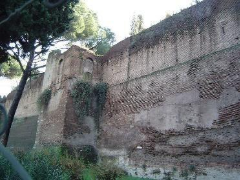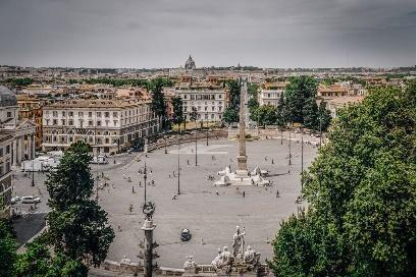
One of the oldest, best-known, and historically most visited piazzas in the City is Piazza del Popolo, a large public square inside the northern gate of the 3rd century BC Aurelian Wall. Through it passed the Via Flaminia, constructed in the 3rd century BC by the consul, Gaius Flaminius. It ran for over two hundred miles from the Capitoline Hill diagonally across the peninsula to Rimini, on the Adriatic Sea. For centuries the piazza served as the gateway for visitors from the North along the Via Flaminia, their first view of the City upon arrival. Pilgrims, merchants, foreign rulers, and invading armies all passed through its arches. The name of the piazza remains the subject of debate. Some believe it comes from the Latin word, populus, poplar, a species of walnut tree which once grew in the area and, according to legend, hosted the ghost of Nero whose family tomb stood nearby. Others think it was after the shrine (Maria del Populo), built in the late 11th century by Pope Pascal II, to exorcize that very ghost.

Three streets branch out from this piazza towards the city and form a
trident.

The eye-catching arrangement of these parallel streets represents but a small part of great Renaissance urban planning projects of the papacy, Pope Sixtus V especially, the great builder pope of the late 16th century.
The popes of this period intended to connect with wide and straight roads the great basilicas of the City: Via di Ripetta on the right leads to St.
Peter’s, the Via del Corso in the middle to St. John Lateran, and the Via del Babuino on the left to St. Mary Major.

On a much wider scale throughout the City, the same scheme appears as well in the grand streets arranged in a cruciform plan and connecting on one side St. Peter’s to the Lateran and, on the other, St, Mary Major to St. Paul outside the Walls. The strategic placement of obelisks along these thoroughfares and the intersection of the two great axes of the roads at the Colosseum underscores the carefully considered scope of the long-range plan.
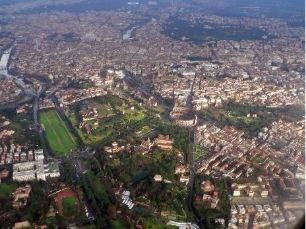
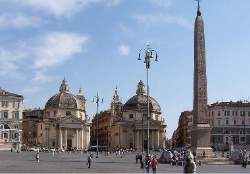
General Giuseppe Valadier, an architect, engineer and city planner under Napoleon Bonaparte and various popes, significantly altered the appearance of the City in the late 18th and early 19th centuries. His many projects include transformative works on churches (Saint Peter’s and San Rocco), public squares (del Popolo and the Lateran), and the restoration of ancient monuments in the Roman and Imperial Fora. The most recognizable of these today is his neo-classically styled Piazza del Popolo. Circular in shape, it looks north towards Via Flaminia, south towards twin churches, east and west towards two hemi-cycles across from each other. Sphinxes, four seasons’ statues, fountains, a backdrop of cypress and pine trees decorate this great expanse of space.

Valadier linked the piazza with the Pincian Hill by connecting the space near the church of Santa Maria del Popolo to the hill above by means of a carriage road that doubles back upon itself. This same Pincian Hill behind church of Santa Maria del Popolo remains the City’s largest public park. In ancient times Romans called it the “Collis Hortulorum” (hill of gardens) because it contained several monumental gardens of the Roman aristocracy (Lucullani, Sallustiani, Pompeiani and others). Its name derives from the Pincii family who owned it in fourth century.

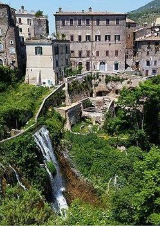
The art of the garden was introduced to Rome by Julius Casar before whom only woods (nemi) existed in the City. Augustus created two in Campo Marzio in his effort to beautify the area and make it accessible to the Roman populace. There emerged gradually the custom of surrounding public buildings with foliage, lawns, and gardens. Great gardens of the wealthy (Sallust) began to occupy the Pincian Hill and other parts of the City and, as well, to surrounding villas in hill town regions nearby (Tivoloi and Frascati). These typically contained, besides flowers and foliage, magnificent walkways, statuary, pools, and shrines.
Valadier’s project for Napoleon included a garden passage extending from the Pincian Hill to Villa Medica at the top of the Spanish Stairs and later would come to include the thirty feet high obelisk which Pope Pius VII in 1822 ordered erected in 1822. The Egyptian obelisk originated in Heliopolis, Egypt, constructed for the emperor Hadrian and dedicated to his lover, Antinous who in 130 AD drowned in the Nile River. He divinized Antinous, transported the obelisk to the City, and placed it in the Circus Variano at his villa property outside the walls. The obelisk, with an inscription on it written by Hadrian and his wife Sabrina, was discovered in the 16th century near Porta Maggiore along the Aurelian Wall whence the nickname, ‘Aureliano’.

At the center of the Piazza del Popolo stands the Egyptian obelisk of the Pharaohs Sety I and Ramses II (19th Dynasty). This obelisk (the Flaminian, named for the road that enters the Piazza), the first transported to the City from Egypt, remains the third tallest in the world (after St. John Lateran and St. Peter’s respectively) at eighty-five feet. Transported to Rome in 10 BC by Augustus after the defeat of Marc Antony’s fleet at the Battle of Actium (31BC), he dedicated it to the god Apollo to whom he attributed his victory over his arch-rival and had it set on the spina of the Circus Maximus. Unearthed in 1587, Pope Sixtus V ordered its restoration in 1589 by the architect Domenico Fontana and its transfer to this Piazza as part of the urban to beautify the City and to develop in it an improved road system. It contains three inscriptions: a hieroglyphic one on the shaft for Rames II and Seti I, and two Latin ones for Augustus and Sixtus V. The 16th century (Sixtus V) inscription reads (in translation): ” I stand much happier here before a Temple dedicated to one whose virginal womb bore in Augustus’s reign the Son of justice”.

Surrounding the obelisk sits the Fontana del Obelisco, a group of four small fountains made with lion figures, rest on stepped plinths.

Two decorative Baroque churches (Santa Maria dei Miracoli (right side) and Santa Maria in Montesanto (left side) separate the streets of the Trident and were designed by the great Baroque architects Carlo Rainadi, Bernini and Carlo Maderno. The original designs were by Rainaldi but altered later by Bernini for more dramatic effect. Bernini, for example, used two different shapes for the domes: one round, the other oval. The front entrances of two churches are similar to those of St. Peter’s. The building materials of the churches were recycled from Bernini’s failed bell towers at St. Peter’s.
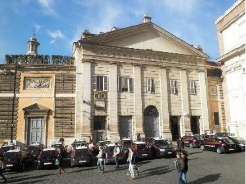
A modern police (carabinieri) barrack, The Giacomo Acqua, stands opposite the church of Santa Maria del Popolo, the place where Mussolini was imprisoned for a few days in July 1943.
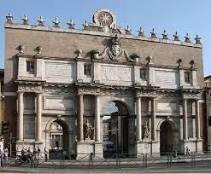
At the north side of the piazza sits the Porta del Popolo which leads to the beginning of the Via Flaminia heading north.
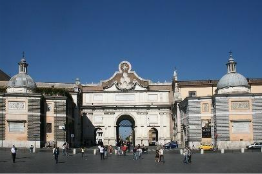
An interior gateway, redesigned in the 17th century, commissioned by Pope Alexander VII, and designed by Bernini, provided a welcome to Rome for Queen Christina after her conversion to Roman Catholicism and the abdication of the Swedish throne in 1655). She arrived here on December 23, of the same year with a retinue of two hundred fifty persons. On the archway Bernini combined the emblems of the Queen, a wheat sheaf, with that of the pope, mountains, and star. The pope himself penned its inscription wishing her a happy and auspicious entrance to the City (“felici faustoque ingressu”).

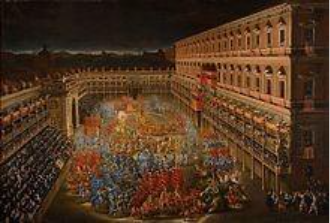
Church and City officials and a large crowd greeted her with great aplomb, cannon bursts and all. A series of flamboyant festivities were celebrated on her behalf for months. The Pope confirmed her at St. Peter’s two days later and gave her the feminine form of his own (Alexandra) for her confirmation name. A great festival reception, took place in the courtyard of Palazzo Barberini in February of 1656.
On the Via Flaminia side stands the exterior gate designed earlier by Nanni di Baccio Bigio who acquired the commission after Michelangelo had turned it down.
The Aurelian Wall, built around the seven hills of the City by Emperor Aurelian around 270 AD, successfully provided the defense of Rome until 1870. Up the street and to the right of the Porta del Popolo remains the Muro Torto, the only section of the Aurelian wall not fortified by the Eastern general Bellisarius in the war against the Goth (Vitiges) in 536 AD because Roman legend held that St. Peter would defend Rome against the Goths at that spot. The part of the wall which runs along the back of Villa Medici (Muro Malo) served as the burial spot for City paupers and prostitutes.