An historically unusual but artistically significant church, Santa Maria della Vittoria, is a 17th century Baroque church, built on an ancient chapel, dedicated to St. Paul, very richly decorated, and filled with marbles of different sorts and gilded stucco work.
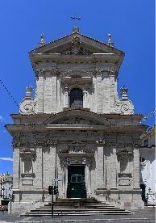
A community of Discalced Carmelites constructed the church in the early 17th century. When clearing the foundations for a new convent the friars discovered a magnificent pagan statue (Borghese Hermaphrodite).

Cardinal Scipio Borghese, the most notorious art collector of his age, desired to acquire it at all costs and did so in exchange for assuming the construction costs of the convent.

Carlo Maderno led the project aided by Giovanni Battista Soria. Pope Innocent X renamed the church and dedicated it to Santa Maria della Vittoria in gratitude for a Catholic military victory over Protestant forces in 1620 during the Thirty Years’ War. For many years until destroyed by fire, the church housed a miraculous icon of the Blessed Mother carried back from the Battle of White Mountain. In the 18th century the church flourished because many wealthy noble families sponsored the construction of its side chapels and decorated virtually the whole space with gilded stucco and polychrome marble making it one of the most remarkable Baroque churches in the City.

Buildings surround the structure on two sides and, because a crypt lies underneath it, the main entrance requires an approach by a flight of stairs.

Its two-story façade, designed by Giovanni Battista Soria, consists of travertine. The first story features six ionic pilasters, two on both sides of the entrance and one each on the outer corners. The second story contains a central round-headed window and a triangular pediment whose tympanum displays the Borghese coat-of-arms.
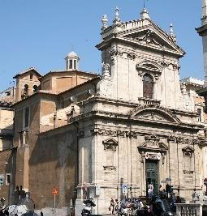
A Latin cross constitutes the plan of this relatively small church.

The nave has a barrel vault with a painting which depicts Mary in heaven and the fall from heaven of Lucifer and evil angels, an allegory of the Catholic military victory in Bohemia.

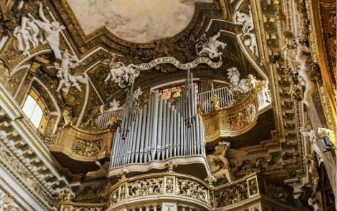
The extraordinarily complex counter-facade houses a pipe organ and balcony (cantorio) designed by Bernini. It is shaped like a drum and surrounded by sculpted angels.

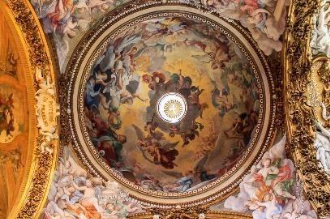
A fresco in the dome represents the continuation of the heavenly sphere theme illustrated in the nave ceiling.
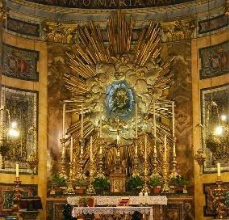
Over the high altar of the sanctuary hangs a copy of the miraculous icon of the Nativity framed in a gilded bronze gloria in the form of a sunburst, the original destroyed in a 19th century fire. A choir space lies behind the apse and behind it, the sacristy with a display of military standards captured in several different skirmishes with Muslim and Protestant forces such as the 1863 Battle of Vienna.
The extraordinary Cornaro Chapel is dedicated to St. Teresa of Avila.

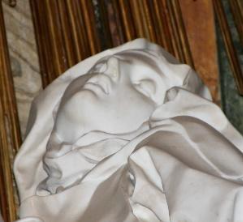
On the left side of the main altar stands the chapel housing the Bernini masterpiece, regarded by many as the highlight of his career, The Ecstasy of St. Teresa.
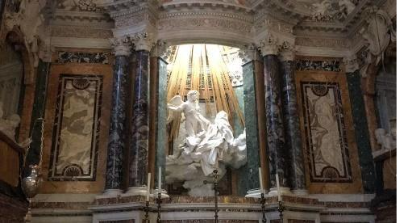
Bernini designed and personally executed this remarkable Baroque chapel and the church’s most famous work of art. It is regarded as one of the finest Baroque sculptures in Rome, one of Bernini’s best works, an artistic tour de force, a magnificent work of art and, at the same time, an act of great spiritual devotion. No other sculptor in the West has succeeded as well as Bernini in so realistically and emotionally, transforming hard stone into soft skin, curly hair, wind-blown fabric, and idiosyncratic features.

The Venetian Cornaro family commissioned it as a funerary chapel. Bernini’s challenge was to work in a very shallow space. He designed the set to theatrically face the nave and better exploit the advantages of lighting, rich marble types, and gilt wood and bronze and succeeded in creating a ‘mixed media masterpiece’.
The visual conceit employed by Bernini in this setting was to create a theater in sculpture housed in a recess above and behind the altar. Colorful marble columns flank dramatically illuminated by natural light from a concealed window above.

St. Teresa, the Spanish founder of the Discalced Carmelite nuns, appears as floating on clouds as if rising to heaven and caught up ecstasy as she described in her autobiography. Eyes closed eyes and mouth open wide as if in erotic bliss, she lies limp to emphasize the gravity of her encounter (transverberation), the piercing of her heart with a fiery arrow of divine love.
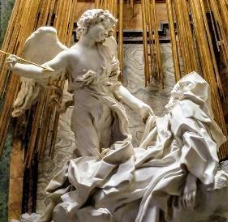
Some contemporary observers were outraged that, in their minds, Bernini would sexualize a profoundly spiritual event. Art critics have tended to the view that Bernini, instead, employed sensuousness as an avenue to explore and depict new and greater levels of spiritual awareness.

In this setting, the image of Teresa expresses her overpowering love of God in a mode known well enough in the theology of her age as bridal spirituality. Bernini’s sculpture depicts the Saint’s overwhelming spiritual desire to serve Christ and Christ alone. He employed the image of sensuous pleasure to describe the palpable aspect of Teresa’s mystical encounter.

Bernini’s Ecstasy stands out as one of the most prominent examples of the Counter-Reformation school of Baroque sculpture. He intended that the Ecstasy be a vigorous rejoinder to the Protestant view which insisted that religious experience should be confined to the use of words and an appeal to the mind. As such, his work embraced the goals of the Catholic Counter-Reformation art movement to make visible to one and all the fundamental conviction of the Catholic faith regarding the intimate connection between body and soul.
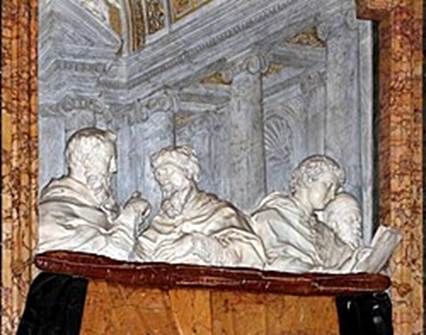
Two theater boxes, set symmetrically into the walls and carved in false perspective to create the illusion of greater depth, contain the sculpted figures of members of the Cornaro family.

The box on the right holds the Cardinal, Federigo Cornaro, gazing at the saint while the other three figures are lost in their own conversation.
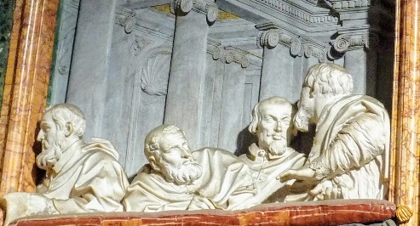
On the other side is a group of family members made up of church and state figures. Bernini used these symbolically as public witnesses who verify that scenario was a genuine spiritual experience sanctioned by the Catholic Church and tradition. A face of one of the figures in the box perhaps is Bernini’s self-portrait.
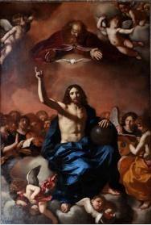
Guercino’s painting, The Holy Trinity, hangs in the Chapel of the Holy Trinity on the far-left side and, as well, as a memorial to Cardinal Berlingero Gessi in the form of an oil portrait by Guido Reni.