
Of all the City’s many churches, the most unusual one is that of San Carlo alle Quattro Fontane, a 17th century church commissioned in the early 17th century by the Trinitarian Order. Originally founded at the end of the 12th century, Trinitarians committed themselves to the ransom of Christians imprisoned in times of war. They dedicated the church both to the Holy Trinity and to the then recently canonized St. Charles Borromeo. Four Renaissance fountains included in the name of the church (alle Quattro Fontane) refer to the four fountains representing rivers of Italy (Tiber and Arno) and their goddesses (Juno and (Diana) situated at the corners of the intersection outside of the church. This intersection is unique as the only place in the city where three obelisks are visible from one place (the church of Trinita ei Monti atop the Spanish Steps, Quirinal, St. Mary Major).

The compact church encompasses a central plan (oval/rectangle). Its design expresses the post-Tridentine emphasis on preaching and Eucharist. Because of the small size of the structure, the nickname for the church, the ‘Carlino’, literally “Little Charles” fits supremely well.
Contrary to those who erroneously state that is small enough to fit inside one of the four piers at the base of the dome of St. Peter’s, its actual dimensions are roughly twice the size of those piers.

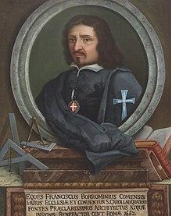
In 1634 the friars commissioned the architect Francesco Borromini to build the church, his first major independent commission in Rome and the one regarded by many as one of the best expressions of his architectural genius, and comparable, architecturally, in his age as that of Michelangelo in the late Renaissance.
Baroque art, born of the Italian Counter-Reformation movement in the late 16th century, is characterized in all forms by a highly dynamic, decorative, flamboyant, and theatrical style. Architects like Carlo Maderno, Pietro da Cortona, Gian Lorenzo Bernini, adapted the basic features of Renaissance
structures to create spaces characterized by greater height, high energy, upward movement, and colorful drama. Borromini’s style, the most innovative and radical of his predecessors, is best known for structures which feature undulating curves, variegated and interlocking geometric patterns, dramatic play of light, oval plan shapes, overlapping spaces, and understated color tones. The Baroque style quickly caught on in the City, and spread to parts of Northern Europe, particularly in Germany, but did not tickle the fancy of all art critics. Johann Winckelmann, a German ex-patriot living in the 18th century City and an internationally recognized art critic, decried the Baroque style, generally, as wretched, and Borromini’s work, particularly, as ‘bizzarro’ and a deterioration of its Renaissance antecedents.

Borromini completed work on the cloister and the block along the Via del Quirinale in 1636, but the church project and work on the church stalled for 22 years. Borromini recommenced in 1665 Borromini began construction of the façade. His suicide in 1667 halted the work again. Only in 1677 was the work completed.
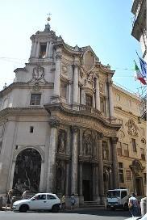
Stucco covers the brick church except for the travertine façade.
A curved, undulating façade forms a double “S” and consists of two stories, two orders of equal visual import. The upper level, unfinished at the time of Borromini’s death was completed by his nephew in 1677.

Embedded in it are many symbols, most with a reference to the Temple of Solomon: cherubs, palms, crown of eternal life. The Greek cross symbol adopted by the Trinitarian Order on their habits appears often in many of the design features of the church including the façade.
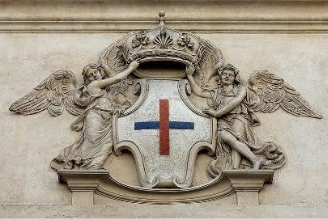
The lower story consists of three bays divided by columns. The two concave bays on left and right and one convex in the middle feature Borromini’s characteristic preference for fluid and dynamic motion. Its niches contain three statues: Charles Borromeo in the center and the two founders of Trinitarian order, John Matha and Felix of Valoix. The undulating upper story, unfinished at the time of Borromini’s death, features bays, all concave with a central niche formed by the wings of two angels. An oval dome holding four octagonal windows is not readily visible from the street. Bernardo Borromini, Francesco’s nephew, constructed the campanile (bell tower).

The interior, a masterpiece with its characteristic Baroque features of undulating movements, sculptural effects, and concave and convex lines, unites an oval shape within a Greek cross. The dominant color of the interior strikes the eye with its off-white with some pink hue.
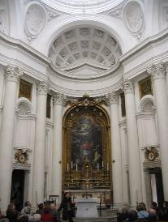
Windows and unique capitals integrate architecture, painting, and sculpture and at the same time combine various geometric patterns with sophisticated levels of religious symbolism: the triangle (triune God) and the circle (eternity of God).

Two equilateral triangles set base to base dominate the floor plan within which the architect ingeniously encloses two circles within which he sets an oval, a rectangle, and multiple triangles. A thematic pattern of the number three emerges throughout the entire structure.

Though small in space the church generates a spacious feel due in part to its coffered niches which create an optical illusion of great depth. Its walls seem to flow in a way that creates the sense of continuous unfolding motion.

Four apses fill the interior: that of the main altar; two smaller ones on either side of it, each containing a side altar; the fourth at the entrance identical in plan to the main altar on the opposite side of the church.

The church’s focal point centers around the interior dome positioned by Borromini above the three altar apses and embellished. The structure contains no widows: all light comes from the dome with its four partly hidden octagonal windows. The coffered dome, oval because of the constricted space of the site, subtly evokes an ethereal effect. Complicated and nuanced, the design fully engages geometric patterns which include crosses, octagons, and hexagons. These shrink in size as they rise toward its large oculus creating the effect of an optical illusion, a technique successfully employed by Borromini in other building projects. Its honeycomb design cleverly references the Barberini coat of arms.

Set in an arched, gilded stucco aedicule, the main altar rests against the far wall. The front of the altar consists of of alabaster and features the omni-present Trinitarian cross formed by a vertical red bar and a blue horizontal which appears as well on the tabernacle and at the top of the aedicule.

A door to the right of the main altar leads to the crypt, entirely painted in white and sometimes described as the space intended for Borromini’s tomb. Instead, he was buried, as he wished, alongside his uncle, Carlo Maderno, one of the architects of Saint Peter’s Basilica, in the church of San Giovanni dei Fiorentini where Borromini had been working at the time of his death.

The strikingly unusual cloister, adjacent to the church and accessed from the door in back and to the right of the main altar, emerges as a lovely and intimate space of two stories. The rectangular plan encompasses arcades on all four sides and represents the uniquely original work of inventive genius. Convex surfaces in the first story are flanked by Doric columns.
The second story arcades sit on columns in the same positions as the space below. At the short ends of the cloister archways supported by pairs of columns correspond to convent doorways, one leading to the sacristy, the other to the street. A room off the sacristy displays a portrait of Borromini.
