
Sant’Andrea al Quirinale originated in the 17th century, built in 1661 as the chapel for the Jesuit Society novitiate. The Society of Jesus (Jesuits) founded in 1534 by St. Ignatius of Loyola, were papally approved and recognized as a religious community in 1540. They established it as their novitiate in 1556 on an abandoned church property donated to its superior general, St. Francis Borgia. Giovanni Tristano, a Jesuit trained as an architect, received the commission to rebuild the church and add a separate novitiate building. Subsequent rapid growth of the new order made the complex inadequate almost as soon as it was completed. Pope Alexander VII authorized the construction of a new and larger church under the direction of Gian Lorenzo Bernini.

Many regard the church as one of the finest examples of Roman Baroque architecture, a uniquely successful integration of architecture, sculpture, and painting. The grand works of Francesco Borromini and Gian Lorenzo Bernini mark the beginning of a new artistic style, Baroque, which would dominate Roman architecture and impact much of northern Europe throughout the 17th and 18th centuries. It’s conscious aim was to symbolize the papal victory over the forces of Protestant heresy made possible by the successes of the earlier Catholic Counter-Reformation. Designed to stimulate the imagination and rouse emotion in all its artistic features, external and internal, it produced throughout the City hosts of theatrical-like churches with dynamic facades, animated and playful fountains, and ceilings crammed with angels and puti, ablaze with trompe-l’oeil artifices.
Bernini, like Borromini in his work for San Giovanni dei Fiorennti church, accepted no money in payment for the project, intending it a labor of faith, despite the many challenges he faced in its construction.
The Jesuits insisted that the church have five altars despite the smallness of the space. Bernini, according to his son’s account, described it as his only perfect work and where he often came to pray and attend Mass in his old age. Of it, Bernini himself said, it was only from this one work of architecture that gave him a genuine sense of satisfaction. An interesting observation, this, because in the minds of many art historians, no artist more than Bernini refashioned the City and more clearly defined its modern image than he, in collaboration with his numerous ardent papal patrons: Urban VIII, Innocent X, and Alexander VII.
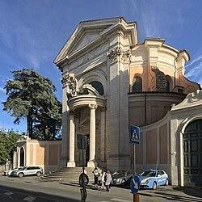
Comparison is often made between this church by Bernini and another Baroque masterpiece, the church of San Carlo alle Quattro Fontane, by his arch-rival, Francesco Borromini. The two styles contrast sharply: the theatrical and the mathematical. Bernini’s church appears as a theater created for sacred functions and remains one of the best examples of how architecture can serve the purposes of art.

Its shallow and barely visible exterior dome supports a tall lantern and circular cupola.
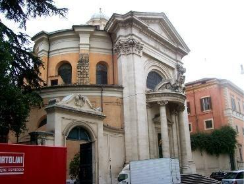
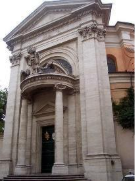
A travertine facade showcases three horizontal elements. The middle extends forward, crowned by a triangular pediment. Approached by a semi-circular set of ten stairs its steps lead to a curved porch. Over the molded doorway sits a triangular pediment, Ionic pilasters, and a lunette window.
Ionic columns topped by a large Pamphilj family coat-of-arms support the roof.

Two concave side walls of the façade reflect the plan of the church interior which magically blends polychromatic materials and the flow of light.
An elliptical plan shapes the church.

Unlike most elliptical churches, however, the major axis (line toward the altar) of this one rests on the shorter axis of the ellipse.
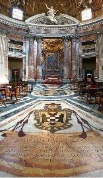
Above the counter-facade entrance lies a memorial inscription in the form of a banner designed by Bernini. Four side chapels, two on each side of the church and four large niches align the walls.
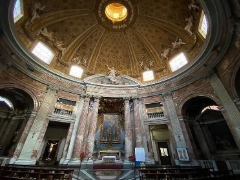
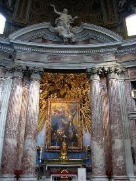
The stonework consistent throughout covers walls with white-veined, red marble, the same type on four fluted Corinthian columns in the space around the high altar. Between the side spaces stand ribbed Corinthian pilasters made of white Carrara marble. In the apse sits a high altar framed by two pairs of fluted, red and white, marble columns and an aedicule in gilded bronze. The side walls of the apse and the counter-façade in the back of the church consist of white veined green marble.

A niche over the high altar niche provides illumination from a hidden source and becomes the visual focus of the entire interior space. From the entrance of the church the eyes are drawn immediately to the main altar.
The story of St. Andrew is narrated on the wall, beginning at the high altar and culminating in the dome. Here Bernini created visually the image of the apotheosis of the saint.
The interior dome, coffered in gilded stucco, dominates the interior filling it with golden light. Ribbing in the domes reaches the lantern whose rays in the form of palm fronds are the symbol of martyrdom.
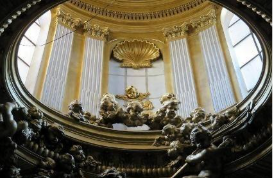
Eight windows illuminate the entire structure, those over the side chapels slightly larger than the others. Over these lie fishermen whose nets drape downward. Puti playing with garlands occupy the space. The oculus holds yellow glass in its windows to accentuate its effect. At the very top shines forth the Dove of the Holy Spirit.

Side chapels have identical designs. Archways with Doric pilasters provide entrance to each chapel, illuminated by lunette windows.

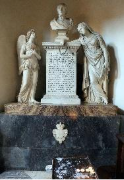
To the left of the altar an exit leads to a chapel the tomb of King Charles Emmanuel IV of Sardinia and Piedmont who abdicated the throne to enter the Society of Jesus.
The sacristy on the right of the altar houses an altarpiece depicting
the Immaculate Conception by Andrea Pozzo, the Jesuit artist who painted the ceiling fresco at the Jesuit church of San Ignazio. The colored marbles of its holy water font match those found throughout the church.
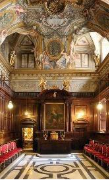
St. Stanislaus Kostka’s novitiate room and where he died, now reconstructed, is located above the sacristy accessible by a staircase. From the right side and moving counterclockwise, other chapels include that of St Francis Xavier with three paintings by Il Baciccio; the Passion of Christ; St. Stanislaus Kostka with the relics of several saints under its altar; St. Ignatius Loyola.

