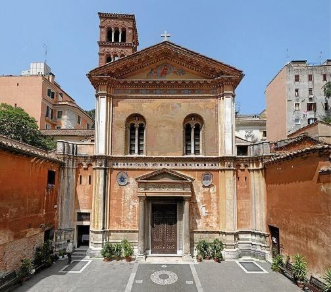
One of the City’s oldest places of Christian worship is the basilica of San Pudenziana located on the Viminal Hill. It sits over the site where once stood a small 2nd century public bath (thermae) and next to a private house where Christians gathered to worship. Because the church later became known as the Titulus Pudentis, the great likelihood is that the original owner’s name was Pudens. Legend has it that Pudens, a Roman senator who, along with other family members (daughters Pudenziana and Prassede), converted to Christianity through the efforts of St.
Peter who lived there while he resided in the City. After the great fire in 64 AD the family suffered martyrdom when Nero scapegoated Christians and blamed them for the fire. The site became an oratory dedicated to St. Peter (Pastor) around 145 BC during the papacy of Pius I. In the 4th century, when Siricius was pope, it acqired the status of a basilica. During the Middle Ages the church belonged to several religious communities (Canons Regular, Cistercians, Dominicans). The structure of the present church results from more recent major restorations: those of 1588 by Francesco Volterra and those of 1870 commissioned by Napoleon’s great-nephew, Cardinal Lucien Bonaparte.

Santa Pudenziana stands on a site lower than the street (Via Urbana) running in in front of it. City developers raised the 16th century road as part of Pope Sixtus V’s urban redevelopment plan to connect the major basilicas of the City by modern thoroughfares. One approaches the church from the street through iron railing gates, a set of two staircases and a small courtyard. A 13th century Romanesque campanile with five stories emerges on the left of the church near the Caetani Chapel. Each of its stories has arched openings, the upper ones with marble columns and the top one with discs of green stone.

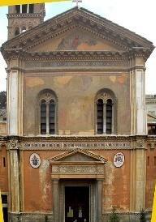
The simple two-storied façade, restored in 1870, retains much of its earlier form. The main entrance, reconstructed in the 16th century showcases medieval materials. Ancient, white, marble, and fluted columns encase the door.

An 11th century frieze, decorated with alternating Cosmatesque purple and green discs and squares, displays five circular medallions (tondi) separated by scrollwork: Christ the Lamb of God at the center, St. Pudenziana to his left, St. Prassede to his right, and at the far ends, Pudens (left) and St.
Pastor (right). The tympanum fresco depicts Mary enthroned with the child Jesus, while the upper story is framed by a pair of pilasters which support a decorated but faded entablature. Over this sits an ornamented architrave. The triangular pediment holds a damaged fresco of Christ in glory. A late nineteenth century restoration replaced a large Baroque window with the current pair, each with a tympanum containing images of Saints Peter and Paul. Faded frescoes depicting Saints Peter, Pudenziana and Prassede appear, only slightly visible, on the upper story.
Visitors enter the church through a side door on the left side of the courtyard. It leads to a vestibule off the left side aisle of the church. Above the main entrance on the counter facade wall rest two fresco paintings: St. Augustine of Hippo on the right and the Baptism of St Pudens on the left. Like most basilica-styled churches in the City, it has a central nave, many (seven) bays, two side aisles, a transept and an apse.

Some bays in its very broad nave have been walled up.
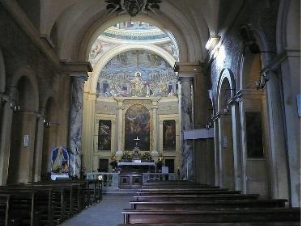
The nave ceiling, barrel-vaulted, remains undecorated and painted in a cream color, except for the 16th century coat-of-arms of titular
Cardinal Enrico Caetani. Lunettes sit over the bays and traces of the original bath-house windows remain visible on some wall surfaces.

Black and white marble Doric columns support the triumphal arch. At the upper level lies an apocalyptic mosaic scene: Christ at the center in the company of angels, prophets, Mary, and the apostles and under it, the monogram of Pope Paschal.
An early 19th century high altar has an altarpiece depicting the Apotheosis of St Pudenziana.

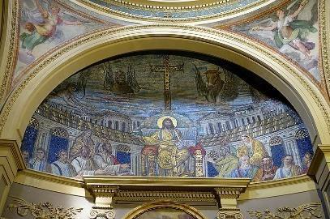
The late 4th century mosaic in the apse stands out as one the oldest and most beautiful in the City, and historically important for its iconography. In early Christian art, Christ was typically represented symbolically as the good shepherd or a lamb, not the human figure as he is here. The regal nature of this figure anticipates the majestic bearing of Christ as depicted later in Byzantine mosaics and the naturalistic style of the figures with the hieratic tradition of the Byzantine style is very evident.
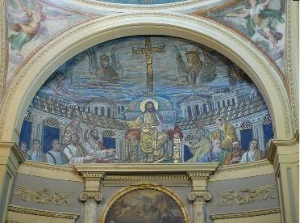
In the mosaic Christ presides over his apostles. Sitting on a bejeweled throne, he wears a golden toga trimmed with purple trim, a sign of imperial authority and here, his rule over all things. Among all the figures in the scene, Christ alone wears a halo, a characteristic feature in early mosaics. The jeweled cross on a hill (Golgotha) above the Christ figure symbolizes his triumph over death and sin. Nearby appear symbols of the four Evangelists (angel, lion ox, lion), the oldest extant examples of their kind depicted all together. Two figures of the apostles on the right side of the mosaic no longer exist, destroyed in the 16th century restoration. The apostles wear the togas of Roman senators. The two apostles nearest Christ are Peter and St. Paul (replacing Judas) on the right. The two female figures hold wreaths over their heads and represent both the Christian Church and the Jewish Synagogue. Above them sit the roofs and domes of the heavenly Jerusalem.

An ambulatory turns around the back of the apse and originally was part of an ancient bathhouse. The chapel in the left corner of the ambulatory is dedicated to St. Peter. It has a well-known 16th century sculptured altarpiece depicting Christ handing the Keys of the Kingdom to Peter. The 19th century altar enshrines part of an ancient wooden altar, allegedly used by the Apostle. Testing initiated by the English cardinal, Nicholas Wiseman, showed that the wood of the altar here matches the wood from a piece of the same altar in the church of Saint John Lateran.
Off the left aisle stands the Caetani Chapel, built over a much earlier oratory. This 16th century Baroque structure, designed for the titular Cardinal Enrico Caetani by Francesco Volterra, was completed by Carlo Maderno. Near the entrance of the chapel lies the Holy Well. According to the ancient legend, the sisters, Pudentiana and Prassede, hid the bodies of three thousand martyrs, mopped up their blood, and poured it into this well. The wellhead is covered by a porphyry slab and an iron grating. Above the entrance hangs a lunette mosaic depicting Saints Pudenziana and Prassede collecting the blood of the martyrs.
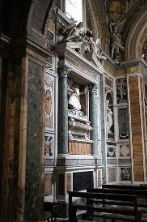
Within a rectangular apse behind the triumphal arch stands the main altar. The rich sanctuary interior abounds with marble fittings: the floor with marble inlay work, the walls with polychrome marbles and the vault with gilded stucco decorations. On the steps to the altar remain traces of blood left miraculously, according to tradition, by a host that had fallen from the hands of priest celebrant who had ceased to believe in the doctrine of the Real Presence. Two matching funerary monuments commemorate Caetani family members. Panels in the vault display the four Evangelists and in the lunettes on the sides sit angels and sybils designed by Federic Zuccari
