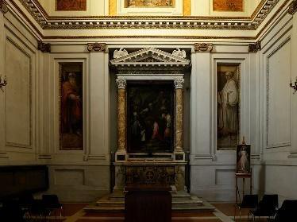
Santa Prassede is a 9th century basilica built over a much earlier 6th century church whose origins extend back to a legendary account according to which St. Pudens, a Roman senator, provided hospitality to St. Peter during his first century stay in the City. Christians dedicated this church to Prassede, one of two martyred daughters of Pudens. A nearby church is dedicated to the other daughter, St. Pudenziana. The church of San Prassede provides visitors with an unusually good visual account of early 9th century architectural and artistic media: mosaics, fresco painting, and sculpture.
In the late 16th century San Prassede became the titular church of the important Counter-Reformation figure, Cardinal, Saint Charles Borromeo, who made significant renovations to it.

Most visitors use the side entrance to visit the church.
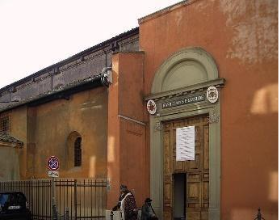
The principal entry, however, is through the original portico located around the corner on Via San Martino ai Monti. This porch structure contains ancient Ionic columns. Its façade once had a simple Renaissance frontage but, since the renovation of 1937, only the doorway survives. Above it sit identically sized round-headed, restored windows. The 12th century campanile rises over the left arm of the transept but because of later renovations now, unfortunately, is invisible from the street.

An original nave, modified, contains three aisles whose pillars enclose some of the original granite columns.
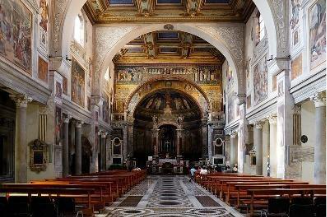
A 20th century Cosmatesque-styled floor holds a large porphyry disc near the entrance. It covers the site of a well into which St. Prassede, according to legend, poured the blood of martyrs whose death she had witnessed.
She deposited the blood into the well on which now reads the inscription “repository of the holy martyrs”. She was later buried in the same place. The sponge she used to collect the blood remains now in a reliquary under the high altar.
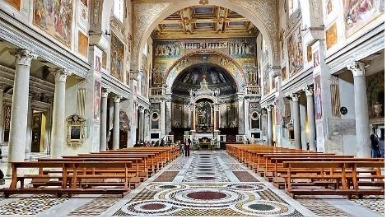
A 19th century nave ceiling coffered in gold and light grey provides much color to the space. The wall of the main entrance highlights frescoes of the Annunciation and above, episodes from the life of Moses. Its pillars nearby retain frescoes of the Apostles.
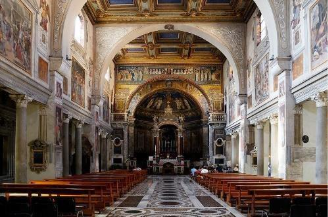
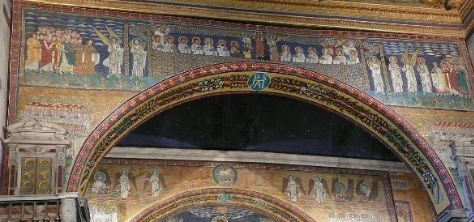
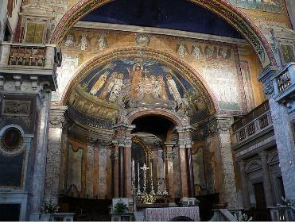
Two mosaic-clad arches represent an unusual feature of the church. The first separates the transept and body of the church from the apse which the second, the triumphal arch and the apse holds 8th century mosaics displaying the monogram of Pope St Paschal. The Second Coming of Christ and the End of Time described colorfully in the Book of the Apocalypse constitute the basic themes of the mosaics.
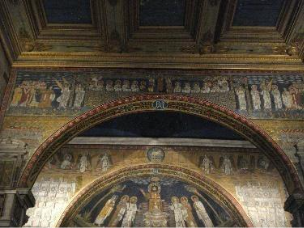
Mosaics on the triumphal arch depict the Heavenly Jerusalem wherein the celestial court, the Blessed Mother, saints and apostles, Moses and Elijah venerate the central figure of Christ.
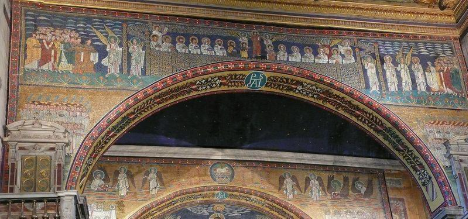
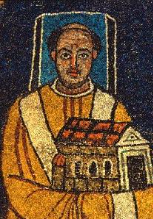
Very much modelled on that in Santi Cosma e Damiano near the Roman Forum, the apse mosaic depicts the vision of Christ in glory at His Second Coming. He stands at the arch keystone, the Lamb of God, together with the Book with Seven Seals of the Apocalypse, the Seven Lampstands, four angels, winged creatures symbolizing the Evangelists, and twenty-four bearded elders holding crowns. Around him stand the apostles Peter and Paul, Saints Prassede and Pudenziana, together with local saints and the donor of the church, Pope Paschal who holds in his hands a model of the church. Iconographic symbols such as the Jordan River (baptism), Lamb of God (savior) and twelve sheep (Christian flock), cities of Jerusalem and Bethlehem (church), four rivers (Rivers of Paradise) fill the space. Pope Paschal wears a square halo symbolizing that he was living when the mosaic was installed. Visible too is the monogram of the same Pope Paschal.
In the 18th century sanctuary two staircases of rosso antico marble provide access to the presbyterial area. Colorful porphyry and marble columns support the baldacchino and cupola over the high altar. Legend has it that Napoleon intended to remove and use them for his imperial throne.
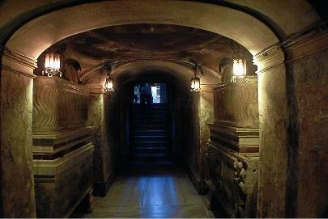
At the confessio under the altar, a staircase leads to the crypt where two pairs of ancient Christian sarcophagi sit on top of each other. The relics of Saints Prassede and Pudenziana rest in the sarcophagus on the lower right. The others contain the remains martyrs moved here from the catacombs. Fragments of paleo-Christian tombs line the semi-circular corridor behind the altar, itself a fragment from the first basilica.
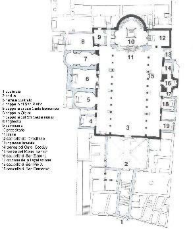
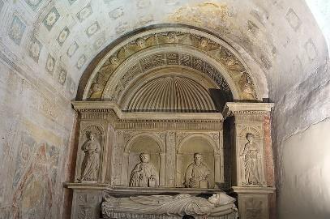
Some of the chapels and items of interest on side aisles described in counterclockwise order from the right aisle near the apse include the Chapel of the Crucifix, next to the apse on the right where, according to tradition, St. Bridgit of Sweden used to pray in the 14th century and where the crucifix spoke to her. The chapel contains a 13th century tomb, (Cardinal Anchero Pantaléon), attributed to Arnolfo di Cambio

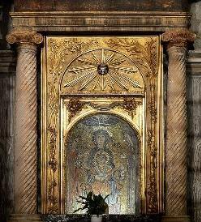
In the foyer of the side entrance hangs the highly venerated 13th century icon, the Madonna della Salute.
The Coetivy Chapel contains the Andrea Bregno tomb of Cardinal Alain de Coetivy, a 15th century titular holder of the church.
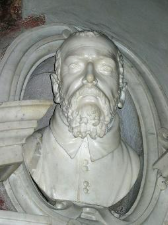
Near the main entrance of the San Zeno chapel and on a pillar, remains one of Bernini’s earliest sculptures, a funerary bust of Bishop Giovanni Battista Santoni, majordomo of Pope Sixtus V, carved when the artist was about 22 years old.
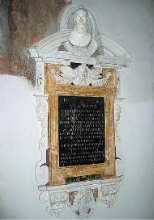
Art historians point out its naturalism visible in the subject’s wrinkled skin, furrowed brow, crow’s feet eyes, incised pupils and the folds of his collar and cassock. Bernini probably crafted the mannerist-styled frame around it as well.
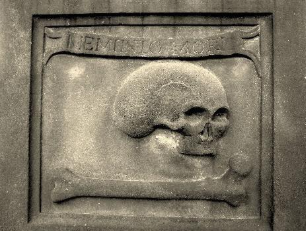
The church houses a tomb with an epitaph in Latin (memento mori) which serves as the prototype frequently seen on contemporary tombs: ’what you are I was, what I am you will be’ (quod vos etis, ego fui; quod sum, vos eritis).
The Chapel of St. Zeno, known also as the “Garden of Paradise”, served as a mausoleum for Theodora, the mother of Pope St Paschal I and a shrine for the relics of the 4th century saint, St. Zeno of Verona.
Although at the time it was regarded as a somewhat unusual arrangement, it was not entirely without precedent for a funerary chapel. In the early 8th century Pope John VII created one for his parents and his wife (Blatta) in the church of Sant’Anastasia near the Forum. This chapel, however, more than others in the City, is unparalleled in its use of mosaic decorative schemes, brilliant, visual images composed of pieces of highly colored and reflective marble and glass, set obliquely into a plaster foundation.
Its spectacular façade centers around the formal doorway composed of two ancient granite columns with Ionic capitals and a cornice. A dedicatory inscription rests above it and an open window. In front, stands an ancient vase used in pagan ceremonies. Some believe this vase contained Theodora’s remains. The blue arch above it depicts thirteen images of Christ, the apostles, Moses and Elijah, with Pope Paschal and his successor at the bottom.

Mosaics with gold backing (gold the symbol of heaven) entirely cover the interior. Their themes throughout underscore the funerary function of the chapel (Last Judgement, Harrowing of Hell, Deesis). Each tile (tessera) of the mosaic consists of clear glass with gold leaf on the back. It remains the only remaining Byzantine monument still intact in the City. Designed in the form of a Greek cross, the chapel resembles the burial chambers found in the catacombs. Byzantine-styled mosaics cover the interior. The present arrangement of three doorways results from a 15th century restoration.

A large rectangular niche with a window above houses a 17th century altar. Over this hangs a 13th century mosaic of the Madonna and Child together with Saints Prassede and Pudenziana. Each of the walls forms an arch supporting a small dome. Stunning polychromatic mosaics make up
the floor pavement and the porphyry disc in the center is set over the remains of Theodora. A magnificent ceiling vault displays Christ the Pantokrator against dark blue and star-filled background.

The left wall features Saints Agnes, Pudentiana and Praxedis (they are labelled), garbed as Byzantine royalty.

In the doorway niche, the tympanum mosaic shows the Lamb of God set over the Rivers of Paradise. The mosaic below depicts Theodora the mother of Paschal, Saints Prassede and Pudentiana and the Blessed Mother. Theodora bears a square halo signifying that she was alive when the image was composed. The unusual accompanying inscription reads, “Theodora Episcopa” (Theodora Bishop).

The interior curve of the niche arch depicts the Harrowing of Hell, Christ’s rescue from Hell of Adam and Eve and other Old Testament figures. It symbolizes the popular Christian belief that death serves as the beginning of a new life salvation achieved through the mercy of Christ. The right wall features the apostles, Saints John, Andrew and James. In the counter façade wall above the entrance are Saints Peter and Paul. The image reflects the Christian belief that Christ, even though absent in his visible body, will one day return at the Second Coming to take his place as ruler of the universe. Near the San Zeno Chapel, the Chapel of the Pillar, contains the pillar against which, it is said, Christ was scourged, a relic brought from the Holy Land
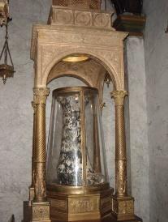
Along the left aisle is a shrine housing of the marble slab which St. Prassede used as her bed and later for her tomb. Nearby the Chapel of St Charles Borromeo displayed in a glass case is the chair owned by the saint. A 16th century, funerary chapel (Olgiati Chapel), the third on the left aisle, showcases a vault frescoed by the Cavalier d’Arpino. The altarpiece encloses the table used by St. Charles Borromeo.