Augustus Caesar, the great-nephew and posthumously adopted son of Julius Caesar, created the foundations of the Roman Imperial State, one that endured for 500 years, because of his political acumen and the good fortune to have ruled that State for its first forty or so years. Rome’s first emperor inaugurated the great “Pax Romana”, an era of peace and prosperity, law and order, the revival of traditional religious and moral values, which would endure for virtually 200 years, ending in 180 AD with the death of the philosopher-warrior, Emperor Marcus Aurelius. The astounding success of his lengthy political career reflects the practical genius of this grand stateman. The absolute power he came to acquire was, at the same time, precariously held. Careful to avoid the fate of his great-uncle, Caesar, and fully aware that his survival and success depended upon the support of the military as well as the general population, these he meticulously cultivated by avoiding the appearance of self-aggrandizing activities and promoting those that served the interests of the state. In exchange for the gradual acquisition of supreme authority by holding its highest offices (Consul, Tribune, Princeps, Pontifex Maximus, and Imperator), he created for the Roman world the return to political, social, and economic stability and, after years of civil war, the end of anarchy and rebellion. The focal points of his long career centered around efficient administration, city planning projects (reorganizing the City from four to fourteen districts, monumental reconstruction of 28 temples alone), patronage of the arts (literature, poetry, history, architecture, sculpture and painting) and the restoration of traditional religious beliefs and practices. About him and his extraordinary reign, Tacitus, the historian, remarked that ‘in him Romans had, at last, found peace and a sovereign’.

To celebrate Augustus’ return to Rome after military victories in Spain and Gaul, the Roman Senate commissioned in 13 BC, the Ara Pacis Augustae (Altar of the Peace of Augustus). They proposed to erect a votive shrine in the Senate House (Curia) which he refused but, agreed to the construction of one dedicated to peace in the Campo Marzio area, located, interestingly enough, not far away from the space (Villa Publica) where the Altar of War (Ara Martis) had stood in ancient times. Although political and propagandistic in nature the monument remains, ironically, one of the most intimate and modest of all imperial monuments in the City. Clearly it associates the person of Augustus with the providential nature of his military successes and to his ancestral connection begun earlier to Aeneas and his descendants, Romulus and Remus. Symbolically the altar represents the transition from one historical age, the Republic, to a new one, the Imperial, a process initiated by Caesar and fully realized by his stepson, Augustus (adopted posthumously by Caesar).

The number of ancient monuments buried under the earth of the City and waiting to be resurrected is too great to count. Above the ground, however, more than fifty remain, some completely intact, others only partially so. The earliest and fragmentary one is the 6th century BC foundation platform of the Temple of Jupiter Optimus Maximus on the Capitoline Hill. The last imperial monument (intact) to rise in the Forum, is the 7th century Column of Phocas, the Byzantine emperor. The Ara Pacis of Augustus combines both elements (partial and complete). During the Middle Ages the monument virtually disappeared but, but after the 16th century, its fragments began to reemerge in piecemeal fashion. Some were purchased and used as decorations on newly constructed buildings (Villa Medici on the Pincian Hill) while others ended up in museums as far away as Paris. The modern reconstruction of the Ara Pacis began in the 19th century with the gradual discovery of some of its parts. As early as the 16th century residents began to discover fragments of the Ara in the Palazzo Peretti Ottobono Fiano near its original location. These ended up in museums and private collections in Rome, Florence, Vienna, and France. Many more (53 fragments) emerged in the same area again in the late 19th and early 20th centuries, some pieces employed, for example, in the construction of the tomb of a 17th century priest in the Gesu church. State officials decided to recover all remnants of the altar still buried underground and engineers successfully excavated these in 1937, but only with the greatest difficulty. Their recovery entailed the freezing of the earth below and around them to prevent the collapse of surrounding buildings and structures.

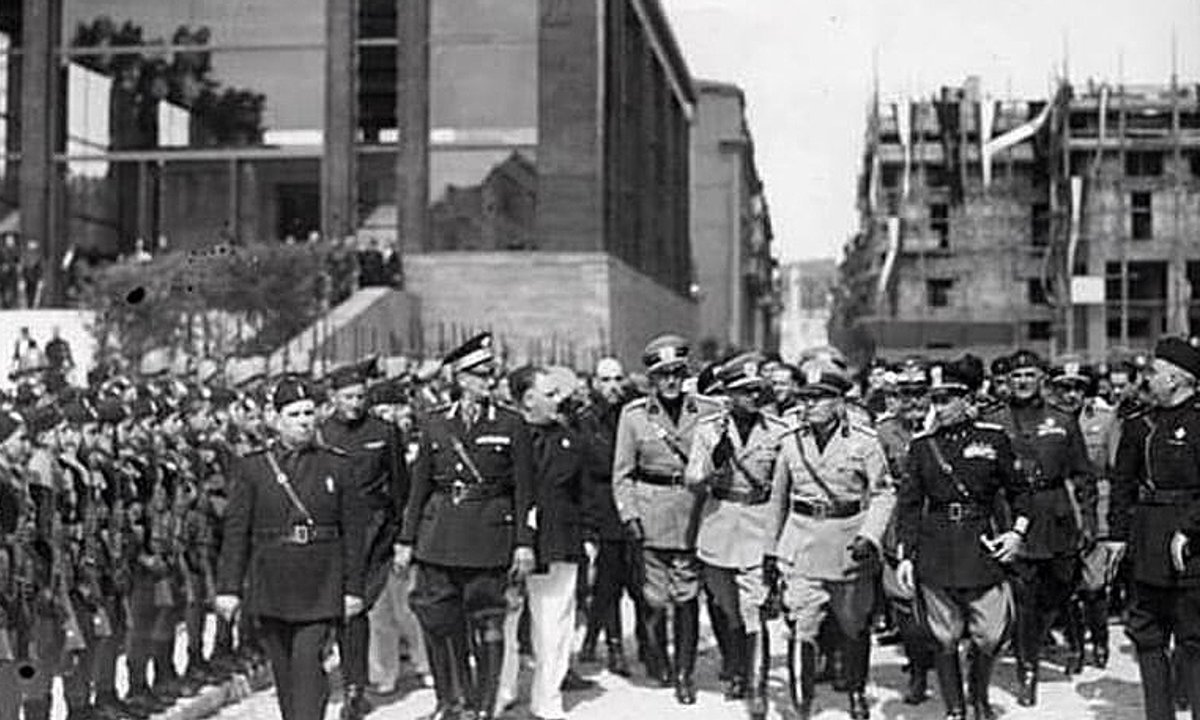
In 1938 the Mussolini government for political and propagandistic reasons reconstructed the Ara from its fragments and from reproductions of some of its missing parts. They transferred these and its pavilion to their present site very near the Mausoleum of Augustus, across the street from the Tiber River.
The marble monument, rectangular in shape (35’ x 39’), consists of a central uncovered altar surrounded by walls open on the eastern and western ends. It contains eclectic artistic elements: Greek (family procession), Hellenistic (large friezes with the panels of Tellus and Aeneas) and Roman (small friezes around the altar). Its white luna marble altar rests on a pyramid of steps carved with images depicting the religious and sacrificial ritual performed at the altar with animals being led to sacrifice. The interior walls come alive with carved images, ox skulls and garlands, expressive of the idea of sacrificial piety.

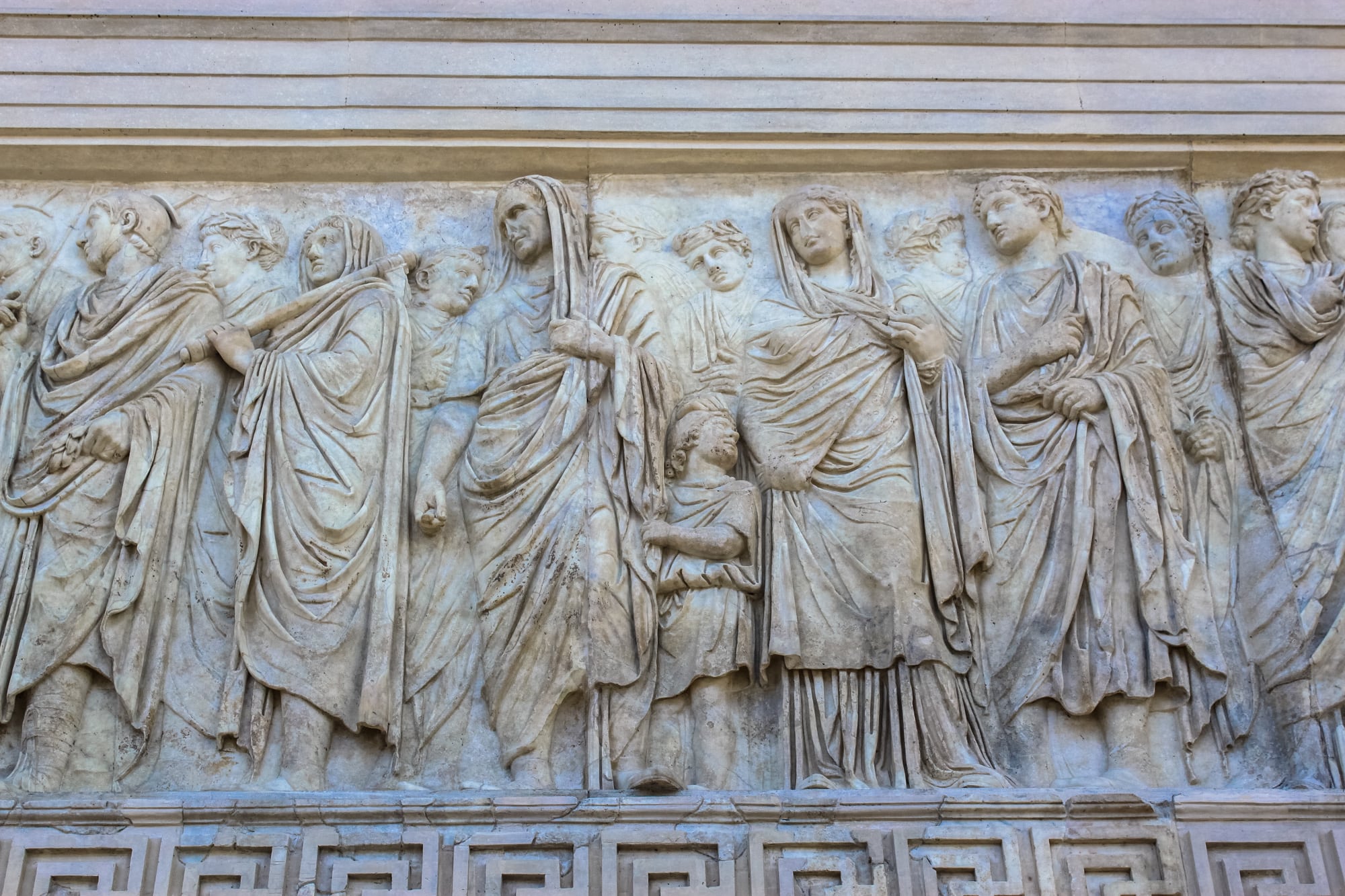
Exterior walls on the long sides of the Ara Pacis display allegorical and historical relief panels on the upper level. These depict the emperor, his family, and their retinue as they process to the altar of sacrifice. Augustus personally participated in the consecration ceremony of the Altar. Those figures with covered heads play active roles in the sacrificial ritual. Others wear laurel crowns, the traditional Greek and Roman symbol of victory. Members of diverse religious colleges, women and children also appear in the procession to symbolize Augustus’ desire to promote traditional Roman moral values and familial piety. Augustus and Agrippa are toga covered, indicating their role in the procession as the presiding magistrates.

Augustus’ hooded figure stands taller than the rest, a reference to his status as “primus inter pares” among his patrician peers and “princeps” (first citizen) among members of the Senate.
In the course of his long thirty-one year-long rule over the Roman state tens of thousands bronze and marble images of him were created and disseminated over the Empire. More than two hundred still survive. The best known is the Prima Porta portrait sculpture of the emperor excavated in 1863 in the Villa of Livia, twelve miles north of the City on Via Flaminia. The sculpture resides now in the Braccio Nuovo section of the Vatican Museums.

The lower level contains scenes of nature, flowering plants and acanthus leaves, Augustus’ family symbol. The central acanthus shows viewers a snake stealing lark eggs, a reference to passages from Vergil’s Georgics and Horace’s Odes and symbols of the fertility and vitality of the new Augustan Age. Next to the walls on the short ends stairs ascend to the altar.

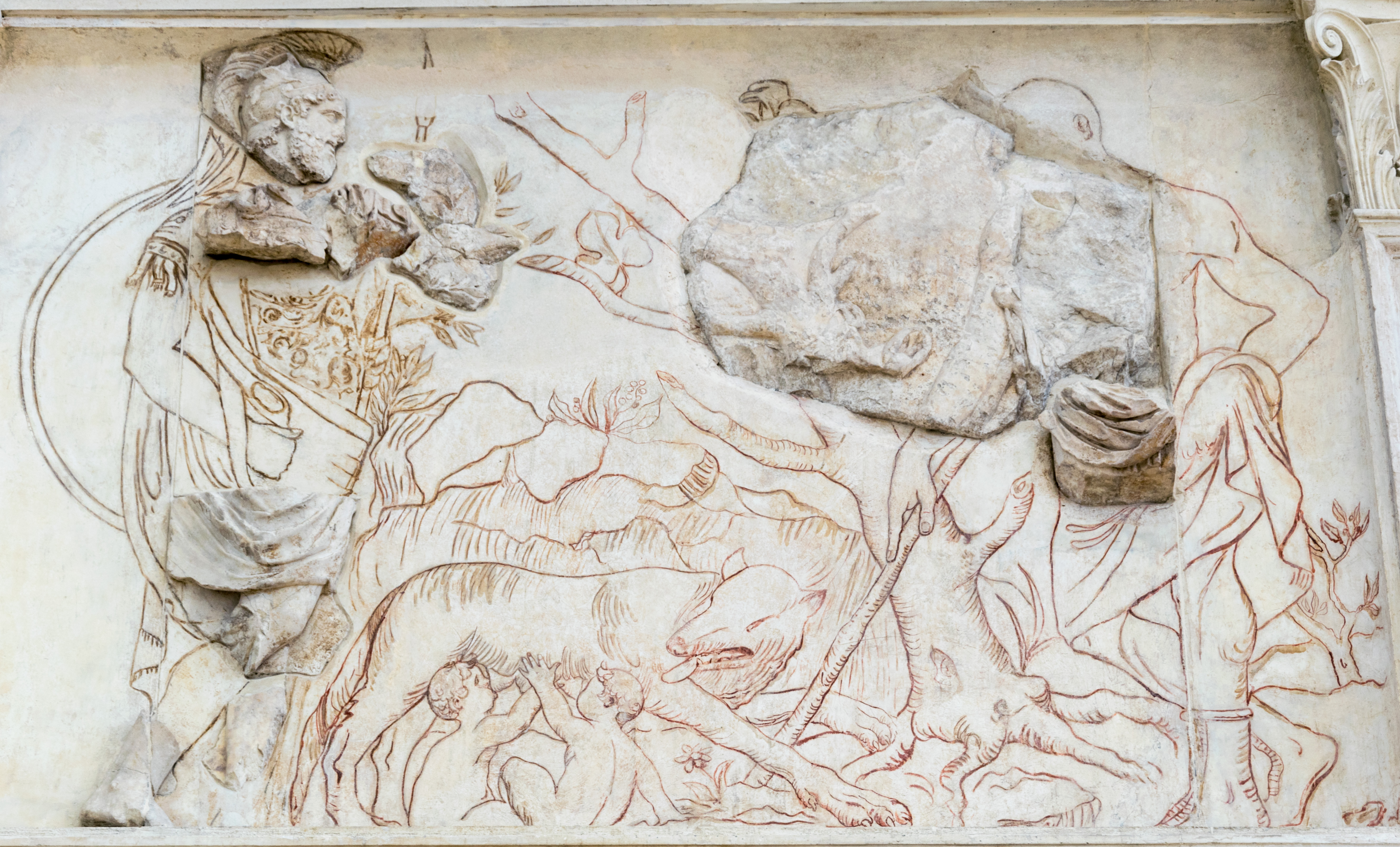
Mythological scenes on both sides of the entrance walls represent the ideals of world peace and traditional piety with images of Romulus, Remus and the She-Wolf (Lupa) on one end and the goddesses of Roma and Pax on the other, a visible reference to Virgil’s prophetic Fourth Eclogue which presaged a new and golden age ushered in by ‘the first-born who comes down from heaven above’. Together with the other panel depicting Augustus offering sacrifice, the Ara glorifies him not only as the bearer of peace and prosperity but, as well, a divinely commissioned savior figure.

The panel on the left side depicts the figures of those who safeguarded and nurtured the twins: the god Mars on the left, the shepherd Faustulus on the right, and in the center, the two animals sacred to Mars, Lupa, the She-Wolf and Picus, the woodpecker (sitting atop the fig tree). Both animals brought food to the abandoned boys.
The City replaced the original pavilion with a new one in 2006, now called the Ara Pacis Museum. This modern glass and steel structure designed by Richard Meier, an American architect, caused, then and now, much controversy not only about the appropriateness of its contemporary style, but also because he was chosen by the mayor of the City without any competitive selection process.

Travertine, glass and concrete make up the materials of Meier’s structure. The altar is housed in a central space enclosed in glass and visible to all passers-by on foot or in vehicles. Natural light floods the structure, climate controlled which not only protects the altar but, as well, prevents condensation on the surrounding windows. Many critics dislike the walls set on both sides of the monument as a mitigant to noise created by traffic on the riverside. The municipal government around 2010 reached a tentative agreement with Meier to eliminate the walls, to enlarge the space between the monument and the Tiber, and to reroute part of the Lungotevere road under the new pedestrian mall.

Despite it all, the Ara continues to re-evoke to Roman and visitors, alike, Vergil’s most famous and haunting words from the Aeneid: ‘Remember, oh Roman people, that you are to rule over the world; that yours is the task to create a culture of peace, to show mercy to your subjects and to bring down the haughty’ (‘tu regere imperio populos, Romane; memento hae tibi erunt artes; pacisque imponere morem, parcere subiectis et debellare superbos’).