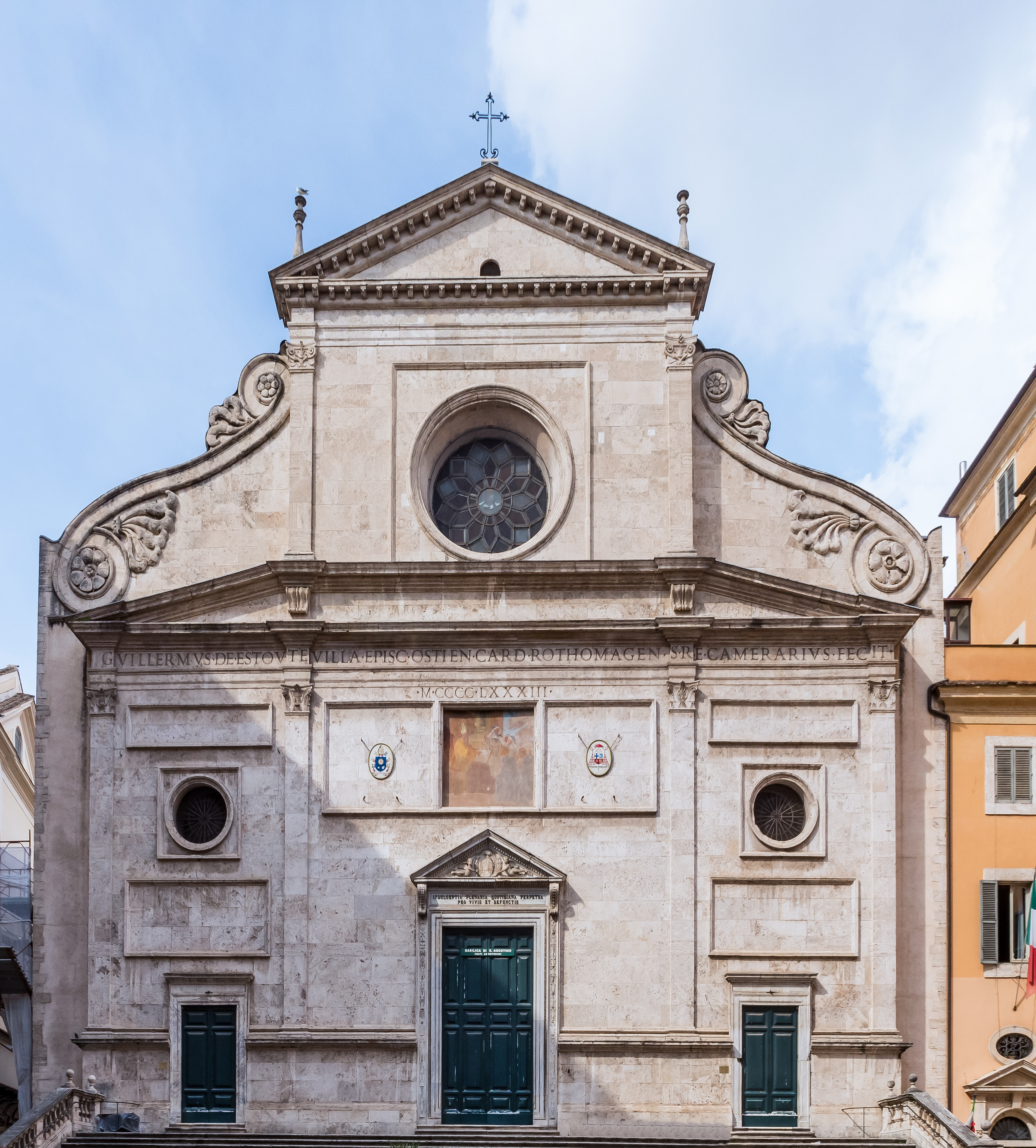
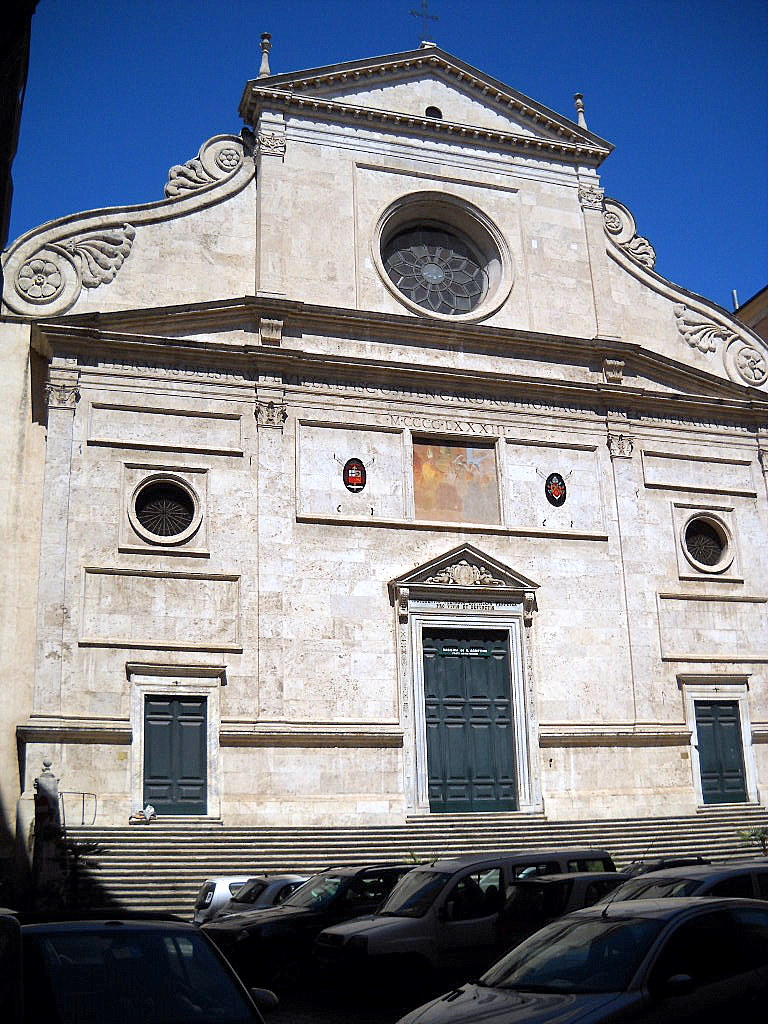

This charming and stately church dedicated to St. Augustine of Hippo with its simple and straightforward Renaissance façade was constructed from stone plundered from the Colosseum and remains the earliest of its kind in the City. Its origins go back to the late 14th century when Pope Boniface VIII ordered the Augustinian friars to construct it, a process which lasted a century and a half. In the 15th century Cardinal d’Estoutville, papal chamberlain (camerlengo) and protector of the Augustinians, funded much
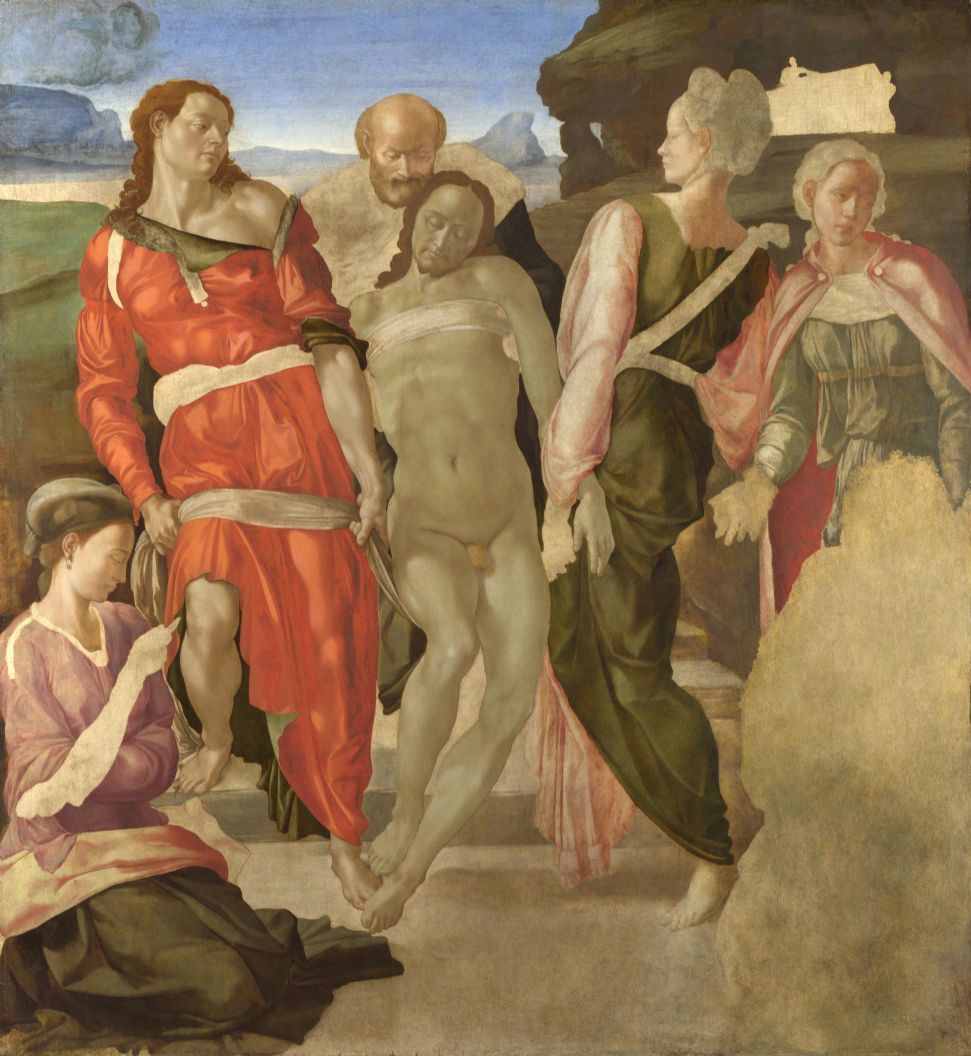
of its costs. Among the several artists commissioned to paint its interior was Michelangelo who, though he began for it the painting, Entombment of Christ, never completed the project. It now hangs, unfinished, in London’s National Gallery.
Martin Luther, the German reformer, visited the City on pilgrimage around the year 1511. Historians are not sure where he lived, but many assume that he resided during his stay at the Santa Maria del Popolo Convent. Some, however, but some believe that he may have lived here at the San Agostino convent next to the church which then served as the general headquarters of the Augustinian community.

Prior to the Sack of the City by Imperial forces in 1527, the church enjoyed great popularity among late Renaissance humanists, scholars, and their courtesans. Some endowed the church with artworks and chapels. Johannes Goritz provided it with a sculpture of St. Anne and Mary and a very famous fresco. Fiametta Michaelis, mistress of Cesare Borgia, endowed a chapel here. Because the Tiber frequently caused flooding in the area, architects raised the floor of the church very high above the level
of the piazza which explains the 15 steps leading up to the main entrance. Renovations to the church occurred in the 17th century with the participation of the important architect, Francesco Borromini, in 1661.

Over the middle of its three doors rests a pediment containing the coat of arms of its patron, Cardinal d’Estouteville, titular bishop of Ostia, Dean of the College of Cardinals, and Camerlengo of the Roman Church. A prominent inscription on the façade architrave attests to his benefaction and lists those important offices of the Church he held at the time of its construction.
Cardinal d’Estouteville played major roles in the public and political affairs of the Church in the late 15th century and contended in two papal elections: 1458 (Pius II elected) and 1471 (Sixtus IV elected). As Camerlengo of the Roman Church, he was the last non-Italian to hold that position until the 20th century (Cardinal Jean Villot, another Frenchman). In his role as Camerlengo, he consecrated Francesco della Rovere (later Pope Sixtus IV) as bishop and cardinal. All currently ordained bishops (including popes) trace in an historical line their consecrations either to him (through Sixtus
IV) or to the 16th century Cardinal Scipio Rebiba (through Benedict XIII). Unbroken historical records of episcopal succession in the Catholic Church can be traced back only to d’Estouteville or to Rebiba. Records before them no longer exist. When he died in 1483, Cardinal d’Estouteville was buried near the high altar in a tomb, unfortunately, now lost. Near the door of the sacristy, at the end of the right aisle, however, remains a 15th-century bust of Cardinal d’Estouteville and a commemorative plaque recognizing his benefaction to the church.

The façade of the church was designed by the humanist artist and architect, Leon Battista Alberti, one of Europe’s greatest 15th century scholars in the realm of art engineering, and architecture. His writings in these fields (De re aedificatoria, De Pictura, and De Statua) set the standards in these fields throughout the Renaissance and established him as the Vitruvius of his age.

Resembling that of Santa Maria del Popolo, the façade has two stories. Constructed from stone, spolia, quarried from the Colosseum, a phenomenon not unnoticed by the painter, Raphael remarked that the ‘modern City was built virtually on the wreckage of the ancient one’.
A scarcely visible fresco of Saint Augustine rests above these. Two small circular windows (oculi) over each of the side doors on its lower level and a single larger one (rose) in the center of the upper story provides great symmetry to the whole. Empty panels between the doors and panels, probably intended for frescoes or mosaics were, perhaps put on hold because of the death of Cardinal d’Estoutville in 1483. The upper story holds an oculus , larger than those below, but with the same design. An almost invisible 18th century campanile (bell tower), between the nave and right transept, sits at the back of the church. The former convent of the Augustinian friars, once the residence of the order’s general superior, lies adjacent to the church on the right and now houses government offices. In 1870, the newly created state, the Kingdom of Italy, expropriated the buildings (generalate, convent and library) and these now serve as the State Attorney’s Office and Library (Biblioteca). The dome, the City’s first in a church, looms large over the interior whose 19th century frescoes center around Christ the Redeemer with apostles and evangelists.
The form of a Latin cross defines the 17th century, internal plan, designed by Francesco Borromini.

A nave with six bays leads to transepts with semi-circular apses.

At the main entrance in a niche near the entrance sit large, angel-supported, holy water fonts executed by Antonio Raggi along with Jacopo Sansovino’s well-known statue of the Madonna del Parto (childbirth). The Madonna became such a popular shrine with expectant mothers that their touching and kissing of Mary’s foot have worn much of it away. One 19th century English visitor described this church as the “Methodist meetinghouse” of the City because in it the extravagant enthusiasm of the lower classes freely expressed itself in the proliferation of votive offerings of all kinds adorning its statues, images and ceilings throughout the entire space.

Frescoes on nave walls above the arcades depict episodes from the life of Mary together with images of Old Testament women and prophets above.

The first chapel on the right contains an altarpiece, a painting on slate, St. Catherine, by Marcello Venusti, friend and caretaker of Michelangelo in his old age. With Michelangelo’s approval, Venusti painted for Cardinal Alessandro Farnese a miniature version of the Sistine Chapel’s Last Judgement.

Hardly noticeable in the third pillar of the left nave rests the remarkable fresco, Isaiah, by Raphael, commissioned in 1512 by and painted for the funerary monument of Johannes Goritz (Corycius), a Renaissance scholar, humanist, owner of garden and vineyard at Trajan’s Forum, Vatican official, a friend of Michelangelo.
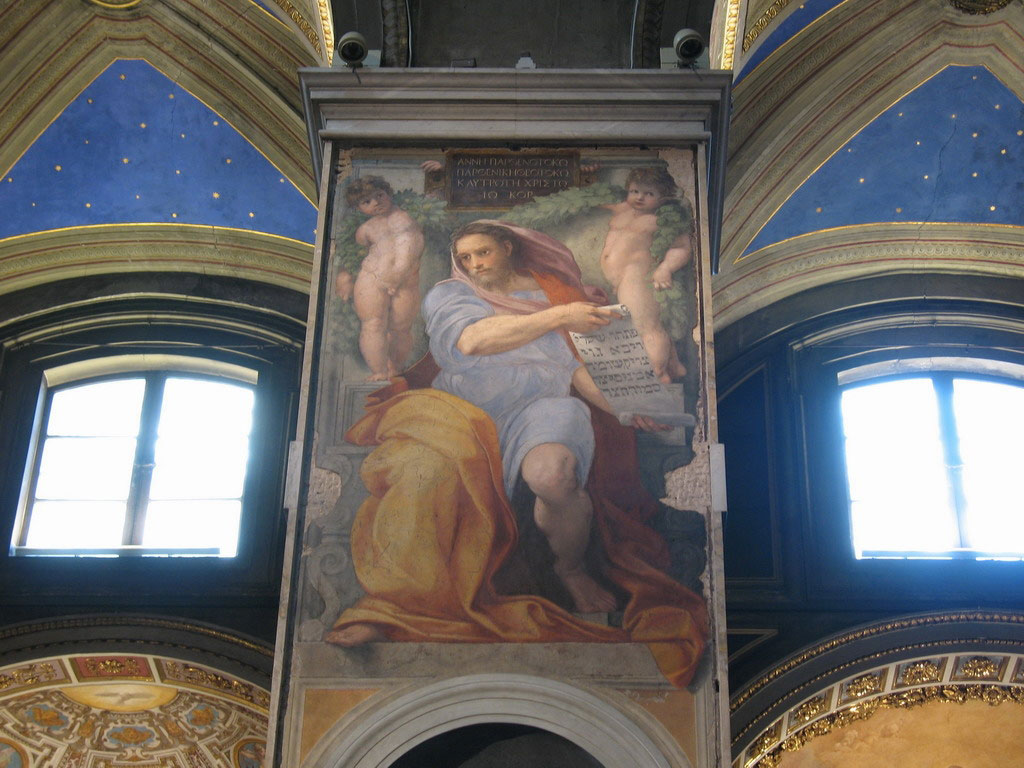
The story has it that when Goritz complained to Michelangelo about its cost, the Master replied that the knee itself was as valuable as the whole. (So much for the alleged animosity of Michelangelo to Raphael.) Michelangelo’s contemporaneous frescoes in the Sistine Chapel, viewed by Raphael unbeknownst to Michelangelo himself, very obviously influenced the image of Isaiah in this fresco. Michelangelo’s pupil and disciple Daniele da Volterra, ironically, did repairs on it later when it needed these because of deterioration, perhaps occasioned by Raphael’s faulty technique.

Beneath Raphael’s fresco sits Andrea Sansovino’s statue of the Madonna and Child with St Anne, commissioned by Goritz at the same time as the Isaiah figure. Once regarded as the most famous of its kind in the City, this sculpture, carved from one block of marble, combines elements of serene classicism and austere religious sensibility, the Virgin’s face modelled on that of an ancient Roman matron. At the festival celebrated every year by poets on the feast of St. Anne, July 26, writers from all over the City would come to the church and post their poems on Sansovino’s sculpture.

The high altar enshrines a Byzantine icon of the Blessed Virgin which, according to legend, was painted by the Gospel writer, St. Luke. Christians plundered it from the Church of the Hagia Sophia in Constantinople at the time of the conquest of the city by Turks in 1453.

To the left and behind the main altar sits the St. Monica chapel dedicated to, mother of St. Augustine. Monica died in Ostia in 387, the city port at the mouth of the Tiber River.

It holds her relics later brought to the City (1424) and enshrined under the altar in a tomb designed by Isaia da Pisa whose bas relief sculptures adorn many of the City’s churches including St. John Lateran, St. Mary Major, Santa Maria sopra Minerva, and Santa Sabina.

Buried in the church is Contessina de’Medici, youngest child of Lorenzo Medici (il Magnifico), sister of pope Leo X, and, allegedly, youthful, love interest of Michelangelo.
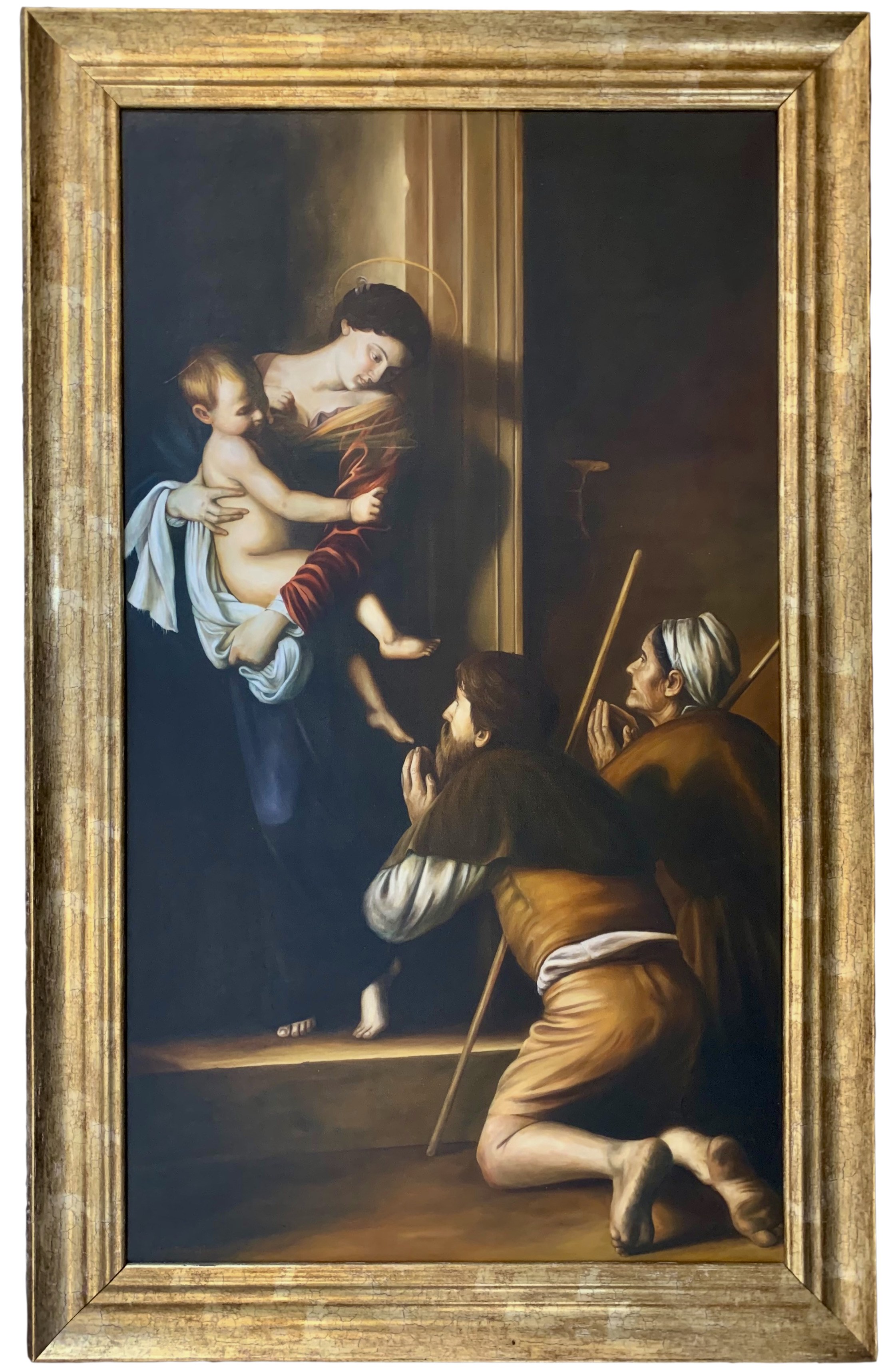
The Chapel of Our Lady of Loreto (Cavaletti Chapel), the first chapel on the left of the entrance, holds the famous Caravaggio painting of the Madonna dei Pelegrini executed in 1605, sometime after Caravaggio had made a pilgrimage to the shrine in Loreto. Commissioned by Ermete Cavaletti who required a painting with a Loretto theme, it depicts Our Lady presenting the four-year-old, Christ-Child to two pilgrims at the family house in Nazareth. As in an earlier painting, the Death of the Virgin, Caravaggio presents his subject in the most human and natural of settings. The realistic, but very unusual, depiction of the bare feet of Mary and the pilgrims, and the modernity of Mary’s dress caused some consternation among viewers at the time of its unveiling. Although influenced by the spirituality of the Roman St. Philip Neri with its sensitivity and outreach to the poor and marginalized, many of Caravaggio’s contemporaries took exception to the artist’s use of a friend, Lena (Maddalena Anognetti), a reputed prostitute, as the model for Mary. Her bare feet and the filthy feet of the pilgrims, together with the questionable posture of the mother in the doorway, aroused the ire of many spectators. Critics wondered, as well, about the slimness of Mary’s halo, the nakedness of the child Jesus, and the physically impossible positioning of Mary’s feet. Despite it all, Cavaletti retained the painting, objections notwithstanding.
One block behind San Agostino runs the narrow but colorful Via dei Portoghesi. On it stands the lovely, Baroque church of Sant’Antonio dei Portoghese whose ribbed dome Carlo Rainaldo created in the 17th century. Dedicated to St. Anthony of Lisbon, it serves as the national church of the City’s Portuguese community.

Diagonally across from the façade of the church rises into the air the distinctive medieval Torre della Scimmia, remnant of the compound belonging the once powerful Frangipane family. The tower’s odd name derives from a popular legend about a pet monkey which seized the family’s newly born baby, jumped out of the window with the baby in its arms, and carried it up to the top of the parapet. No amount of cajoling on the part of the baby’s parents could persuade the monkey to return the child until supplication was made to the Blessed Virgin. In thanksgiving for the safe return of the baby, the family gratefully created a votive shrine to the Madonna and Child visible now at the top of the structure and vowed to maintain next to the sculpture a perpetually burning lamp which subsequent owners of the building have continued to this day.

Down the street, which becomes Via del Orso, remains one of the City’s oldest restaurants, the 15th century, the Hostaria dell’ Orso.

Although constructed as a family residence, it was converted into a popular hostel (Ostaria), regarded as one of the City’s best whose guests included Dante (according to legend), Francois Rabelais, Michel de Montaigne, and Johann Wolfgang von Goethe. A famous anecdote recounts how its owner commissioned a painter to create frescos of a bear on both sides of its entrance. The artist offered for 8 scudi to paint the two bears with chains or 6 scudi without chains. The owner agreed to the 6 scudi offer. When the frescos began to fade after a very short time, the owner complained to the artist, whose only reply was that he should have paid the extra scudi to put the chains on the bears.

At the far side of Via della Scrofa, on a street which runs along the side of Palazzo Firenze, stands a narrow side street, the Vicolo del Divino Amore. Located there at # 19 remains the apartment where Caravaggio lived and worked for two years.
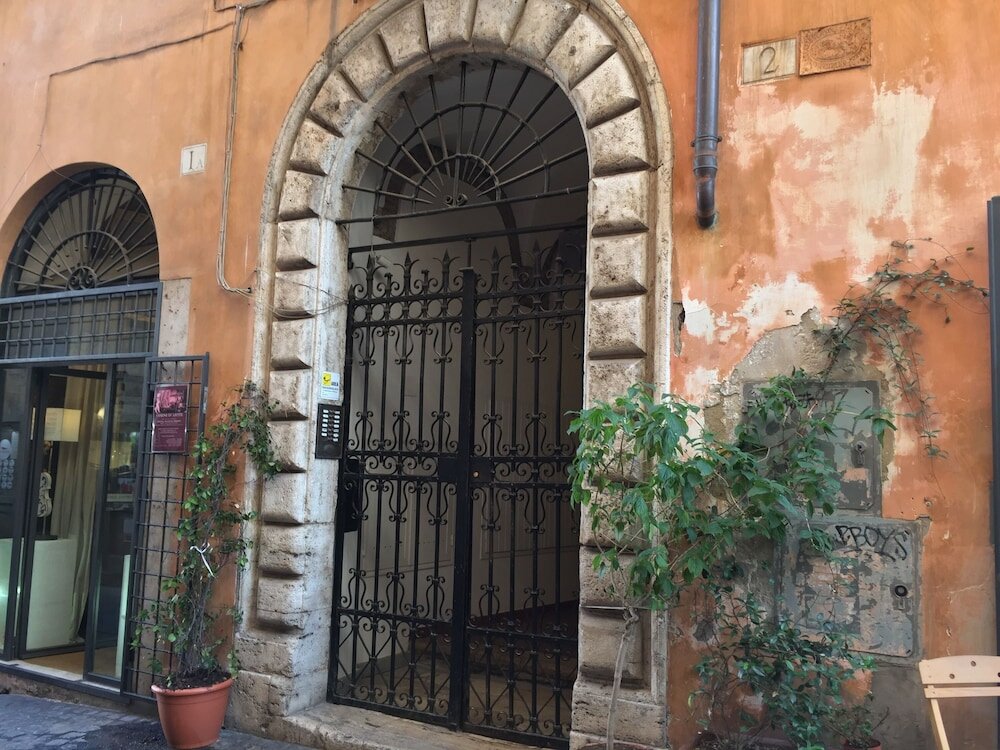
For most of his almost 20-year sojourn in the City, Caravaggio lived in lodgings not his own (Cardinal del Monte’s Palazzo Madama and the Palazzo of the Mattei brothers and others). This changed in 1604 when, after his arrest for brawling and release from the Tor di Nona jail, he was subject to house arrest, necessitating the acquisition of an abode of his own. From 1604 until 1605 he rented (40 scudi a year) from Prudenzia Bruni a two-story apartment in Vicolo del Divino Amore (then Vicolo di Santo Cecilia e Biaggio), on the right side of Palazzo Firenze. There he lived and kept a studio, modified for his painting needs, together with his apprentice, Francesco Boneri. In this studio he painted the Madonna of Loretto. Caravaggio paid his rent faithfully until January 1605, but then, suddenly, stopped. Bruni went to court which gave her an injunction to evict Caravaggio and confiscate his belongings. The records of that court represent some of the very few extant personal historical traces of this important Baroque artist. Not long thereafter, in 1606, after losing a bet in a tennis match at a court located in this same neighborhood (Via Pallacorda), he dueled with and killed his opponent, Ranuccio Tomassini. Caravaggio spent the rest of his life in exile and on the run from authorities, until his tragic death in 1610 on the beach of Porto Ercole, north of the City.

Further down the Via della Scrofa, towards the end and near the Tiber River’s Ponte Cavour, stands the Palazzo Borghese, one of the City’s most uniquely designed. Built in the 16th century, Cardinal Camillo Borghese purchased the building in the early 17th century but, shortly afterwards (1605), was elected pope (Paul V) and turned it over to family members.

For almost 100 years a series of illustrious architects (Vignola, Martino Longhi the Elder, Flaminio Ponzi, Carlo Madero and Giovanni Sanzio) worked on its construction and renovation. Romans nicknamed it the ‘cembalo’ (harpsichord) because of its trapezoidal shape and its three entrances and facades. Cardinal Scipio Borghese, nephew of Pope Paul V and patron of Caravaggio and Bernini, maintained a large art collection in the Palace, much of which, later, ended up his Cassino on the Pincian Hill, the Galleria Borghese.